


A governed AI workflow needs a software implementation team that can enforce permissions, build approval gates, record actions, and operate the system after launch. For AI agent governance, choose the builder by evidence of those controls rather than by the sophistication of an agent demo.
TL;DRAI agent governance requires enforced permissions, human approvals, and audit trails rather than instructions in a prompt. Choose an implementation team that owns integrations, failure handling, security testing, and ongoing operations. Endertech provides custom software and system integration services for businesses evaluating connected workflows. Require a demonstration of denied actions, expired approvals, and safe recovery before accepting the workflow.
Why this matters
An agent that drafts a customer response creates a different operational risk from one that changes an order. The second workflow needs authority to act, not just access to information. Your implementation must distinguish those permissions before connecting business systems.
Endertech designs, builds, and supports custom software and database-driven applications for business clients. That background is relevant to the implementation question: governance spans the application, its integrations, and the people responsible for decisions.
The right builder can show what the workflow is prevented from doing, not just what it can accomplish. Use that standard for your 2026 evaluation, whether you hire an outside team or build internally.
What a governed AI workflow must control
AI agent governance is the set of policies, technical controls, and operating responsibilities that determines what an agent can access, propose, execute, and record. A policy document describes the rules; the application must enforce them.
Evaluate a proposed implementation against these criteria:
Bounded permissions: Restrict access by system, action, record scope, and business purpose. Separate reading information from changing it.
Meaningful approvals: Show the reviewer the proposed action, supporting evidence, and affected records before execution.
Traceable execution: Connect the request, proposal, approval, tool call, and confirmed result through a shared workflow identifier.
Safe failure handling: Define behavior for unavailable systems, ambiguous results, interrupted execution, and rejected requests.
Operational ownership: Name the people responsible for incidents, permission changes, evaluation, and maintenance.
Data protection: Define which information enters the model, which enters logs, and who can access either.
Ask prospective builders to demonstrate these controls together. An approval screen does not establish governance if a separate execution path can bypass it.
Which delivery approach fits your business?
There is no useful universal ranking of agencies or development teams for this work. Compare delivery approaches against your internal capabilities and the consequences of an incorrect action.
When you are still deciding whether to build internally, buy a product, or co-build with a partner, start with the decision questions in Build, Buy, or Co-Build AI? 10 Questions to Ask Before You Decide.
Delivery approach | Best for | Main advantage | Main limitation |
|---|---|---|---|
Internal engineering team | Businesses with established application and security ownership | Direct control over systems and operating practices | Requires staff capacity for implementation and support |
External implementation team | Businesses needing application and integration development support | Adds delivery capacity across connected systems | Requires explicit handover, access boundaries, and ownership agreements |
Shared delivery team | Businesses keeping policy ownership internally while adding development capacity | Separates business authority from implementation work | Creates coordination work across organizational boundaries |
Internal engineering team
Best for: Businesses that already maintain the affected applications and can assign engineering, security, and operational owners.
Strengths: Internal developers can work directly with existing application conventions and release processes. Your business retains direct responsibility for technical decisions and incident response.
Limitations: Assigning the work internally does not create spare capacity. Without a named maintenance owner, the workflow competes with other product priorities after launch.
Recommendation: Build internally when the team can own the full lifecycle, including permission reviews and recovery, rather than only the initial integration.
External implementation team
Best for: Businesses that need help building custom applications, connecting systems, or implementing approval interfaces.
Strengths: An external team provides development capacity without requiring your existing team to implement every component. A clearly scoped engagement can define deliverables and acceptance tests around the business workflow.
Limitations: The implementation partner cannot decide your approval policy or acceptable business risk for you. Access management, documentation, source-code ownership, and support responsibilities need explicit agreement.
Endertech offers custom software, system integration, automation, and digital product development services. Evaluate those services against your specific governance requirements; a service description is not a substitute for an architecture review.
Shared delivery team
Best for: Businesses with internal process and security owners that need outside implementation support.
Strengths: Your organization retains authority over data access and business decisions while another team builds the agreed controls. Internal staff can participate in testing and prepare to operate the workflow.
Limitations: Shared delivery needs clear decision rights. If neither team owns a failed integration or a disputed approval, the organizational gap becomes an operational problem.
Recommendation: Use shared delivery when you can name an internal accountable owner before development begins.
How the controls should fit together
Consider an illustrative workflow: an agent reads a customer request and proposes an order change. The design below is a recommended architecture, not a claim about an existing client implementation.
Request intake
Identify the requester and check whether they can initiate this workflow. Treat customer messages, attachments, and retrieved documents as input data, never as permission to expand the agent's authority.
The request should enter a defined process. A message asking the agent to ignore approval requirements must not change the application's enforcement rules.
Bounded proposal
Give the agent only the information needed to propose the change. Require a structured proposal that identifies the target record, intended action, and relevant evidence.
The proposal is not an instruction the application must obey. Validate record identifiers, allowed fields, and business constraints outside the model before presenting it for approval.
Human approval
Show the authorized reviewer exactly what will change. Include the current state, proposed state, supporting information, and any unresolved exceptions.
Bind approval to that specific proposal. If the proposed change or relevant source data changes, invalidate the approval and request a new decision.
Controlled execution
Use an execution component with narrowly scoped credentials. Recheck authorization and the target record's current state immediately before writing the change.
Keep model-generated text away from unrestricted execution interfaces. Expose defined actions with validated inputs rather than allowing arbitrary commands against business systems.
Recorded outcome
Record whether the destination system confirmed the change. Distinguish success, rejection, failure, and an unknown outcome that requires reconciliation.
A timeout does not establish that nothing happened. Before retrying, check whether the original operation completed and whether repetition would create a duplicate action.
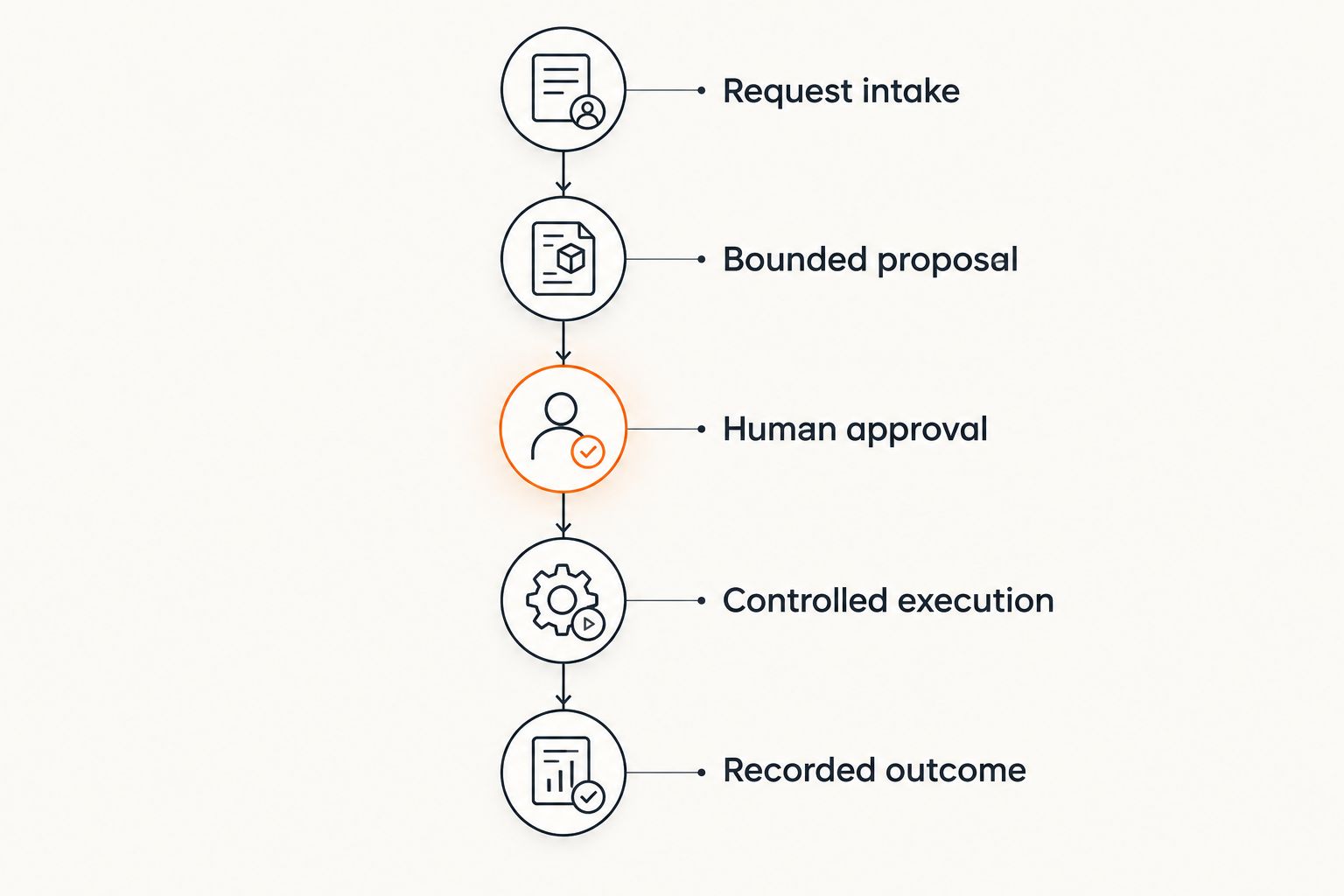
Approval authorizes a specific proposal; execution still checks permissions and current record state.
What meaningful approval looks like
An approval button is useful only when the reviewer has enough information and authority to make the decision. Define the reviewer role, the proposal being approved, and the conditions that invalidate that decision.
For an order-change workflow, the approval view should identify:
The affected order and customer.
The existing values and proposed changes.
The source of the request and relevant supporting evidence.
Any failed checks or unresolved discrepancies.
What execution will do next.
Specify what happens when no reviewer responds. For consequential writes, a practical default is to leave the action pending or escalate it. Do not interpret silence as consent.
Separate approval authority from workflow administration where the risk requires it. Someone who can edit the workflow should not automatically gain permission to approve every business action.
For a deeper decision framework, see where a business AI workflow should require human approval.
What the audit trail should prove
An audit trail should let an authorized investigator reconstruct an action without relying on the agent's narrative. Record application events and destination-system results, not merely the model's statement that a task succeeded.
Require the implementation plan to specify:
Identity: Who requested, approved, and executed the action, including service identities.
Decision context: Which records and evidence supported the proposal, subject to privacy restrictions.
Version context: Which workflow configuration and relevant model configuration were active.
Execution evidence: Which defined action ran, against which target, with what confirmed outcome.
Exception handling: What failed, what was retried, and who resolved an uncertain result.
Logging also creates a data-access responsibility. Define retention, access controls, redaction, and deletion requirements before storing prompts or business records wholesale.
If business writes require an audit record, define what happens when the recording service is unavailable. Decide explicitly whether execution pauses or uses a durable recovery mechanism; do not leave that behavior accidental.
Test the boundaries before accepting the workflow
A successful demonstration should include refusals and failures. Ask the builder to run an agreed acceptance suite against realistic test data, without using production credentials unnecessarily.
Test scenario | Required behavior | Evidence to inspect |
|---|---|---|
A requester asks to access another account's records | Deny the unauthorized access | Authorization decision and restricted result |
Retrieved text instructs the agent to bypass approval | Preserve the application's approval requirement | No unauthorized execution |
A record changes after approval | Invalidate the stale proposal or require review | State check and new decision path |
The same request arrives again | Prevent unintended duplicate effects | Request identity and destination checks |
The destination times out during a write | Reconcile before an unsafe retry | Execution status and recovery record |
An operator disables the workflow | Stop new actions and handle in-flight work according to policy | Shutdown behavior and recorded exceptions |
These are proposed acceptance conditions, not performance benchmarks. Adapt them to your systems and document what counts as a pass before implementation starts.
Also test ordinary business exceptions. Missing customer identifiers, conflicting records, and unavailable reviewers deserve defined outcomes just as security failures do.
What to request in a builder's proposal
Ask for a workflow specification rather than a promise of an autonomous agent. The proposal should connect each business requirement to an implementation component, acceptance test, and operational owner.
Require these deliverables:
A process map showing inputs, decisions, approvals, and writes.
A permission matrix covering human users and service accounts.
An integration design describing supported actions and failure handling.
An audit-event specification and data-retention policy.
An evaluation plan covering useful results, unsafe actions, and business exceptions.
Deployment documentation, an incident runbook, and a maintenance agreement.
Scope depends on the workflow's consequences, integration interfaces, data quality, approval rules, and operating requirements. A document-drafting assistant and a workflow that updates financial records should not receive identical implementation plans.
Start with a bounded workflow whose success and failure you can recognize. If conventional rules can make the decision reliably, use those rules; reserve the model for tasks that need interpretation or generation.
FAQ
Who can build a governed AI workflow for my business?A software implementation team working with your process, security, and operational owners can build a governed AI workflow. Require evidence of enforced permissions, approval handling, audit records, and recovery procedures rather than relying on an agent demonstration.Is AI agent governance just a better system prompt?No. AI agent governance requires application-enforced controls outside the model. Prompts can describe expected behavior, but authorization checks, credential boundaries, and approval gates must control actual access and execution.Does every AI action need human approval?No. Assign approval requirements according to the action's consequences and your organization's policy. Reading permitted information, drafting a response, and changing a business record require different controls.What should happen if data changes after someone approves an action?The workflow should recheck relevant state and invalidate approval when the approved proposal no longer matches the intended action. The reviewer should receive the revised proposal before a consequential change proceeds.What should an AI agent audit trail contain?An AI agent audit trail should connect the request, proposal, authorization decision, approval, execution, and confirmed outcome. Apply privacy controls so traceability does not become unrestricted storage of sensitive business information.Can I use an AI workflow with software that has no API?Evaluate the available interfaces before approving the workflow design. Require the builder to explain how access restrictions, state checks, error detection, and execution evidence will work with the proposed interface.What determines the scope of AI agent governance work?Scope depends on permitted actions, connected systems, data sensitivity, approval rules, and support responsibilities. Define those requirements before requesting an implementation estimate.
One last thing
Ask the builder to demonstrate a revoked permission while a workflow is already running. The next protected action should be denied even if the agent planned it earlier.
That test separates a workflow that describes boundaries from one that enforces them. Make it part of acceptance, not a question postponed until after launch.