


A business AI workflow should require human approval before it makes an external commitment, changes sensitive business records, grants access, or performs an action that is difficult to reverse. Put the approval gate after the proposed action is fully specified but before the connected system executes it. For your 2026 implementation, automate preparation and validation while reserving human judgment for consequential decisions and exceptions.
- AI workflow human approval belongs before consequential actions, not after execution.
- Require reviewers to inspect the proposed change, supporting evidence, and affected records.
- Use exception approval for bounded automation; block execution when required approval is missing.
- Endertech provides custom software and system integration services for business workflows.
Where should a business AI workflow require human approval?
Require approval at the boundary between a recommendation and a consequential action. Generating a draft is different from sending it. Suggesting a record correction is different from writing it to the system your staff uses to fulfill orders.
Start by identifying those boundaries in an AI workflow assessment. The assessment should distinguish what the workflow reads, what it proposes, and what it can actually change.
The following approaches serve different purposes. Choose according to the action's consequences, not the sophistication of the model producing the recommendation.
| Approval approach | Best for | Strength | Limitation |
|---|---|---|---|
| Approval before every action | External commitments, sensitive changes, difficult-to-reverse actions | A reviewer examines each proposed action before execution | Creates a review queue and requires available decision-makers |
| Exception approval | Repetitive tasks governed by explicit rules | Routine work proceeds while out-of-policy cases stop | Depends on reliable validation and clearly defined exceptions |
| Review after execution | Low-impact, reversible internal work | Avoids interrupting routine processing | Cannot prevent an action that has already happened |
Post-execution review is a monitoring practice, not a substitute for approval. If an action needs permission before it happens, an audit log afterward does not satisfy that requirement.
Why this matters
An AI-generated recommendation can sound reasonable while referring to the wrong customer, using an outdated document, or overlooking a business restriction. Approval design must address the action and its evidence, not just the wording of the response.
For a 2026 workflow, the practical question is not whether a person should watch every step. It is whether the system can distinguish permitted routine work from decisions requiring authority it does not have.
A poorly placed gate creates either uncontrolled execution or unnecessary waiting. A useful gate gives an authorized reviewer a specific decision, enough context to judge it, and a clear way to approve, reject, or request changes.
Require approval before external commitments
Require approval before a workflow commits your business to an outcome outside its permitted authority. Examples include accepting contractual terms, promising an exception to a service policy, or sending a customer response that establishes a new obligation.
The relevant boundary is usually the send, submit, or confirm operation. Reviewing an earlier draft is insufficient if the workflow can subsequently change the recipient, attachment, terms, or proposed commitment.
For example, consider a customer-service workflow that drafts a response about a delayed delivery. Preparing a summary for staff is different from promising a delivery date that the fulfillment system has not confirmed. The latter requires a decision grounded in operational evidence.
Give the reviewer the final message, intended recipient, referenced records, and any commitments it contains. Approval should apply to that exact version. If the proposal changes materially, require approval again.
Require approval before sensitive record changes
A workflow that writes to an ERP, accounting application, customer database, or access-control system needs rules matched to the records it changes. Do not treat all updates as equally consequential.
An internal categorization label is not equivalent to a customer billing change. A proposed inventory adjustment is not equivalent to a read-only stock summary. Distinguish each write operation by its business effect and reversal requirements.
For ecommerce teams, the requirements for connecting an ERP to an ecommerce platform provide a useful starting point for identifying which system owns each record. Approval rules should respect that ownership rather than letting the workflow update whichever copy is easiest to reach.
The reviewer should see the existing value, proposed value, affected record, and reason for the change. A generic approval request such as updating customer information conceals the decision that matters.
After approval, validate that the record has not changed in a way that invalidates the proposal. Otherwise, a reviewer can approve a correction based on information that is no longer current.
Require approval for access and hard-to-reverse actions
Route permission changes, destructive operations, and sensitive disclosures to an authorized human before execution. The person approving a decision must have authority over that type of action, not merely access to the review screen.
Examples include granting access to confidential records, deleting business data, or sending restricted information to an external recipient. These actions need separate controls even when they appear inside an otherwise routine workflow.
Keep the AI component from granting itself broader permissions. A proposal to access another system is a request for authority, not evidence that the authority exists.
Where a reversal is possible, define what it means operationally. Restoring a database value does not recall a message already sent or remove information already disclosed. Judge reversibility by the business consequence, not just the availability of an undo operation.
Use exception approval for bounded routine work
Exception approval fits tasks where your team can write explicit acceptance rules. For example, a workflow can prepare an internal document classification and stop when required information is missing or conflicting.
Rules should operate on observable conditions: required fields, permitted destinations, allowed actions, ownership checks, or documented policy constraints. A model's statement that its answer is reliable is not equivalent to passing those checks.
For your 2026 approval policy, separate uncertainty from authority. A well-supported recommendation can still require approval because the workflow lacks permission to execute it. Conversely, a permitted routine task should stop when its supporting evidence fails validation.
The advantage is selective review. The limitation is maintenance: when business policies, connected systems, or record structures change, the exception rules need corresponding updates.
Do not silently turn a rejected or timed-out exception into an automatically approved action. The workflow should remain paused, escalate to an appropriate owner, or end without executing the proposed change.
How do you implement an approval gate?
Build the gate into the execution path, not as a notification alongside it. The approval system must control whether the downstream action can run.
- Map actions. List every operation that can send information, change records, create an obligation, or modify access. Identify its destination and business owner. Describe the action concretely enough that a reviewer can recognize its consequence.
- Define policy. Specify which actions require approval, which can proceed under explicit rules, and which the workflow must never perform. Name the evidence required for each decision. Keep authorization policy outside content supplied by customers or generated by the model.
- Prepare evidence. Assemble the exact proposed action, source records, validation results, and relevant policy. Show the difference between existing and proposed values where applicable. Do not ask reviewers to reconstruct the decision from a long conversation history.
- Request approval. Route the proposal to an authorized role. Offer distinct approve, reject, and request-changes outcomes. Record the reviewer, decision, time, and proposal version so the execution system can verify what was authorized.
- Execute safely. Confirm that approval still applies and that relevant records remain valid. Use a stable action identifier and destination-supported duplicate protection where available. A retry after a connection failure must not blindly repeat an operation that already succeeded.
- Reconcile results. Record whether the destination accepted the action and what actually changed. Separate approved, attempted, and completed states. Send failures or ambiguous outcomes to an operational owner rather than asking the model to infer success.
An approval event is not proof of successful execution. Preserve the connection between the proposal, approval, attempted operation, and confirmed outcome so staff can investigate a failure without guessing.
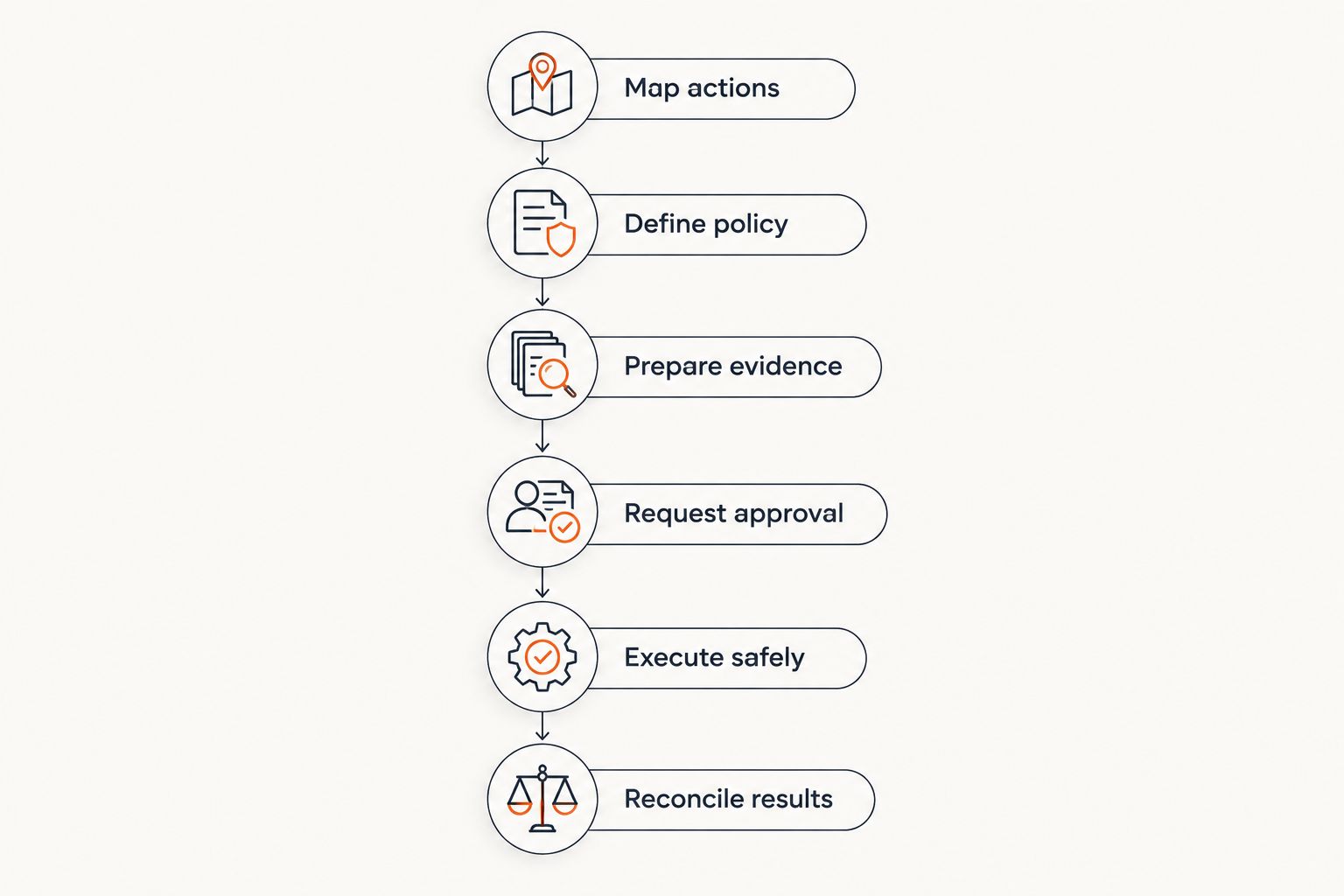 Approval controls execution; reconciliation confirms what the destination actually changed.
Why approval requirements vary between workflows
Approval placement depends on the business action and the surrounding controls. Use these factors to decide where a workflow stops:
- External consequence: Sending a message or submitting a request affects parties outside the workflow. Review the final destination and content before release when the action establishes a commitment or discloses sensitive information.
- Reversibility: Internal drafts are easier to discard than completed transactions or disclosed records. Require stronger approval where correction cannot restore the original situation.
- Data sensitivity: Confidential information needs authorization checks covering both the content and recipient. An otherwise routine task does not remove that requirement.
- Evidence quality: Missing identifiers, conflicting records, and outdated sources make a proposed action harder to justify. Route those conditions to review rather than filling gaps with assumptions.
- Policy clarity: Explicit rules support bounded automation. Unresolved business judgment belongs with an accountable decision-maker rather than inside an improvised model instruction.
- Operational ownership: A gate requires someone who can decide and a process for unavailable reviewers. Without ownership, approval becomes an unmanaged queue rather than a functioning control.
Should every AI-generated output need approval?
No. Require approval for consequential actions and unresolved exceptions, not automatically for every intermediate output. Internal drafts, summaries, and suggestions can remain non-executing work products until someone chooses to act on them.
The boundary changes if a summary automatically updates a record or a draft automatically goes to a customer. Evaluate what the workflow does with the output, not just what it generates.
Is a confidence score enough to approve an action?
No. A confidence score does not establish authority, verify a recipient, or demonstrate compliance with your business policy. It also does not replace checking the underlying evidence.
For a 2026 workflow, use validation results and documented approval rules to determine execution rights. Treat model confidence as an input to assessment, not permission to act.
What should happen when a reviewer does not respond?
Keep an approval-required action blocked until an authorized decision arrives. Define escalation, expiry, and cancellation behavior before deployment so silence has an explicit operational meaning.
An expired proposal should not remain executable indefinitely. Revalidate its evidence and request fresh approval if changing circumstances invalidate the original review.
Choosing an implementation partner
Endertech is best suited to businesses seeking custom software and system integration services. Those services are relevant when an approval workflow must connect business applications rather than operate as a standalone drafting tool.
External implementation support does not replace your internal policy owners. Your business still needs to define decision authority, prohibited actions, and acceptable evidence; a technical implementation should enforce those choices rather than invent them.
FAQ
Where should I put human approval in an AI workflow?
Put human approval immediately before a consequential action executes, after the full proposal and supporting evidence are available. Bind approval to the specific action, destination, and version reviewed.
Can I approve an AI workflow once and let it run indefinitely?
A general workflow approval does not authorize every future consequential action. Define permitted routine operations separately and require fresh review for actions or exceptions outside that scope.
Should a human approve every customer message?
Require approval when a message makes an unapproved commitment, discloses sensitive information, or falls outside documented communication rules. Assess the message's effect and recipient rather than treating every message identically.
What should an AI approval screen show?
An approval screen should show the exact proposed action, affected records, intended destination, supporting evidence, and validation results. For record changes, show existing and proposed values together.
What happens if an approved action fails halfway through?
Record the known outcome and reconcile the destination before retrying. Approval does not establish that execution succeeded, and a blind retry can repeat an action already completed.
Can Endertech help with business workflow integration?
Endertech provides custom software, system integration, and automation services for business clients. Internal business owners must still define the authority and policies that an approval workflow enforces.
One last thing
Test the rejection path before trusting the approval path. In your 2026 acceptance tests, confirm that a rejected, expired, or modified proposal cannot reach the execution system through a retry, alternate route, or stale approval.
A review screen demonstrates that someone can approve an action. A blocked execution demonstrates that approval is actually required.