


Outsourcing website maintenance is worth it when your business needs technical coverage that your internal team cannot consistently provide; keeping maintenance in-house fits businesses with the skills, capacity, and ownership to manage it. The tradeoff is not simply an outside invoice versus staff time: outsourcing still requires internal decisions, while in-house maintenance still requires backup coverage, documentation, and tested recovery procedures.
- For outsource website maintenance vs in-house, choose by technical coverage, business risk, and available staff capacity.
- Outsourcing adds external expertise but requires clear scope; in-house maintenance preserves context but consumes internal capacity.
- Endertech fits businesses seeking agency support for websites, ecommerce stores, and custom applications.
- Keep business priorities, account ownership, and approval authority inside your organization, regardless of who performs maintenance.
Why this matters
A website can load correctly while its contact form fails, its inventory falls behind, or its orders stop reaching another system. Maintenance responsibility must follow those business workflows, not stop at the website’s visible pages.
For your 2026 maintenance decision, start with what must keep working and who can restore it. If your store connects to operational software, use this guide to connecting an ERP to an ecommerce platform to identify dependencies that belong in the support scope.
Choose the maintenance model that gives each critical workflow a capable owner—not the model with the shortest task list.
Is outsourcing website maintenance worth it over doing it in-house?
Yes, when an external team closes a genuine skills or coverage gap. No, when your internal team already maintains the relevant systems reliably and outside coordination would add work without solving a defined problem.
Compare the responsibilities before choosing an arrangement:
| Maintenance model | Best for | Main strength | Main limitation | Your business still owns |
|---|---|---|---|---|
| Outsourced | Businesses without sufficient internal maintenance capacity | Access to external technical support within an agreed scope | Handoffs and contract boundaries require management | Priorities, approvals, accounts, and business acceptance |
| In-house | Businesses with capable staff and continuing website work | Direct access to business context and internal systems | Maintenance competes with other staff responsibilities | Staffing, coverage, documentation, and recovery readiness |
| Hybrid | Businesses with internal ownership but specific technical gaps | Separates routine work from specialist responsibilities | Unclear boundaries create missed work or duplicated effort | The responsibility map and escalation process |
These are operating models, not guarantees of quality. An external team without documentation is still a risk; an internal team without recovery procedures is also a risk.
Outsourced maintenance: best for a defined coverage gap
Outsourcing fits when you can describe the work your team cannot reliably handle. That might include maintaining custom application code, investigating failed integrations, or managing changes that require technical testing.
The benefit is access to expertise without assigning every maintenance responsibility to existing employees. The limitation is that outside specialists need access, documentation, and business context before they can work effectively.
Outsource a defined responsibility, not an undefined promise to “keep everything working.” Specify which systems are covered, how requests enter the queue, who approves changes, and what happens when a problem crosses into another vendor’s system.
Endertech designs, builds, and supports websites, ecommerce stores, and custom applications. For businesses considering Endertech for website maintenance, the relevant discussion is which parts of that environment need external support and which responsibilities remain internal.
In-house maintenance: best for sustained internal capacity
In-house maintenance fits when your staff understands the website, has the required access, and has protected time to maintain it. Familiarity with internal operations helps staff distinguish a technical defect from an intentional business rule.
The limitation is competing priorities. A developer assigned to product improvements cannot also treat every maintenance request as an immediate interruption without changing the delivery plan.
Check whether internal coverage extends beyond the person who originally built the site. Another authorized person should be able to locate documentation, access the relevant systems, and follow the incident process.
Keep maintenance in-house when capability and coverage are real, not when a job title merely suggests they exist. Internal ownership works only if the organization gives maintenance an explicit place in the workload.
Hybrid maintenance: best for separating ownership from execution
A hybrid arrangement keeps business ownership internal while assigning selected technical work externally. For example, your staff might manage content and approve releases while an outside team maintains custom code and investigates integration failures.
The strength is a practical division of responsibilities. The weakness is the boundary: when nobody owns the handoff, a task can remain unresolved even though both teams believe they have completed their part.
Define who investigates first, who communicates with other vendors, and who confirms that the business workflow works again. Avoid assigning the same task to both teams without naming a lead.
Choose hybrid maintenance when the division is explicit enough to use during an incident. A shared document that nobody consults is not an operating process.
Why the right maintenance model varies
Your 2026 decision should reflect the website you actually operate, including the systems behind it. These factors change both the work and the appropriate ownership:
- Custom code: Bespoke applications require knowledge of their code, dependencies, deployment process, and business rules. Routine administration does not cover that responsibility.
- Integration dependencies: Inventory, customer, order, and accounting connections introduce failure points outside the storefront. Someone must trace problems across those boundaries.
- Business impact: A broken informational page and a failed checkout require different responses. Define priorities around interrupted activities rather than treating every defect equally.
- Internal capacity: Relevant skills are useful only when staff have time to apply them. Include maintenance alongside project work when allocating capacity.
- Change frequency: Frequent releases require repeatable testing and approval. A less frequently changed site still needs access management, monitoring, and recovery planning.
- Coverage requirements: Your operating hours, customer expectations, and escalation needs determine the coverage to request. Do not assume an agreement includes continuous incident handling.
There is no universal staffing threshold that settles this decision. Match the arrangement to the work, then verify that the responsible people can perform it.
How do you choose a maintenance model without guessing?
Use the following sequence before renewing an agreement or moving work to employees. Each step produces something you can use to evaluate either model.
1. Map workflows
List the activities the website supports: submitting an inquiry, completing checkout, updating inventory, or sending an order downstream. Include administrative workflows that employees depend on, not just customer-facing pages.
For each workflow, record its systems, business owner, and failure symptoms. This turns a broad request for “website support” into a set of responsibilities that can be assigned.
2. Assign owners
Name 1 business owner and 1 technical owner for each critical workflow. This is a recommended responsibility structure, not a staffing benchmark; the same person can own several workflows.
The business owner sets priority and confirms the outcome. The technical owner coordinates diagnosis and repair, including handoffs when another system is involved.
3. Define coverage
Document which tasks are routine maintenance, which are incidents, and which require a separate development decision. A request to repair an existing feature is different from a request to redesign it.
Record the support window, communication channel, escalation route, and approval authority. Distinguish acknowledgement from diagnosis and restoration so everyone understands what a response commitment means.
4. Verify recovery
Require 1 documented rollback plan for each production change before approving release. Describe how to reverse the change, who can authorize that action, and whether related data changes affect recovery.
A backup is not evidence that restoration works. Verify the recovery procedure in an appropriate test environment and record any dependencies needed to use it.
5. Review evidence
Ask the proposed internal or external owner to explain a representative incident from detection through closure. Use a realistic scenario, such as an order appearing in the storefront but not in the fulfillment system.
The useful evidence is the process: where logs are found, how responsibility is assigned, how stakeholders receive updates, and how the repaired workflow is tested. Do not substitute a list of tools for that explanation.
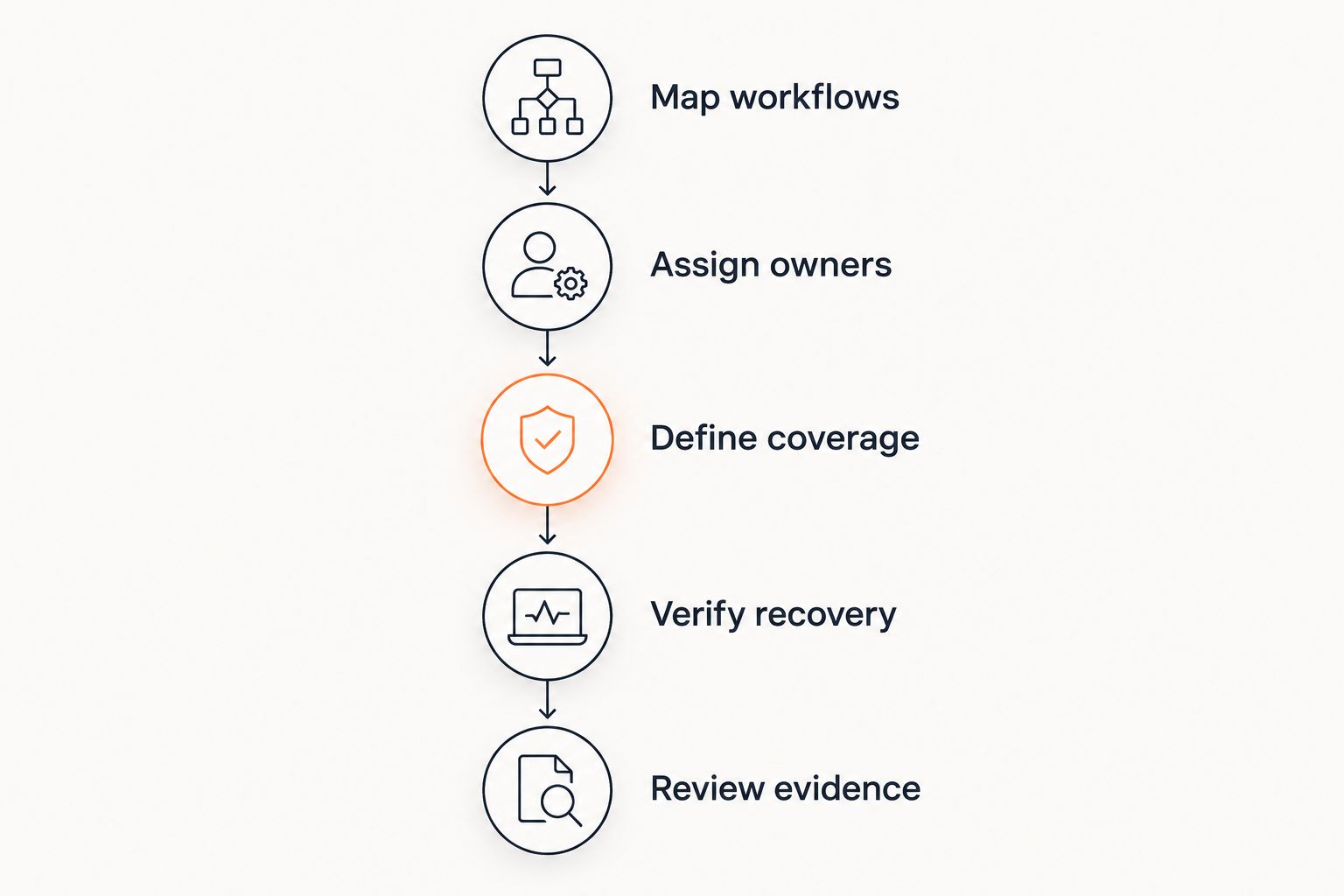 Choose ownership after identifying workflows, coverage needs, and recovery responsibilities.
What should a website maintenance scope include in 2026?
A useful scope describes actions, boundaries, and evidence of completion. It should be understandable to the person approving the work, not only to the person performing it.
Include these areas where they apply:
- System inventory: Identify the website, hosting environment, applications, integrations, and third-party services covered.
- Access management: State who owns accounts, how access is granted, and how access is removed when responsibilities change.
- Routine work: Describe applicable updates, dependency reviews, backup checks, and housekeeping tasks.
- Testing: Identify critical workflows and the checks required after a change.
- Incident handling: Define reporting, triage, escalation, communication, and closure.
- Change control: Explain approval, deployment, rollback, and documentation requirements.
- Exclusions: Identify work that needs separate approval, such as new features or platform migration.
A maintenance agreement is incomplete when it lists activities but leaves responsibility unresolved. The same standard applies to an internal operating document.
If an external team proposes the scope, your business must still confirm that the covered workflows match actual operations. Technical coverage and business coverage are not automatically the same thing.
Can you outsource maintenance and still control your website?
Yes. Keep account ownership, business priorities, and approval authority inside your organization while delegating defined technical tasks.
Use named accounts and appropriate permissions rather than sharing an employee’s credentials. Document how your organization can transfer responsibility, retrieve current documentation, and remove access when the arrangement ends.
Is in-house maintenance better for an integrated ecommerce store?
In-house maintenance is better when your team can support both the storefront and its connected workflows. Familiarity with the business alone does not establish the ability to diagnose integration problems.
For your 2026 operating plan, assign responsibility across the entire transaction path. If an order fails between systems, the customer needs a functioning process—not a debate about which application is at fault.
FAQ
What's the best way to choose between outsourced and in-house website maintenance?
Choose by workflow ownership, technical capability, and available capacity. Document the work first, then select the arrangement that provides clear coverage without leaving responsibilities unassigned.
Will outsourcing website maintenance remove all work from my team?
No. Your team still sets business priorities, approves changes, manages ownership, and confirms that repaired workflows meet business needs. Outsourcing delegates execution, not accountability.
Is outsourcing website maintenance always less expensive?
No. Compare equivalent responsibilities, including internal coordination, testing, documentation, incident handling, and coverage. An external agreement and an employee's available time are not equivalent scopes.
Can our existing developer handle website maintenance?
Yes, if the developer has the relevant skills, access, and allocated capacity. Establish backup coverage and documentation so maintenance does not depend entirely on that person's availability.
Can we keep content updates in-house and outsource technical maintenance?
Yes. A hybrid arrangement can separate content responsibilities from code, integration, and deployment work. Define the approval boundary when content changes affect layouts, functionality, or connected systems.
Does outsourcing guarantee website security or prevent downtime?
No. Evaluate the actual controls, maintenance procedures, recovery preparation, and incident responsibilities instead of treating outsourcing as a guarantee. Technical ownership still requires verification.
What should we discuss with Endertech about website maintenance?
Discuss the website, ecommerce platform, custom applications, and connected systems that need support. Bring a workflow inventory, known problems, access constraints, and internal responsibilities so the scope reflects your business.
One last thing
Before choosing your 2026 maintenance arrangement, run a handoff exercise: ask someone other than the usual maintainer to locate the documentation, identify the technical owner, and explain how a failed release would be reversed. Do not make a production change for the exercise.
If that person cannot explain the process, fix the handoff before changing who performs the work. Moving responsibility does not repair an undocumented system; it moves the uncertainty to someone else.