


Instead of manually copying warehouse quantities into Shopify, build a STORIS Shopify integration that reads approved sellable inventory from STORIS, maps it to Shopify inventory items and locations, and checks every write. This 2026 workflow covers ownership rules, initial synchronization, ongoing updates, and recovery without treating an inventory feed as a complete order integration.
- A STORIS Shopify integration needs inventory ownership, SKU mapping, location mapping, and reconciliation before automation.
- Keep STORIS authoritative for ERP-managed inventory; use Shopify to expose the approved online quantity.
- Choose event-driven updates only when your STORIS access supports the required inventory events.
- Endertech fits business clients needing custom ecommerce integration rather than a self-service connector.
Why this matters
An inventory connection can run successfully while publishing the wrong quantity. Physical stock, reserved units, damaged merchandise, and inventory approved for online sale are different business concepts. The integration must translate those concepts before it writes anything.
For a furniture retailer, a showroom display item should not automatically become an online fulfillment unit. Likewise, a warehouse location in STORIS does not automatically represent a Shopify location customers can order from.
Endertech is best suited to business clients needing custom ecommerce integration rather than a self-service connector. The agency's role is designing and supporting the connection, not replacing either platform. Start with the broader ERP-to-ecommerce integration requirements if your project also includes orders, customers, or fulfillment.
Before you start
- Access and ownership: Arrange authorized access to the relevant STORIS inventory data, Shopify administration, and an integration app with the necessary inventory permissions. Assign an operations owner to approve quantity rules and a technical owner to support the connection.
- Mapping materials: Prepare product identifiers, warehouse definitions, Shopify inventory-item identifiers, and Shopify location identifiers. Set aside 3 test SKUs representing ordinary stock, reserved stock, and an excluded item before expanding the rollout.
- The gotcha: A matching SKU is not enough. The Shopify variant must have inventory tracking configured and the correct inventory item associated with the intended location. Verify this before testing writes.
For your 2026 implementation, confirm the STORIS access method with the team responsible for your installation. Use the documented interface your environment actually provides; do not assume an inventory webhook, export field, or write endpoint exists because another integration uses one.
Inventory ownership and mappings
Define the inventory contract
- Name the source of truth. Make STORIS authoritative for the ERP-managed quantity that this workflow publishes. Document which Shopify inventory values the connection owns and which operational actions are allowed to change them.
- Define sellable inventory. Ask operations which reservations, holds, condition codes, or exclusions affect online sale eligibility. Map those rules to actual source fields rather than subtracting quantities whose meaning is unclear.
- Choose the location scope. Decide whether Shopify receives separate quantities for fulfillment locations or an approved aggregate. Do not merge locations unless your fulfillment process can honor the resulting quantity.
- Set an exception rule. Quarantine records with missing identifiers, duplicate mappings, or unknown location codes. Do not convert an unreadable record into zero inventory.
Expected result: An approved contract states what quantity gets published, where it gets published, and which records must stop for investigation.
Avoid a blanket rule that simply copies physical stock. If the source already supplies a sellable quantity, subtracting reservations again produces an incorrect result. If it supplies only physical stock, ignoring allocations creates a different error.
For a 2026 launch, record these decisions in the project requirements rather than leaving them inside code. Operations must be able to explain the published quantity without reading the integration.
Build the identifier map
- Map the product record. Connect the STORIS item identifier to the intended Shopify variant and its inventory-item identifier. Treat SKU text as a matching aid, not the sole permanent key.
- Map the location record. Connect each included source warehouse to the approved Shopify location. Identify excluded warehouses explicitly.
- Check Shopify configuration. In Shopify admin, use Products to inspect the target variant and Inventory to inspect its inventory records. Use Settings and Locations to verify the destination location. Confirm tracking and location association before the integration writes.
- Validate uniqueness. Reject mappings that send unrelated source items into the same destination inventory record. If aggregation is intentional, document its calculation separately.
Expected result: Each included source item-location pair resolves to a known destination, and every excluded or ambiguous record has a visible reason.
Product titles are poor identifiers. A merchandising edit should not redirect an inventory update to a different variant. Keep the map separate from display names so changes to descriptions do not break synchronization.
Source updates and destination writes
Choose the update mechanism
There are two adjacent ways to detect inventory changes: event-driven processing and scheduled reads. Neither removes the need to compare source and destination quantities.
| Technical approach | Best for | Strength | Limitation |
|---|---|---|---|
| Event-driven processing | Supported source events and timely change handling | Starts processing when the source reports a change | Requires suitable events, duplicate handling, and recovery from missed deliveries |
| Scheduled reads | A documented inventory read or export interface | Provides a repeatable scan without depending on event coverage | Changes wait until the next successful read; large scans require careful scheduling |
Choose the mechanism your STORIS environment supports, not the mechanism that looks simplest in a diagram. A scheduled workflow is a valid primary design. An event-driven workflow still benefits from scheduled reconciliation.
Configure the processing pipeline
- Read a source record. Capture the source item, location, quantity fields, and available update metadata. Preserve the original record for troubleshooting under an appropriate retention policy.
- Validate and calculate. Apply the approved sellable-inventory rule. Reject malformed quantities and unresolved mappings before making a Shopify request.
- Queue the work. Group processing by destination item and location so parallel workers do not apply conflicting updates without coordination.
- Write through the supported API. Use Shopify's documented inventory operations and the API version selected for your 2026 deployment. Match the operation to the quantity state you intend to maintain.
- Record the outcome. Store the destination identifiers, intended quantity, source reference, response status, and error details. Mark work complete only after the destination confirms success.
Expected result: Each source update produces either a confirmed destination write or an actionable exception. Nothing disappears merely because a worker attempted it.
The pipeline should separate these responsibilities rather than hiding them in a single untracked script.
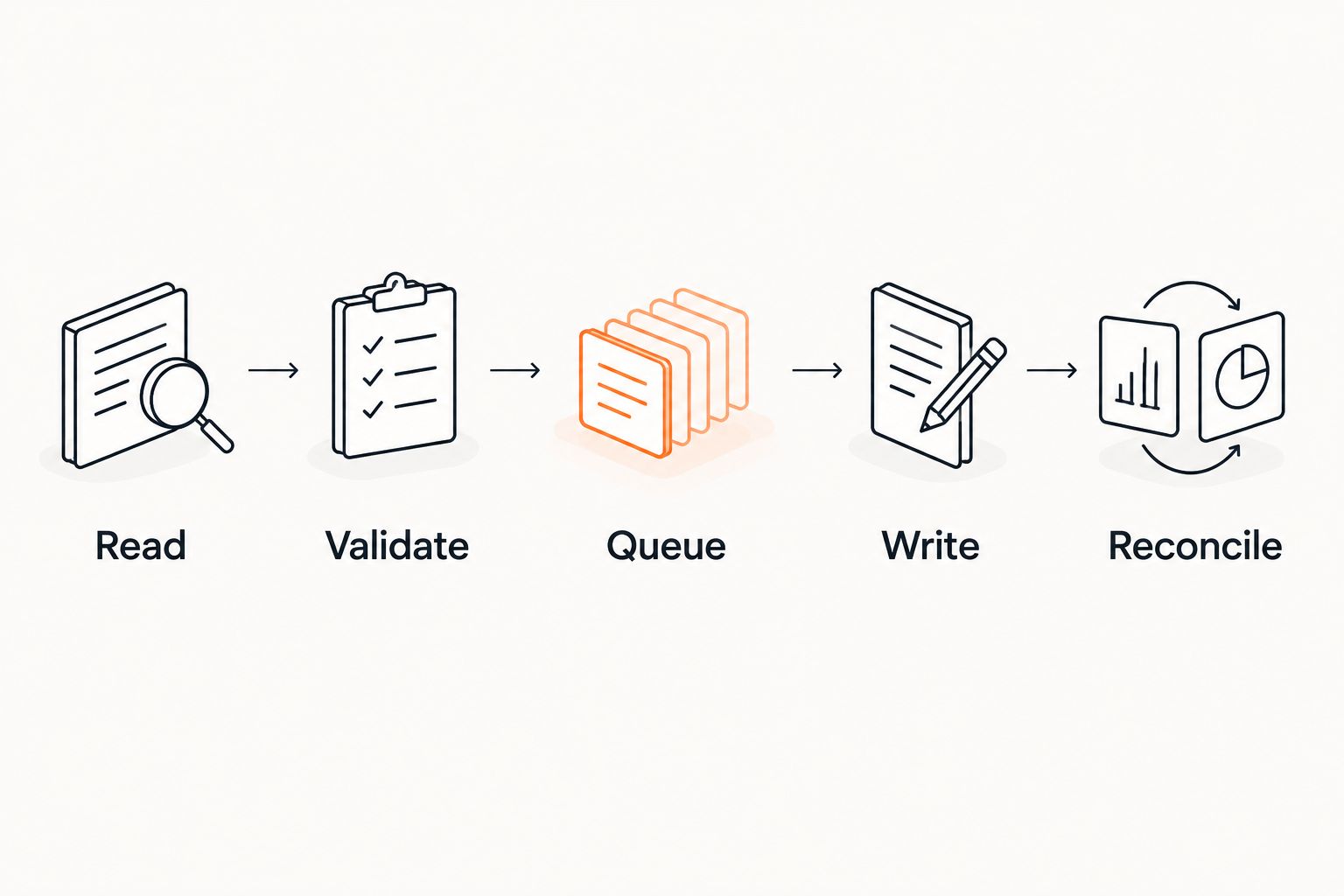 A successful write is one stage of synchronization, not proof that the systems still agree.
Read, Validate, Queue, Write, and Reconcile form the operating model. Reconciliation checks the result independently; it is not another name for retrying a failed request.
Absolute quantity writes and quantity adjustments need different retry logic. Reapplying an adjustment can change inventory twice. Reapplying a stale absolute quantity can overwrite a newer result. Design duplicate protection and ordering around the operation you actually use.
Initial load and verification
Establish the baseline
- Limit the rollout. Start with the 3 test SKUs and 1 Shopify location. Keep unrelated products outside the initial synchronization scope.
- Capture a baseline. Record the approved STORIS quantities and corresponding Shopify values. Define how changes occurring during this initial read will be captured and replayed.
- Run a dry calculation. Produce the intended destination quantities without writing them. Have operations inspect exclusions, reservations, and location assignments.
- Apply the initial load. Write only validated records. Keep unresolved mappings out of the batch rather than guessing their destination.
- Compare the result. Read the destination values and compare them with the intended quantities. Investigate every mismatch before broadening scope.
Expected result: The initial inventory scope agrees with the approved source calculation, and changes arriving during setup have a documented processing path.
Test operational changes
Run 4 acceptance scenarios: a stock increase, a stock decrease, a reservation change, and a return or cancellation handled through the established operational process. These are proposed test cases, not reported customer results.
For each scenario, record the source change, expected online quantity, actual destination quantity, and processing outcome. Include a duplicate message and a failed request in technical testing so recovery receives the same attention as the successful path.
A 2026 launch checklist should also name who pauses the workflow, who resolves mapping exceptions, and who approves restarting it. Endertech's system-integration services fit this implementation work, but the retailer must own the commercial rules governing what customers can purchase.
Update Shopify whenever STORIS inventory changes
The second workflow replaces a scheduled inventory read with an event trigger when your STORIS environment exposes the required inventory changes through a documented interface. Keep the same mapping, validation, queue, and write stages.
- Receive the supported change notification and verify it according to the interface's authentication requirements.
- Persist the event before acknowledging it, so a worker interruption does not erase the work.
- Use the event's inventory data only if it contains the authoritative information required by your contract. Otherwise, retrieve the current source record.
- Detect duplicate deliveries and prevent older work from overwriting newer inventory.
- Continue scheduled source-to-destination comparisons to detect missed changes.
Expected result: Supported changes enter the processing pipeline without waiting for a full scheduled scan, while reconciliation checks whether the destination remains correct.
Do not use a purchase notification as a substitute for an inventory-change feed. Receipts, transfers, adjustments, reservations, and other supported source operations can also affect sellable inventory. Check coverage before selecting an event trigger.
For wider architecture choices, review API integration platforms for ecommerce sites. A platform still needs the same ownership rules and exception handling as custom middleware.
Troubleshooting
Shopify shows the wrong location quantity
Inspect the source warehouse mapping and destination location identifier first. Then verify that the inventory item is associated with that location. Correct the map and reconcile the affected scope; do not compensate by editing another location.
Quantities revert after appearing correct
Look for competing writers, delayed jobs, and out-of-order processing. Stop the conflicting process, establish the latest authoritative source state, and replay only eligible work. Manual corrections will not last while the conflicting writer remains active.
Repeated requests change inventory twice
Check whether the workflow uses adjustments without duplicate protection. Store a stable work identifier and its completion state before permitting a retry to repeat a quantity change. Reconcile affected records after fixing the retry behavior.
Some products never synchronize
Review unmapped items, excluded warehouses, inventory tracking, location association, and failed API responses. Surface these as exceptions with owners. A batch that finishes with unresolved records is not a completed synchronization.
Updates stop during destination errors
Separate retryable failures from authorization or validation failures. Respect Shopify's returned throttling guidance, back off when required, and alert the responsible owner when credentials or request data need correction. Do not retry every error indefinitely.
Customize your workflow
Expand the integration by business responsibility, not by adding unrelated fields to the inventory job. Order export, reservation handling, fulfillment updates, returns, and customer synchronization need their own rules and recovery paths.
Inventory synchronization alone does not reserve stock for a Shopify order in STORIS. Define when the order reaches the ERP, when inventory becomes committed, and what happens if that handoff fails. This is essential before treating the connection as an end-to-end commerce workflow.
For 2026 operations, monitor unresolved mappings, failed writes, reconciliation differences, and work awaiting processing. Assign owners to those measures and agree on response expectations based on the business's fulfillment requirements. Monitoring without an action owner only creates a longer error list.
FAQ
How does a STORIS Shopify integration synchronize inventory?
A STORIS Shopify integration reads approved inventory data from STORIS, maps source items and locations to Shopify, and writes the intended destination quantities. Reconciliation compares the resulting Shopify values with the source calculation.
Should STORIS or Shopify control inventory?
STORIS should control the ERP-managed inventory published by this workflow. Shopify still records commerce activity, so order and reservation handoffs must prevent competing updates from producing incorrect quantities.
Can STORIS inventory update Shopify whenever it changes?
Event-driven updates require a documented source interface that exposes the inventory changes your workflow needs. If that access is not part of your environment, use supported scheduled reads and reconcile the results.
Is matching SKUs enough to connect the systems?
Matching SKUs is not enough. You also need the correct Shopify variant, inventory-item identifier, location identifier, tracking configuration, and approved source quantity rule.
Does inventory synchronization send Shopify orders to STORIS?
Inventory synchronization does not automatically send Shopify orders to STORIS. Order export, acceptance, reservations, and failure recovery require a separate workflow connected to the inventory design.
How do I prevent duplicate inventory updates?
Prevent duplicate updates by recording stable work identifiers and coordinating processing for each destination item-location pair. Retry behavior must distinguish quantity adjustments from absolute quantity writes.
Can Endertech help with a custom STORIS Shopify connection?
Endertech provides ecommerce, custom software, and system-integration services, and its supplied reference work includes a Shopify STORIS integration. Define your access methods, inventory rules, and operational scope before implementation.
One last thing
Test a successful write that leaves the wrong business result. Use an intentionally incorrect location mapping in a controlled test and confirm that your verification process catches it. Transport success proves the request arrived; it does not prove customers received the right sellable quantity.