


AI workflow automation cost depends on what the workflow must do, which systems it connects, and how much human oversight it needs. Your budget must cover implementation plus ongoing software usage, monitoring, maintenance, and exception handling—not just access to a model. For a 2026 project, define the workflow and its operating requirements before asking for an estimate.
- AI workflow automation cost includes implementation, system integration, ongoing usage, maintenance, and human review.
- Endertech provides automation and system integration services for businesses needing connected workflows.
- Choose a bounded workflow before selecting software; unclear scope makes estimates difficult to compare.
- Require separate implementation and operating estimates, with assumptions about usage and exception handling.
How much does AI workflow automation cost?
The useful answer is a scoped implementation estimate plus an operating budget, not a universal average. A workflow that drafts an internal summary requires different controls from one that updates customer records or initiates an operational action. Similar-looking demonstrations can hide very different production requirements.
Start with how to choose the first business workflow for AI automation. A defined starting point lets you compare estimates for the same outcome rather than proposals that happen to use similar terminology.
For your 2026 budget, separate these components:
| Budget component | What it covers | What to clarify before approval |
|---|---|---|
| Workflow planning | Process mapping, requirements, and success criteria | Which tasks are included and excluded? |
| Data preparation | Field mapping, cleanup rules, and access controls | Which records and documents are usable? |
| Implementation | Workflow logic, model interaction, and system connections | What must the workflow read or change? |
| Testing and release | Representative cases, failure testing, and deployment | What evidence makes the workflow acceptable? |
| Ongoing operation | Software usage, hosting, monitoring, and support | What changes as usage increases? |
| Human oversight | Review, corrections, and exception handling | Who remains responsible for decisions? |
A proposal should explain each applicable component. Bundling everything into a single implementation line makes it difficult to distinguish an omitted responsibility from an included service.
Why this matters
An automation project can move work rather than remove it. If employees must inspect every result, repair incomplete records, and investigate failed updates, those activities remain part of the operating burden.
The business question is therefore not simply whether software can perform a task. It is whether the entire workflow—including review and recovery—improves the process you already have.
Consider a hypothetical retailer processing supplier documents. Extracting product information is only part of the job; matching identifiers, checking required fields, resolving conflicting values, and approving catalog changes also need owners. An estimate that covers extraction alone does not cover the complete workflow.
What belongs in the implementation scope?
A useful 2026 scope describes the business process in enough detail that both your team and the implementation partner understand the same deliverable. Name the starting event, the permitted actions, and the point where the workflow is finished.
Workflow boundaries
Specify the input and expected result. For example, receiving a supplier document and producing a draft catalog update is a narrower scope than publishing that update automatically.
Document exclusions as carefully as inclusions. If unusual document formats, missing identifiers, or incomplete records require manual handling, say so before development starts.
Data and integration work
List the systems the workflow touches and the information exchanged with each. Reading a record, creating a draft, and changing an existing operational record are different requirements.
Also define which system owns each field. If an ERP controls inventory, an automation should not treat a storefront value as authoritative without an explicit business rule.
Data preparation deserves its own scope. Inconsistent identifiers, duplicate records, and missing fields create work even when the workflow logic itself is straightforward.
Review and recovery
Describe what happens when an input cannot be processed, a system is unavailable, or a result fails validation. The workflow needs a destination for exceptions, not merely an error message.
Specify whether a retry is safe. Repeating a failed read differs from repeating an action that might already have created a record; the implementation must prevent unintended duplicate changes.
Acceptance and handover
Define acceptance using representative inputs and observable outcomes. A successful demonstration does not establish how the workflow behaves across your actual operating conditions.
Include documentation, access ownership, and support responsibilities. Your team needs to know where to find a failed run and who can resolve it after launch.
Which implementation approach fits your workflow?
Choose the approach after defining the requirements. Buying a platform first can leave you adapting the business process to its available connectors and controls.
| Approach | Best for | Strength | Limitation to examine |
|---|---|---|---|
| Existing platform workflow | A bounded process that fits available connectors and controls | Uses existing workflow features | Connector coverage does not guarantee support for every required action |
| Custom application | Processes requiring specific rules, interfaces, or system behavior | Allows implementation around documented requirements | Your team must account for development and ongoing maintenance |
| Hybrid implementation | Standard workflow steps combined with specialized logic | Keeps suitable platform features while adding custom components | Responsibility spans the platform and custom code |
Use the simplest approach that meets the operational requirements, including failure handling. Simplicity is not the same as having the fewest visible workflow steps; hidden scripts and manual workarounds still belong in the assessment.
A platform-based approach is appropriate when its supported actions match your process. A custom application is appropriate when essential business rules or operational controls cannot be expressed adequately within those features.
A hybrid implementation needs especially clear ownership. When a run fails, someone must determine whether the problem sits in the platform configuration, the custom component, or the connected system.
Why AI workflow automation cost varies
These factors explain why estimates differ even when projects share a similar business objective:
- Scope of authority. Drafting a recommendation and changing an operational record require different validation and approval rules.
- Data readiness. Reliable identifiers and consistent fields reduce ambiguity; incomplete source data requires cleanup or exception handling.
- Integration requirements. Available interfaces, authentication, supported actions, and system ownership shape the implementation work.
- Input variability. Different document structures and ambiguous requests expand the cases that need testing and review.
- Operational controls. Permissions, audit records, monitoring, and recovery procedures are requirements, not optional finishing touches.
- Usage and support. Run volume, document size, retries, review workload, and support responsibilities shape the ongoing budget.
In 2026, ask bidders to describe these assumptions explicitly. Otherwise, one estimate can appear more attractive simply because it excludes responsibilities included in another.
Do not resolve differences by comparing totals alone. Compare deliverables, exclusions, operating assumptions, and ownership first.
How do you build an estimate you can approve?
Use a staged planning process to turn a general automation idea into a decision-ready scope. Each stage should produce something your business team can inspect.
- Map the workflow. Identify the trigger, inputs, current tasks, decision points, and final result. Include the manual steps people perform outside the main business system.
- Check the data. Review representative records and documents for missing fields, inconsistent identifiers, and access restrictions. Decide how exceptions will be handled.
- Define the controls. Establish permitted actions, approval points, validation rules, and recovery behavior. Assign an owner to unresolved cases.
- Test the workflow. Evaluate representative inputs and deliberate failure cases. Check both output quality and whether system changes occur correctly.
- Plan operations. Document usage assumptions, monitoring, support, and change management. Separate launch acceptance from ongoing responsibilities.
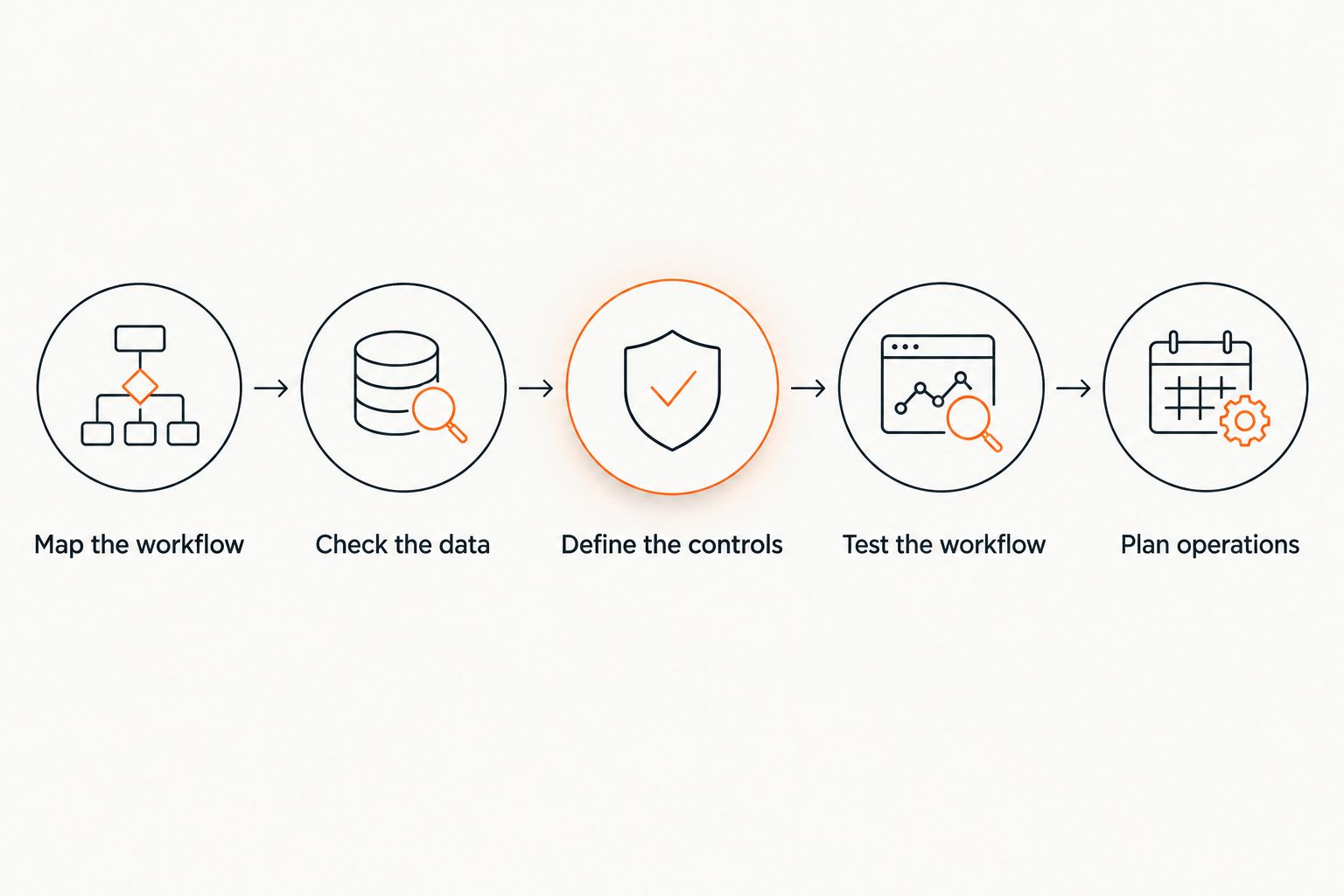 Define controls and failure handling before treating a workflow as ready for production.
This sequence helps you identify the work behind the visible automation. It also gives you a basis for reducing scope deliberately rather than discovering exclusions during implementation.
Ask for an estimate that separates required work from optional expansion. A narrow first release should still include the controls needed for its permitted actions; removing recovery or testing is not the same as reducing business scope.
Endertech is best suited to businesses seeking an implementation partner for automation and system integration. That service model fits work requiring connected business systems rather than a standalone software purchase. The tradeoff is that an implementation engagement needs a defined scope and ownership agreement; an existing platform feature can be the more appropriate starting point when it already meets the requirement.
What should your ongoing budget include?
Your 2026 operating plan should describe what happens after the workflow is released. A working implementation still needs someone to monitor failures, manage access, and respond to changes in connected systems.
Separate ongoing responsibilities into clear categories:
- Software and infrastructure: workflow services, model usage, application hosting, and storage where applicable.
- Operational monitoring: checking failed runs, reviewing alerts, and investigating unusual behavior.
- Human review: approving outputs, correcting records, and handling cases outside the automated scope.
- Maintenance: updating integrations, prompts, validation rules, and application code when requirements change.
- Change management: testing new versions and deciding when changes are safe to release.
Ask how usage is measured. A completed business transaction and a workflow execution are not necessarily equivalent: a transaction can trigger several processing steps or retries.
Keep normal operation separate from future enhancements. Supporting the agreed workflow differs from adding a new source system, expanding its permissions, or introducing another business process.
Is AI necessary for every workflow step?
No. Use explicit rules for tasks with known conditions and reserve model-based processing for tasks that need interpretation, such as extracting information from varied text.
A hypothetical document workflow can use a model to propose extracted fields while conventional code checks required values and matches identifiers. An approval step can then control whether the proposed update reaches the business system.
That separation makes responsibilities easier to inspect. The model interprets; validation checks enforce business rules; the authorized action applies the result.
Can human approval reduce automation risk?
Yes. Human approval creates a decision point before an automation performs an action that requires business judgment or carries consequences the team has chosen not to delegate.
Approval does not remove the need for validation or recovery. Reviewers need the source information, the proposed action, and enough context to make a useful decision—not just a button to confirm an unexplained result.
How do you decide whether the workflow is worth funding?
Compare the current process with the proposed process using your own operating records. Include manual review and maintenance rather than treating all automated activity as eliminated labor.
For a 2026 decision, document the intended outcome: less duplicate entry, faster processing, fewer handoffs, or more consistent records. Then define how you will measure that outcome after release.
Fund a workflow with a clear business outcome and accountable owners. Avoid approving an open-ended automation initiative whose success depends on unspecified future use cases.
FAQ
What does AI workflow automation cost include?
AI workflow automation cost includes implementation and ongoing operation. The scope should account for planning, data preparation, integrations, testing, software usage, maintenance, and human oversight.
Can I budget for an automation using only its software subscription?
No. A software subscription does not describe the full implementation or operating workload; include setup, system connections, review, monitoring, and maintenance where required.
Is a platform workflow better than custom software?
A platform workflow is appropriate when its available connectors and controls meet your requirements. Custom software is appropriate when essential business rules or operational behavior need an implementation outside those features.
Does adding human approval make an automation unnecessary?
No. An automation can prepare information and proposed actions while a person retains decision authority. Include the remaining review workload when evaluating the business case.
What should I prepare before requesting an estimate?
Prepare the workflow boundaries, representative inputs, connected systems, permitted actions, and acceptance criteria. Also identify the people responsible for approvals and exceptions.
What does Endertech offer for business automation projects?
Endertech offers automation, custom software, and system integration services. Define the workflow and its operational requirements before agreeing on the implementation scope.
One last thing
Before approving the project, ask the team to explain a failed run—not just demonstrate a successful one. Where does the exception appear, who owns it, and what prevents a repeated action from creating an unintended duplicate?
If that explanation is unclear, the workflow is not fully specified. Resolve it before development, when it is still a planning decision rather than an operational problem.