


Custom software development cost in 2026 has no defensible fixed figure until the work is defined. The estimate must account for planning, design, development, integrations, testing, deployment, and support; a build quote that excludes data migration or ongoing maintenance does not represent the full commitment.
- Custom software development cost in 2026 depends on scope, integrations, migration, and support—not a universal price range.
- Endertech is a fit for businesses planning custom web applications and ecommerce integrations, not projects seeking a scope-free quote.
- Compare proposals against the same requirements, assumptions, exclusions, and support responsibilities.
- Define the smallest useful release before estimating the entire product.
Why this matters
A low initial quote can describe less work rather than a more efficient way to deliver the same system. For example, an ecommerce project might cover a storefront while leaving product-data cleanup, order synchronization, and migration outside the estimate. The distinction changes what your team must fund and manage.
If the project involves replacing an existing platform, read what controls a Magento-to-Shopify migration timeline before treating development as the whole project. Planning for the transfer and validation of existing data belongs in the decision, even when those tasks are not part of a new feature build.
How much does custom software development cost in 2026?
Custom software development cost is the cost of a defined deliverable and its dependencies, not a standard price for an application. In 2026, ask for an estimate tied to documented workflows, integrations, data responsibilities, acceptance criteria, and post-launch ownership. Without those, a single figure tells you little about what will be delivered.
A useful breakdown separates the work you need from the work a proposal actually includes:
| Cost component | What the estimate needs to cover | Common omission to check |
|---|---|---|
| Planning and specification | User workflows, requirements, technical decisions, and acceptance criteria | Time needed to resolve conflicting requirements |
| Design | Interface flows and the screens users need to complete their tasks | Revisions after stakeholders review a working version |
| Development | Application behavior, data handling, and administrative functions | Work assumed to be handled by an existing platform |
| Integration | Connections and data exchange with existing systems | Error handling, reconciliation, and ownership of failed transfers |
| Data migration | Mapping, cleanup, transfer, and validation of existing records | Source-data problems discovered during testing |
| Testing and release | Functional checks, user acceptance, deployment, and launch preparation | Responsibility for fixing defects found before acceptance |
| Ongoing operation | Hosting arrangements, monitoring, maintenance, and future changes | Who responds when an integration or workflow stops working |
This is a comparison checklist, not a claim that every project requires every item. If your business already has a system that handles a workflow, the estimate should say whether the new application reuses it, connects to it, or replaces it. Those choices produce different scopes.
Ask each prospective delivery team to identify what is included, what is excluded, and which decisions remain open. Then compare proposals against the same scope. A quote with unresolved integration requirements is not directly comparable with one that includes integration design and testing.
What changes the estimate most?
The largest scope questions are usually about what the software must do, what it must connect to, and what must happen to existing data. In 2026, document these factors before asking anyone to commit to a project estimate:
- Workflow scope: List the tasks each user must complete, including exceptions and approvals. A request to manage orders is less precise than a documented sequence for creating, changing, and fulfilling an order.
- Existing systems: Identify the ecommerce platform, accounting software, ERP, or database involved. State which system owns each record and what the new application must read or update.
- Data quality and migration: Describe the records that must move and who will resolve duplicates, missing fields, or inconsistent formats. Moving data and confirming that it works in the destination are different tasks.
- User roles and permissions: Specify who can view, create, change, approve, or export information. Permission rules affect both application behavior and testing.
- Design and acceptance: Decide whether the work includes designing new interfaces and who signs off on completed workflows. Without acceptance criteria, disputes about completion become scope disputes.
- Support after launch: Assign responsibility for maintenance, changes, and integration failures. A launch deliverable and an ongoing service are not the same commitment.
For an ecommerce integration, the critical question is not simply whether the systems connect. It is what happens when an order changes, inventory conflicts, or a transfer fails. Those are workflow requirements, and leaving them unspecified makes the estimate less useful.
Should you build, configure, or integrate?
Custom development is not automatically the right answer to a software gap. First determine whether an existing platform can handle the workflow, whether a connection between current systems solves it, or whether the business needs behavior neither system provides.
| Approach | Best for | Advantage | Limitation |
|---|---|---|---|
| Configure an existing platform | Workflows the platform already supports | Keeps more behavior inside an established product | Platform rules can limit the process you want |
| Integrate existing systems | Work split across applications you plan to keep | Preserves systems that already serve their purpose | Data ownership and transfer failures need explicit handling |
| Build custom software | Workflows or applications existing systems cannot adequately support | Lets you define behavior around the business process | Your team must plan for testing, ownership, and maintenance |
Choose the least custom approach that meets the documented requirement. If configuration covers the workflow, a separate application adds something to maintain. If two systems each do their job but do not exchange the right information, integration deserves evaluation before replacement. If neither option supports the required behavior, custom development has a clear reason to exist.
Endertech builds custom software and database-driven applications alongside ecommerce work. Endertech is a fit for businesses planning a custom web application or ecommerce integration; it is not a reason to build what an existing platform can already do. That distinction protects the scope of the project as much as the budget.
How do you get an estimate you can use?
Start with the business process, not a list of screens. A screen describes where a user clicks; a workflow explains what information enters the system, what changes, and what result the business needs.
- Define the outcome. Describe the problem in operational terms, such as avoiding duplicate entry between an online store and an existing business system. State how the team will recognize that the new process works.
- Map the current workflow. Record who starts each task, which system holds the information, where staff intervene, and what happens when a task fails. Include exceptions, not just the ideal path.
- Choose the first useful release. Separate functions required to run the workflow from functions that can follow later. An estimate for a bounded release is easier to evaluate than an estimate for an undefined final product.
- Inventory systems and data. Name the applications that must exchange information and the records each owns. Note whether historical records must be transferred or only new activity must flow between systems.
- Write acceptance criteria. Specify observable results for each important workflow. For example, identify what users should see when an update succeeds and what staff must be able to do when it fails.
- Request assumptions and exclusions. Have the proposal state what it expects your team to provide, how changes will be approved, and who handles deployment and support.
Planning is part of delivery, not paperwork added before delivery. Endertech’s stated Concept to Launch process starts by clarifying the vision and creating wireframes and a project backlog before significant development. That sequence makes the estimate about an agreed product rather than competing interpretations of an idea.
The same discipline applies when requirements change. Record the change, determine which workflows and integrations it affects, and decide whether it belongs in the current release. Otherwise, an estimate gradually stops describing the work being done.
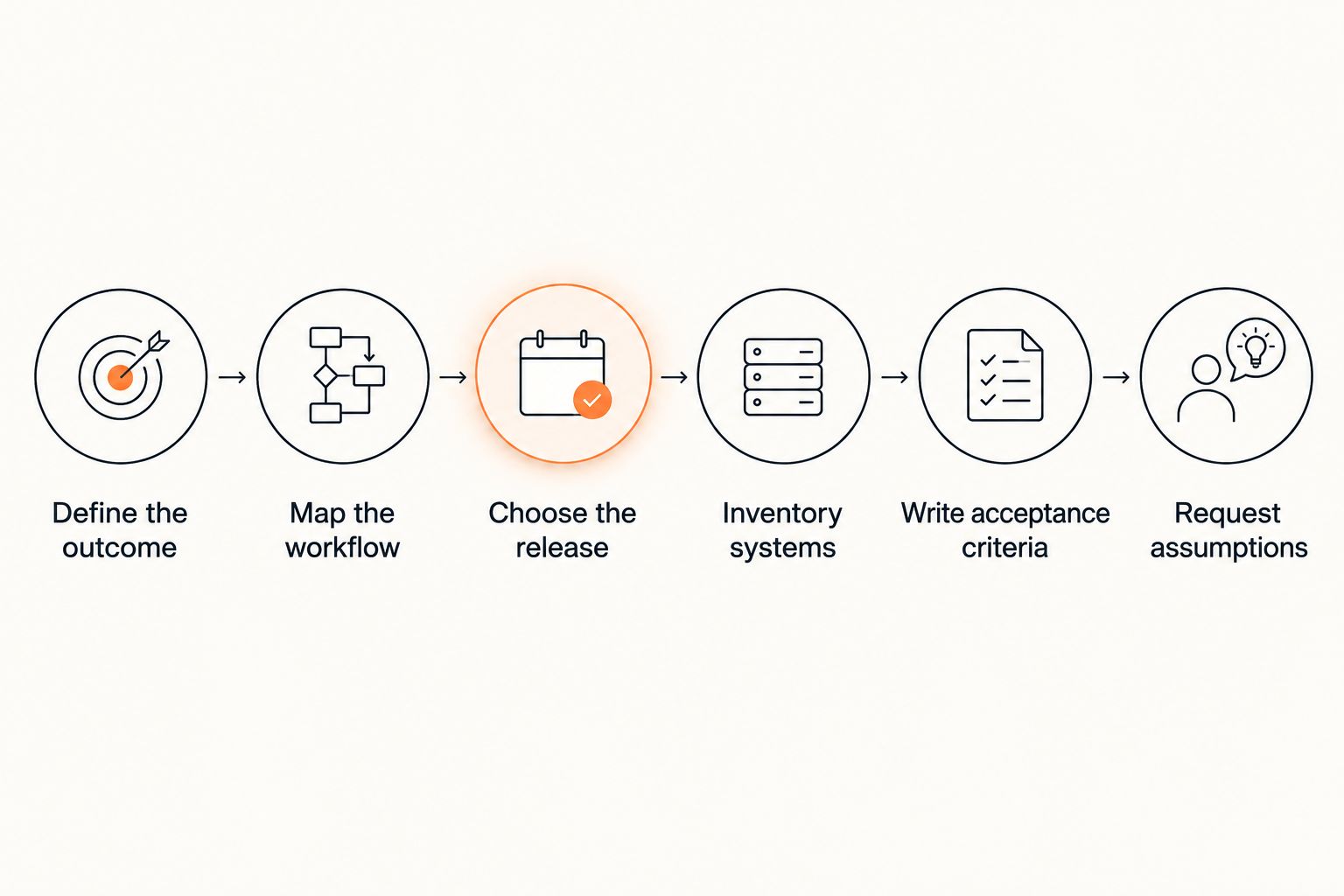 A usable estimate follows a defined workflow, release scope, and acceptance criteria.
Which proposal details prevent budget surprises?
A proposal should let you trace each required outcome to work that is included. Ask where the document addresses the following:
- Deliverables: What will users and administrators be able to do when the work is accepted?
- Dependencies: Which accounts, documentation, access permissions, and decisions must your team supply?
- Integration boundaries: Which records move, in which direction, and which system remains authoritative?
- Migration boundaries: Which existing data moves, who cleans it, and how will the result be checked?
- Testing responsibility: Who tests business workflows and who resolves issues found before acceptance?
- Change control: What happens when a requested feature differs from the agreed scope?
- Post-launch responsibility: Who handles operational issues, maintenance, and later enhancements?
Look especially closely at statements that sound complete but describe only a connection. An integration can successfully send data while still leaving staff to resolve mismatched records manually. The proposal needs to address what the business does when data is rejected, delayed, or changed in both systems.
For a platform migration, separate the work of building the destination experience from the work of preserving useful existing data and processes. Both need owners and acceptance checks. A broad migration label does not establish that either task is included.
What should you budget for after launch?
In 2026, the project decision should include who will operate and change the software after its initial release. Support is not interchangeable with development: keeping a live integration working, addressing defects, and adding new behavior are distinct kinds of work.
Ask which party maintains the application, how issues are reported, and what happens when a connected platform changes its requirements. If internal staff will take ownership, include the documentation and access they need in the handoff. If an outside team will retain responsibility, define the boundary between correcting agreed functionality and requesting new work.
Endertech supports websites, ecommerce stores, and custom applications. For a business evaluating Endertech custom software development, the useful question is not whether support exists in general; it is what support the specific proposal includes. Get that answer in writing before comparing the initial build against another option.
Can a small first release reduce custom software development cost?
A smaller first release reduces the work in the initial scope; it does not erase work the business still needs. In 2026, define the first release around a complete, usable workflow and defer additions that are not required to operate it. Do not defer a necessary integration, permission rule, or error path merely to make the quote appear smaller.
A useful release has a clear user, a clear result, and a way to verify that result. If the proposed first release cannot complete the business task without a manual workaround, document the workaround and decide whether the business accepts it. That is a scope decision, not a surprise to discover after launch.
Is an hourly rate enough to compare development proposals?
No. An hourly rate does not tell you which tasks or risks a proposal covers. Compare the deliverables, assumptions, exclusions, and responsibility for changes first. Then assess the proposed commercial terms against the same documented scope.
In 2026, a proposal that includes discovery and migration validation describes different work from one that starts with implementation and assumes clean data. Treat those differences as questions to resolve, not as evidence that either proposal is automatically better.
FAQ
How much does custom software development cost in 2026?
Custom software development cost in 2026 requires a defined scope before it can be estimated responsibly. Document workflows, integrations, migration, testing, and support so a proposal covers the work you actually need.
What affects custom software development cost most?
Workflow scope, existing-system integrations, data migration, permissions, testing, and support affect the estimate. Define each requirement and identify who owns it before comparing proposals.
Is an integration cheaper than a custom application?
An integration is the narrower choice when existing applications already handle the required workflows and only need to exchange data. Its scope still depends on data ownership, error handling, and the records that must move.
Should I build custom software or configure an existing platform?
Configure an existing platform when it supports the required workflow without unacceptable constraints. Build custom software when the documented business process needs behavior the platform cannot adequately provide.
Does a development estimate include data migration?
Only if the proposal explicitly includes data mapping, transfer, and validation. Check who cleans source records and who confirms that migrated data works in the destination system.
What should a custom software proposal include?
A custom software proposal should define deliverables, assumptions, exclusions, acceptance criteria, and responsibilities for testing and launch. It should also state how scope changes and post-launch work are handled.
Can I estimate an application before all features are defined?
You can scope a bounded first release before defining every future feature. The estimate still needs clear workflows, dependencies, and acceptance criteria for the work it covers.
One last thing
The most useful estimate exposes a decision you have not made yet. If no one has determined which system owns a customer or order record, get that answer before asking a team to price the connection. In 2026, resolving that dependency makes competing proposals easier to compare and the eventual software easier to operate.