


Yes, Shopify can handle B2B wholesale orders, including company purchasing accounts, customer-specific catalogs, and payment terms through its native B2B functionality on Shopify Plus. The caveat is that accepting an order does not automatically connect credit approval, inventory allocation, fulfillment, and accounting; those workflows need separate planning and, where required, integration.
- Can Shopify handle B2B wholesale orders? Yes: Shopify Plus supports native wholesale purchasing, but operational requirements determine fit.
- Choose native Shopify B2B for company accounts and catalogs; assess apps against your actual wholesale checkout requirements.
- Treat ERP integration, credit controls, and order exceptions as implementation requirements, not storefront details.
- Test wholesale orders through fulfillment and accounting before approving your launch.
Why this matters
Your wholesale website is only part of the ordering process. A buyer can complete checkout successfully while your operations team still has to correct account assignments, confirm credit, or re-enter the order elsewhere.
For a 2026 platform decision, judge Shopify against the complete order lifecycle rather than a feature checklist. If you are also assessing platform fit, the guide to Shopify Plus vs. BigCommerce for complex B2B stores addresses that broader decision.
The right wholesale setup preserves your selling rules from buyer login through fulfillment and accounting. A discount applied to a retail checkout does not establish that the rest of the process works.
Can Shopify handle B2B wholesale orders?
Yes. Shopify supports wholesale selling through native Shopify B2B functionality on Shopify Plus, third-party apps, and custom development. These approaches solve different problems; they are not interchangeable packages.
Native B2B provides company-oriented purchasing capabilities. An app-based approach adds the functions a particular app supports. Custom development addresses requirements that need additional logic or connections to business systems.
| Approach | Best for | Main strength | Main limitation |
|---|---|---|---|
| Native Shopify B2B | Businesses needing company accounts, catalogs, and payment terms | Keeps supported wholesale purchasing functions within Shopify | Your business rules still need to fit the supported model |
| Wholesale apps | Businesses with a narrow, clearly defined wholesale requirement | Adds specific functions without building everything yourself | Account, pricing, and checkout behavior depend on the app |
| Custom development | Businesses with distinct workflows or integration requirements | Connects business-specific rules and systems | Requires development, testing, maintenance, and operational ownership |
These approaches can coexist. A native B2B store can still require an ERP connection, and an app-based store can still require custom integration. Choose the purchasing model first, then identify the gaps.
What Shopify handles versus what your business must define
Shopify can provide the purchasing interface and order record. Your business must define which customers qualify for wholesale, which terms apply, and what happens when an order falls outside normal rules.
For example, a wholesale buyer might have permission to purchase for one company location but not another. Document how that relationship should work before importing customer records or inviting buyers to sign in.
Native Shopify B2B: best for company-based purchasing
Native Shopify B2B on Shopify Plus supports companies and company locations, catalogs, and payment terms. Those concepts give you a foundation for separating business purchasing relationships from ordinary consumer accounts.
The practical advantage is consistency: your team can configure supported wholesale functions within the platform rather than recreating each function independently. The limitation is fit. A company account structure does not prove that every approval rule, purchasing restriction, or contract arrangement maps directly to Shopify.
During a 2026 evaluation, translate your requirements into specific questions:
- Does the company structure represent how your customers actually buy?
- Can you express the necessary catalog and purchasing rules?
- Who assigns and changes payment terms?
- Which exceptions require a staff decision before fulfillment?
Test the answers in the intended configuration. A feature name is not acceptance evidence, particularly when several requirements interact during the same order.
Wholesale apps: best for narrowly defined requirements
Wholesale apps are appropriate when an identifiable gap has a clear boundary, such as controlling access to a wholesale buying experience. Evaluate the individual app rather than treating wholesale apps as a single capability set.
The advantage is a focused implementation. The drawback is dependency: the app's data model and supported behavior become part of your ordering process. Confirm how account access, product visibility, and checkout work together before committing.
Ask what happens when the app is disabled, replaced, or updated. Establish where its customer assignments and configuration live, and how you would recover them.
A simple wholesale requirement can become complicated when separate apps each influence purchasing behavior. Assign ownership for the combined workflow, not just installation of each component.
Custom development: best for business-specific workflows
Custom development is appropriate when your wholesale process needs logic or system connections that the chosen configuration does not provide. Examples include routing an order to an external approval process or translating order data into the structure an ERP expects.
The advantage is control over the implemented workflow. The limitation is responsibility: someone must maintain the code, monitor failures, and adapt the connection when a participating system changes.
Endertech is best suited to businesses that need Shopify wholesale connected to custom software and operational systems. That is a service fit, not a reason to build custom software before checking the platform's supported functions.
Keep custom work tied to a documented business requirement. Rebuilding an available function adds maintenance without necessarily improving how your business operates.
Why Shopify wholesale implementations vary
The main difference between implementations is not the appearance of the storefront. It is the number and interaction of the business rules behind an order.
- Account structure: A buyer, company, location, and billing relationship need consistent definitions across systems.
- Catalog rules: Customer-specific purchasing permissions must match the assortment your sales team has agreed to provide.
- Payment controls: Payment terms, credit decisions, and order-release responsibilities need explicit ownership.
- Inventory rules: Sellable inventory must reflect the stock and allocation rules your operation uses.
- Fulfillment requirements: Delivery instructions, partial shipments, and order changes need a defined path after checkout.
- System connections: Shopify, the ERP, and accounting software need agreed identifiers, data ownership, and failure handling.
Treat these as discovery topics for your 2026 scope. If a requirement has no owner or acceptance test, it is not ready for implementation.
How do you implement wholesale ordering without creating manual work?
Start with the order lifecycle, then configure the storefront around it. The objective is to make the accepted order usable by the people and systems responsible for completing it.
1. Map ownership
Document where company records, product data, inventory, payment terms, and order status originate. Assign 1 system owner per data field wherever possible, with a defined rule for permitted updates elsewhere.
That is a design recommendation, not a platform limit. It prevents a common integration ambiguity: two systems both accepting changes without a rule for resolving conflicts.
2. Configure purchasing
Translate the approved wholesale rules into company access, catalogs, and purchasing behavior. Use representative customer records rather than testing only with an administrator account.
If retail and wholesale share a store, test 2 account types: retail and wholesale. Confirm that each sees the intended purchasing experience and that switching accounts does not expose the wrong customer context.
3. Connect operations
Specify the information that must accompany an accepted order: company identifiers, product identifiers, quantities, addresses, payment status, and any required operational instructions. Define what happens when a receiving system rejects that information.
The guide to connecting an ERP to an ecommerce platform explains the integration responsibilities behind that handoff. A successful data transfer is not enough; the receiving system must interpret the order correctly.
4. Test exceptions
Use at least 3 test orders as a starting acceptance exercise: a normal wholesale order, a payment-terms order, and an order that encounters an inventory exception. Add scenarios for every distinct rule in your own operation.
Follow each test through fulfillment and accounting, not just checkout. Record the expected result and the actual result so that launch approval rests on evidence rather than a successful demonstration.
5. Assign support
Name the person or team responsible for failed transfers, account problems, and blocked orders. Decide how they will detect an issue and what information they need to resolve it.
For a 2026 launch, this support process belongs in the launch scope. A connection with no failure owner leaves your operations team responsible for discovering problems through customer complaints.
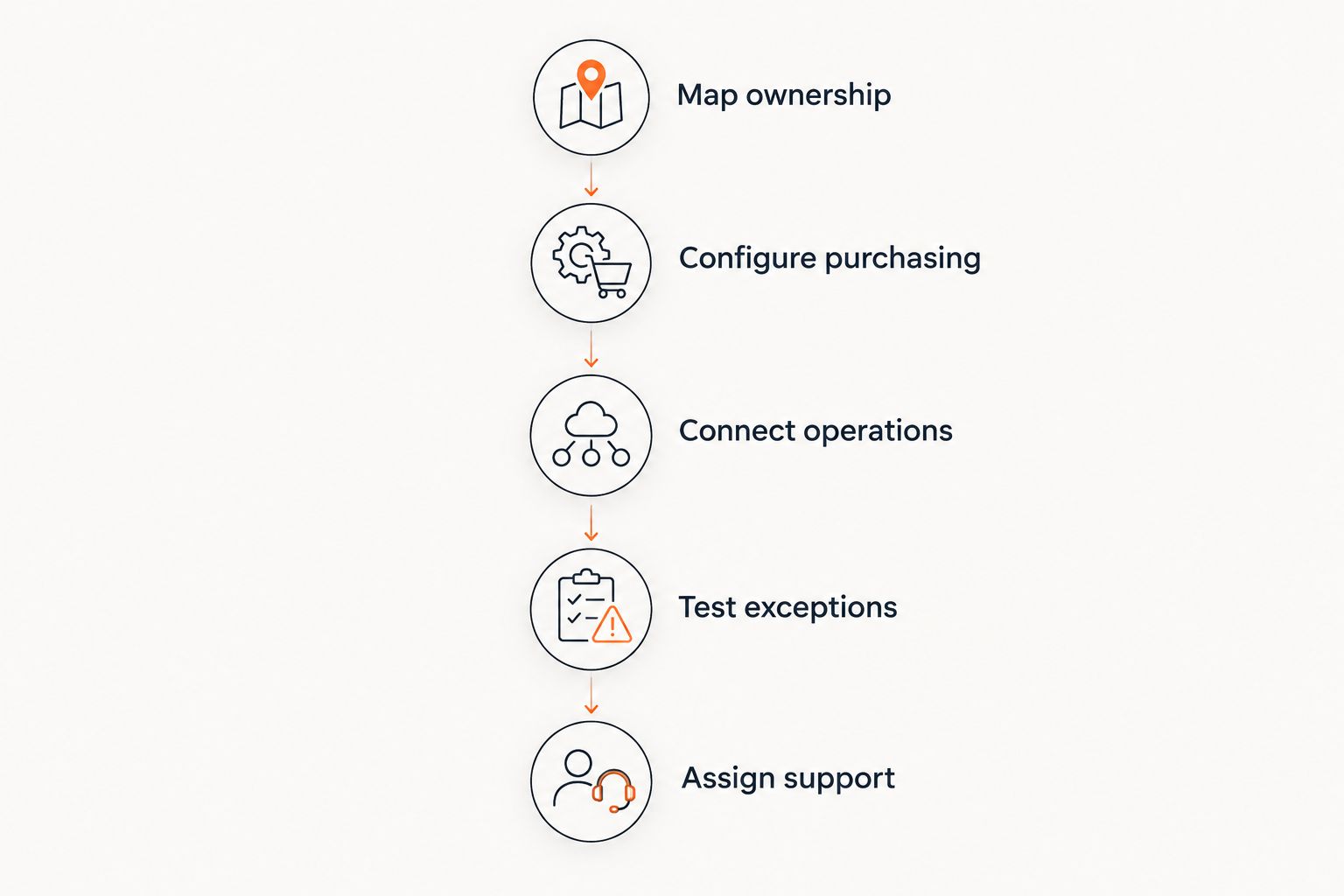 Approve the complete ordering workflow, not just the storefront.
Can retail and wholesale buyers use the same Shopify store?
Yes, Shopify supports a blended B2B and direct-to-consumer store, while a dedicated B2B store separates the wholesale experience. The right structure depends on how much the audiences share and which differences your team must maintain.
| Store structure | Best for | Advantage | Tradeoff |
|---|---|---|---|
| Blended store | Businesses with overlapping retail and wholesale operations | Maintains both buying experiences within one store | Shared configuration needs testing across both audiences |
| Dedicated B2B store | Businesses needing a distinct wholesale experience | Separates wholesale presentation and store configuration | Adds another store environment to maintain and coordinate |
For your 2026 decision, test the hardest customer journey in each structure. If keeping one store requires numerous exceptions, the administrative simplicity of a shared store needs closer examination.
Does an ERP connection replace Shopify's wholesale features?
No. An ERP connection exchanges operational data; it does not automatically provide the buyer-facing account, catalog, and purchasing experience. Shopify and the ERP need clearly divided responsibilities.
For example, your ERP can remain responsible for operational inventory while Shopify presents the buying experience. The integration must define what inventory information Shopify receives and how accepted orders return to the ERP.
What should you require before approving a wholesale launch?
Require evidence that buyers can place valid orders and that staff can complete them without undocumented workarounds. Include account access, purchasing rules, payment handling, inventory exceptions, and downstream order processing in your acceptance criteria.
Ask for a demonstrated recovery procedure, too. Your team should know how to identify a failed handoff, correct its cause, and retry it without creating a duplicate order.
FAQ
Can Shopify handle B2B wholesale orders for my business?
Yes, Shopify can handle B2B wholesale orders through native B2B functionality on Shopify Plus, apps, and custom development. Fit depends on your company accounts, purchasing rules, payment requirements, and operational integrations.
Do I need Shopify Plus to sell wholesale?
Shopify Plus is required for native Shopify B2B functionality. Other wholesale approaches use apps or custom development, whose actual capabilities need separate assessment.
Can wholesale customers have their own catalogs?
Native Shopify B2B supports catalogs associated with company purchasing relationships. Test your intended customer assignments and catalog rules before importing the full customer base.
Can Shopify support wholesale payment terms?
Native Shopify B2B supports payment terms. Your business still needs to define who authorizes those terms and how credit decisions affect order processing.
Can I keep my ERP when I add Shopify wholesale?
Yes, keeping your ERP is an integration design choice rather than a requirement to replace it. Confirm the available interfaces, data ownership, order mapping, and exception-handling process before implementation.
Is a wholesale app better than native Shopify B2B?
A wholesale app is appropriate when its supported functions match a clearly defined requirement. Native Shopify B2B is appropriate when your company-based purchasing requirements fit its supported model; neither choice removes the need for end-to-end testing.
What should Endertech assess before a Shopify wholesale project?
A Shopify wholesale assessment should cover buyer relationships, catalogs, payment controls, inventory, fulfillment, and integration responsibilities. Endertech's ecommerce, custom software, and system integration services are relevant where those requirements cross multiple systems.
One last thing
Test an order change after checkout. A buyer correcting a shipping address or changing a quantity reveals whether your workflow handles updates, not just new orders.
Make the expected behavior explicit: which system accepts the change, who approves it, and how the other systems receive it. That exercise tests the operational boundary that a polished checkout demonstration leaves untouched.