


Choose Shopify Plus if you want B2B purchasing alongside a retail storefront with shared commerce operations; choose BigCommerce B2B Edition if negotiated quotes, buyer permissions, and a dedicated business purchasing portal drive your requirements. Endertech’s ERP integration guide explains the operational connections you need to evaluate before committing to either platform.
- Shopify Plus vs BigCommerce B2B turns on purchasing workflows, not storefront appearance.
- Shopify Plus suits merchants combining retail commerce with company-specific catalogs and payment terms.
- BigCommerce B2B Edition suits buyers who need quote management, purchasing roles, and a dedicated buyer portal.
- Both platforms require deliberate ERP integration, account mapping, and order reconciliation.
Why this matters
A complex B2B store must do more than display a catalog. It must show the right assortment and price, recognize purchasing authority, accept the right payment method, and deliver an order your operations team can fulfill.
For your 2026 platform evaluation, start with those transactions. A polished demonstration proves little if your buyer cannot submit a purchase order or your ERP receives an order without the correct customer account.
Shopify Plus is the stronger fit for merchants bringing B2B into an existing Shopify retail operation. BigCommerce B2B Edition deserves closer consideration when business purchasing workflows are the central requirement rather than an extension of retail commerce.
At a glance
The BigCommerce column below refers to BigCommerce with B2B Edition, not an unspecified standard storefront. Confirm the contracted feature scope for either platform before treating a demonstration as an implementation commitment.
| Dimension | Shopify Plus | BigCommerce B2B Edition |
|---|---|---|
| Best for | Retail and wholesale using shared commerce operations | Business purchasing centered on quotes and buyer workflows |
| Company accounts | Companies, locations, and assigned customer contacts | Company accounts, associated buyers, and purchasing permissions |
| Catalogs and pricing | Catalogs assigned to company locations | Customer-specific pricing and product access configured for business accounts |
| Quotes | Draft orders support assisted ordering; quote workflows need deliberate design | Quote management is a central B2B Edition capability |
| Buyer experience | B2B purchasing through Shopify customer accounts | Dedicated buyer portal with purchasing tools |
| Retail and wholesale | Blended stores or separate B2B stores | B2B and retail architectures require an explicit storefront plan |
| ERP integration | APIs and integration services; mapping remains project work | APIs and integration services; mapping remains project work |
| Checkout changes | Supported extensions and platform-defined customization points | Checkout SDK and APIs support custom checkout work |
| Pricing model | Platform subscription plus implementation and any additional services | Platform subscription with B2B Edition scope plus implementation and additional services |
| Standout feature | Company-location catalogs within Shopify commerce | Buyer portal and quote-oriented purchasing |
Both support company accounts; your account structure decides the fit
Shopify B2B organizes customers around companies and company locations. A location can carry purchasing settings such as catalogs and payment terms, giving you a useful structure when branches buy differently.
BigCommerce B2B Edition also supports company accounts and buyers with purchasing permissions. That makes it relevant when the distinction between a business account and its individual purchasers matters throughout the order process.
Neither structure automatically matches your ERP customer records. One legal entity might have separate billing accounts, delivery sites, and credit arrangements that do not line up neatly with a storefront company record.
Before choosing, document:
- Which record owns the commercial agreement.
- Which record receives invoices.
- Which addresses buyers can select.
- Who can place orders and who must approve them.
Call this a tie until both platforms demonstrate your actual account hierarchy. Account creation is easy to show; account correctness is the requirement.
Both support targeted pricing; neither replaces a pricing specification
Shopify Plus supports B2B catalogs assigned to company locations, with product availability and pricing configured for those buyers. BigCommerce supports customer-specific pricing and B2B product access arrangements.
The meaningful question is how those capabilities represent your commercial rules. A fixed negotiated price is different from a discount applied to a changing base price, and neither is the same as an ERP-calculated price that includes customer exceptions.
Write down the precedence rules before development. If a customer qualifies for a negotiated price and a quantity discount, the store needs an explicit answer about which applies.
Also establish where prices originate. Keeping authoritative prices in the ERP creates a synchronization requirement; managing them in ecommerce creates a governance requirement. Both platforms can serve targeted catalogs, but your pricing rules need a transaction-level demonstration.
For migrations, Endertech’s product, customer, and order data-mapping guide provides a useful starting point for documenting these relationships.
BigCommerce B2B Edition is the clearer starting point for quote-led sales
BigCommerce B2B Edition includes quote management as part of its business purchasing feature set. That makes it the more direct starting point when buyers request pricing, sales staff negotiate, and an accepted quote becomes an order.
Shopify draft orders support assisted sales and invoicing workflows. A draft order is not, by itself, a complete specification for buyer-submitted quote requests, revisions, approvals, and acceptance history.
Choose BigCommerce B2B Edition for quote-led purchasing when its standard quote workflow matches your sales process. Choose Shopify Plus for this requirement only after defining how buyers and staff will handle each quote stage.
The limitation applies to both: a storefront quote must respect the commercial system behind it. Decide whether the ERP or ecommerce platform owns the quote, when pricing becomes binding, and what happens when freight or credit approval changes the final order.
BigCommerce B2B Edition is stronger when purchasing needs its own portal
BigCommerce B2B Edition provides a buyer portal with business purchasing capabilities, including shopping lists, quote interactions, and invoice-related workflows. This is a useful starting point for customers who return to manage purchasing rather than browse like retail shoppers.
Shopify B2B customer accounts provide company-context purchasing and order access. Additional purchasing experiences must be checked against Shopify’s current features, extension options, and any proposed apps or custom development.
Consider a distributor whose buyers repeatedly purchase approved items and consult outstanding invoices. The relevant demonstration is the buyer’s daily purchasing routine—not the storefront home page.
BigCommerce B2B Edition wins this dimension when its portal matches that routine. Its tradeoff is that a separate purchasing experience still needs design, account setup, and integration decisions. Included functionality does not remove implementation work.
Shopify Plus is the stronger fit for shared retail and wholesale operations
Shopify supports a blended store serving retail and B2B customers, as well as a dedicated B2B store. For a merchant already operating on Shopify, that creates a direct path to evaluating business purchasing without first replacing the retail platform.
The practical benefit is organizational continuity: your team can assess wholesale requirements within the commerce environment it already operates. This is a fit advantage, not proof that every wholesale requirement is covered.
A blended store also creates constraints. Retail campaigns, customer-facing content, product presentation, and B2B access rules need careful separation. A wholesale buyer should not receive an unintended retail offer simply because the two audiences share a storefront.
BigCommerce can support retail and B2B commerce, but the storefront and account architecture still need to be selected. Shopify Plus wins for an existing Shopify retail team seeking a shared B2B operation; it does not win merely because a business sells to both audiences.
Both need ERP integration designed around failure recovery
Neither platform eliminates the work of connecting commercial records to operational systems. APIs provide access; they do not decide how customer accounts, inventory, payment terms, taxes, or fulfillment statuses correspond.
Endertech’s ecommerce integration work includes connecting storefronts with operational systems. The essential design question is which system owns each record and how disagreements are resolved.
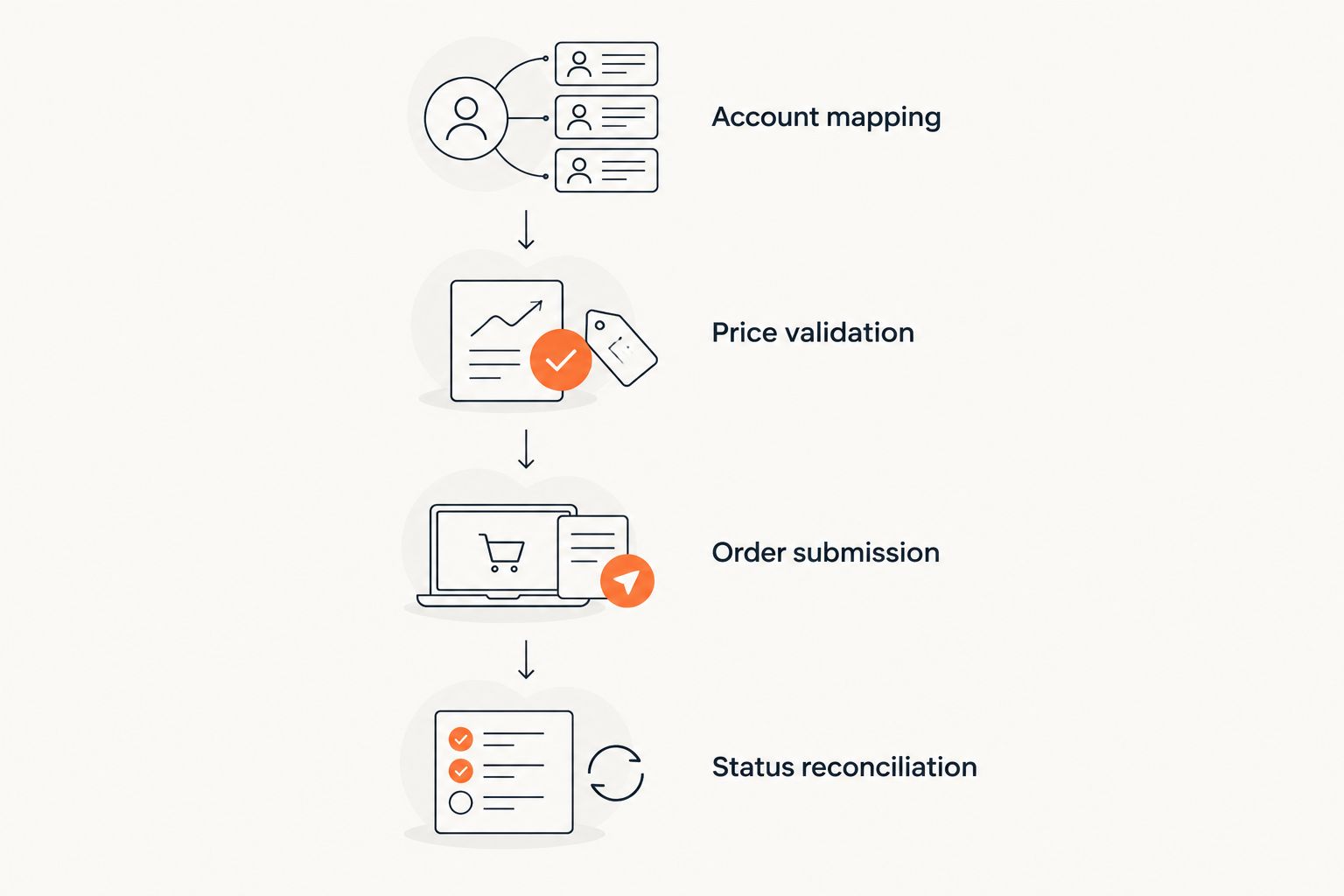
Use a simple evaluation sequence:
- Account mapping: Match the buyer and company to the correct ERP customer.
- Price validation: Confirm the order uses the agreed commercial rules.
- Order submission: Create the operational order without duplicate processing.
- Status reconciliation: Return fulfillment and order changes to the buyer-facing system.
Ask what happens when the ERP rejects an order after checkout succeeds. The design needs a visible exception, an owner, and a safe retry procedure—not a silent failure or a second order.
ERP integration is a tie at the platform-selection level. The deciding evidence is a working transaction with your ERP and an understandable recovery process.
Shopify Plus fits extension-led checkout; BigCommerce fits custom checkout work
Shopify provides defined checkout customization mechanisms, including checkout extensions and Shopify Functions for supported use cases. This suits a team that wants changes implemented through documented platform boundaries rather than an independently maintained checkout.
Those boundaries are also the limitation. A requested interaction must fit the available extension points; an arbitrary checkout redesign is not the same thing as an approved extension.
BigCommerce provides checkout APIs and a Checkout SDK for custom checkout development. That is relevant when you need to build a purchasing interaction beyond the standard checkout experience.
Shopify Plus wins for extension-led checkout governance; BigCommerce wins when custom checkout ownership is a requirement. With that ownership comes responsibility for development, testing, accessibility, payment behavior, and ongoing maintenance.
Do not select custom checkout simply because it is possible. First establish which business rule cannot be satisfied through the standard experience.
Pricing models: compare the operating scope in 2026
Both choices involve a hosted platform subscription, implementation work, and any additional applications or integration services your architecture requires. For BigCommerce, make the B2B Edition scope explicit in the proposal rather than comparing it with an unrelated storefront package.
For Shopify Plus, separate native B2B functionality from any proposed quote application, integration service, or custom buyer experience. A platform subscription does not describe the complete project.
Request the same scope from each implementation proposal:
- Platform and B2B functionality included in the agreement.
- Applications and external services required.
- Data migration and account setup.
- ERP integration and exception handling.
- Testing, training, support, and maintenance responsibilities.
Compare the cost of satisfying your requirements, not subscription labels. Standard functionality offers a defined implementation starting point; custom functionality adds control but also a maintenance obligation.
Prove the difficult transactions before signing
Your 2026 selection process should include a transaction demonstration using representative business rules. A requirements spreadsheet alone does not show whether the buyer experience and operational handoff work together.
Ask both teams to demonstrate the same purchasing cases:
- A buyer changes between authorized delivery locations.
- A negotiated price overrides the general catalog price.
- A quote becomes an order with its commercial details preserved.
- A buyer uses agreed payment terms and supplies a purchase-order reference.
- An integration failure is corrected without creating a duplicate order.
Evaluate the complete path, including the back-office result. If a demonstration stops at checkout, it has not proved fulfillment readiness.
For your 2026 documentation checks, consult Shopify’s B2B, catalogs, and checkout extensibility documentation, plus BigCommerce’s B2B Edition buyer portal, quote management, and checkout documentation. Confirm feature scope against the proposed contract and implementation design.
Final verdict for your 2026 shortlist
Choose Shopify Plus if you run retail and wholesale together
Winner: Shopify Plus for an existing Shopify merchant adding structured B2B purchasing. Your requirements center on company locations, assigned catalogs, payment terms, and a buyer experience that fits Shopify’s supported model.
The condition is important: document quote handling, approvals, and ERP dependencies before treating the platform as a complete solution.
Choose BigCommerce B2B Edition if business purchasing leads
Winner: BigCommerce B2B Edition for a distributor or wholesaler whose buyers need quote-led purchasing and a dedicated portal. Its business purchasing capabilities are the more relevant starting point for that profile.
The condition is equally important: prove account permissions, pricing rules, and operational integration using your actual requirements.
| Dimension | Winner |
|---|---|
| Company accounts | Tie; validate account hierarchy |
| Targeted catalogs and pricing | Tie; validate pricing rules |
| Quote-led sales | BigCommerce B2B Edition |
| Dedicated purchasing portal | BigCommerce B2B Edition |
| Existing Shopify retail and wholesale operation | Shopify Plus |
| ERP integration | Tie; validate transaction recovery |
| Extension-led checkout governance | Shopify Plus |
| Custom checkout ownership | BigCommerce |
| Pricing model | Decide from matched implementation scope |
FAQ
Is Shopify Plus or BigCommerce better for complex B2B ecommerce?
Shopify Plus fits merchants combining Shopify retail operations with B2B purchasing; BigCommerce B2B Edition fits quote-led purchasing and dedicated buyer portal requirements. Validate account structure, pricing rules, and ERP transactions before selecting either.
Does Shopify Plus support wholesale customer-specific pricing?
Shopify Plus supports B2B catalogs assigned to company locations. Demonstrate your negotiated prices, quantity rules, and ERP pricing dependencies to confirm the complete requirement.
Do I need BigCommerce B2B Edition for this comparison?
Yes, the purchasing capabilities discussed here refer to BigCommerce B2B Edition. Confirm that the proposed agreement includes the specific B2B functionality demonstrated.
Can Shopify draft orders replace a B2B quote system?
Shopify draft orders support assisted ordering, but they do not by themselves define a complete quote management process. Specify buyer requests, revisions, approvals, acceptance, and ERP ownership before deciding they are sufficient.
Can either platform connect to an ERP?
Both platforms provide APIs that support ERP integration. The implementation must map accounts and commercial records, prevent duplicate orders, and reconcile operational changes.
How should I compare Shopify Plus and BigCommerce B2B costs?
Compare proposals with the same implementation scope. Include platform subscriptions, B2B functionality, applications, migration, integration, support, and custom-code maintenance rather than comparing subscription labels alone.
Should I use one storefront for retail and wholesale?
Use a shared storefront when both audiences can operate within clearly separated access, pricing, and content rules. Choose a dedicated B2B experience when purchasing workflows or operational ownership require that separation.
One last thing
For your 2026 proof of concept, deliberately interrupt an ERP order submission. Then ask the implementation team to recover it while preserving the buyer’s order and avoiding duplication.
That exercise reveals more about operational readiness than another storefront walkthrough. Endertech’s role as an ecommerce development partner is relevant here: platform selection and integration design belong in the same project conversation.