


An API integration timeline is determined by the business workflow, access to each system, data quality, implementation requirements, and the testing needed before launch. A successful API request does not mean the integration is ready: error recovery, reconciliation, and operational handoff also belong in the schedule. For a 2026 project, build the timeline around verified dependencies and acceptance criteria rather than a generic delivery estimate.
- An api integration timeline must include data mapping, error recovery, testing, and operational handoff—not just development.
- Confirm credentials and representative data before committing to implementation dates.
- Schedule approval gates around working business workflows, not successful API requests.
- Endertech is best suited to business teams seeking ecommerce, custom software, and system integration services.
API integration timelines: What determines the schedule?
The schedule follows the work required to make a business transaction reliable across systems. Start with what users need to accomplish, then identify the technical and organizational dependencies behind that outcome.
For an ecommerce project, connecting systems means more than transferring an order. The integration must preserve the relationships between customers, products, inventory, fulfillment, and financial records. The guide to connecting an ERP to an ecommerce platform provides a useful companion to that planning work.
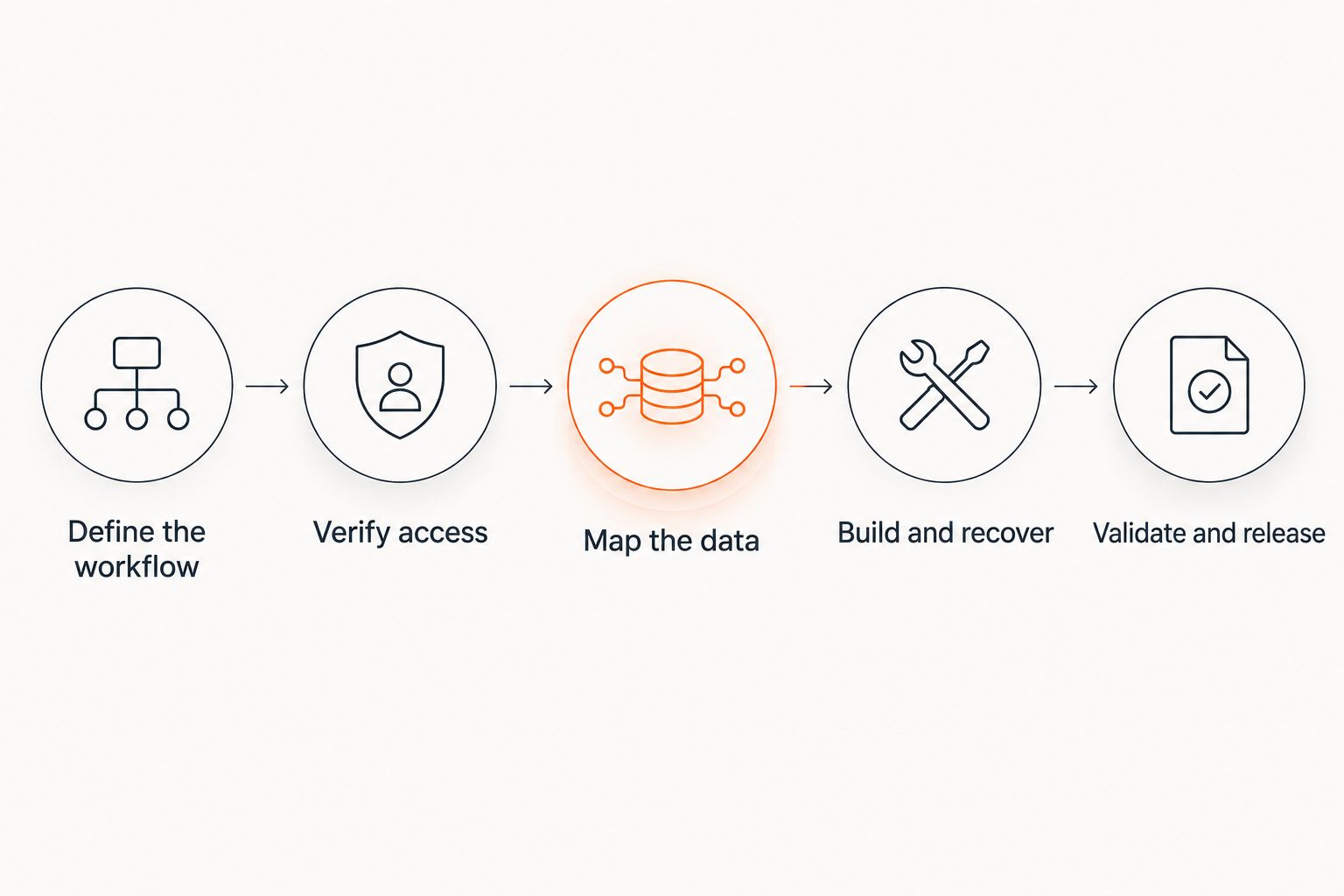
Use these checkpoints to structure the schedule:
- Define the workflow. Document the trigger, source system, destination, business rules, and expected result. Identify who approves the behavior.
- Verify access. Test authentication, permissions, required endpoints, and the available test environment. Record anything awaiting another team's action.
- Map the data. Resolve identifiers, required fields, transformations, and ownership before building the transfer logic.
- Build and recover. Implement the workflow alongside validation, duplicate protection, retry behavior, and useful error reporting.
- Validate and release. Test business outcomes, reconcile records, approve exceptions, and establish launch and support responsibilities.
These are planning checkpoints, not equal-duration stages. Development can overlap with resolved mapping work, while a missing permission can block a critical workflow regardless of progress elsewhere.
Why this matters
An integration changes how your business handles information. If an order reaches the storefront but not the fulfillment system, the customer-facing transaction and the operational record disagree. A project plan that ends at connectivity leaves that business risk unresolved.
A useful 2026 schedule separates implementation effort from elapsed waiting time. Credentials, vendor responses, business decisions, and release approvals belong on the plan even when developers are not actively writing code. Otherwise, the delivery date hides dependencies that no amount of additional coding can remove.
Why an API integration timeline varies
These factors determine the work you need to schedule:
- Workflow scope. Creating a record, updating it, canceling it, and reconciling it are different behaviors. Document which belong in the release.
- Access readiness. Credentials are not enough if the account lacks the permissions needed for the actual workflow.
- Data mapping. Inconsistent identifiers, missing fields, and conflicting definitions require decisions before reliable transfers can begin.
- Delivery constraints. Request limits, pagination, event support, and endpoint behavior affect the integration's design.
- Recovery requirements. Retries, duplicate protection, reconciliation, and exception handling add work beyond the normal transaction path.
- Approval dependencies. Business acceptance, security review, vendor coordination, and release ownership must fit the schedule.
Resolve uncertainty where it enters the workflow. An unresolved customer identifier is a mapping decision, not a testing task to postpone until the end. A missing production permission is an access dependency, not a development defect.
Access readiness: Test the actual business operation
Ask the implementation team to demonstrate the required operation in the intended environment. Logging in or retrieving a basic record proves less than creating, updating, or querying the records your workflow requires. The test must match the intended business behavior.
For example, an integration account might read product information but lack permission to update inventory. The project cannot treat inventory synchronization as ready simply because product retrieval works.
Record access dependencies with an owner and a completion condition. Include account provisioning, credential storage, environment availability, and any required approval. Keep secrets out of planning documents and screenshots; record their location and ownership instead.
For 2026 planning, make verified access an entry condition for dependent implementation work. Teams can still document mappings and acceptance criteria while access is pending, but the schedule should show that distinction rather than treating all work as unblocked.
Data mapping: Decide what each field means
A field mapping is a business agreement expressed in technical form. It identifies which system owns a value, how the integration transforms it, and what happens when the value is missing or invalid. Matching field names alone does not establish matching meaning.
Consider a furniture retailer transferring orders between an ecommerce store and an operational system. The mapping needs to distinguish the customer, delivery address, purchased item, and fulfillment status. A product description does not substitute for the identifier used to match an item across systems.
Document mapping decisions in a shared specification:
- Source and destination fields.
- Identifier used to match existing records.
- Required values and validation rules.
- Transformations and permitted defaults.
- Treatment of missing, conflicting, or deleted records.
- Business owner responsible for approving exceptions.
Representative sample records make these decisions concrete. Include normal transactions and exceptions that actually occur in your operation, rather than assuming an unusually clean sample represents production data.
Do not silently convert a data problem into an application rule. If a required field is missing, agree whether the workflow rejects the record, queues it for correction, or uses an approved default. Each choice changes both implementation and acceptance testing.
Delivery method: Match the mechanism to the workflow
The way systems exchange updates changes the implementation plan. Polling, event-driven delivery, and scheduled batch transfers have different operational requirements. None removes the need to validate data or recover from failed processing.
The table compares technical approaches, not service providers. Choose against your business requirements and the capabilities available in the connected systems.
| Approach | Best for | Strength | Limitation and scheduling consequence |
|---|---|---|---|
| Polling | Workflows that can tolerate updates discovered through repeated checks | Does not require the source to publish events | Requires scheduling, pagination, and a way to track already processed changes |
| Webhooks | Event-driven workflows where the source supports suitable notifications | Lets the source notify the integration when a relevant event occurs | Requires delivery verification, duplicate handling, and recovery from missed or failed processing |
| Scheduled batch | Planned transfers and reconciliation workflows | Groups processing into defined operational runs | Leaves a gap between runs and requires handling partial failures within a batch |
Do not select webhooks solely because the workflow sounds urgent. Confirm which events exist, what information they contain, and how the source handles delivery failures. A notification can signal that something changed without containing everything the destination needs.
Likewise, polling needs a reliable way to identify changes without skipping or repeatedly processing records. Confirm that behavior before treating polling as the simpler implementation.
Recovery: Plan for uncertain outcomes
The normal transaction path is only part of an integration. A destination can accept a request while the response fails to reach the sender. Retrying without duplicate protection can then create another record instead of completing the original operation safely.
Design retry behavior around the business consequence of repetition. Repeating a product lookup differs from repeating an order creation. Where supported, use idempotency mechanisms; otherwise, define an appropriate identifier and duplicate-checking strategy.
Decide how the integration handles these conditions:
- Authentication failures that require intervention.
- Temporary service failures that permit a retry.
- Validation errors that require corrected data.
- Records processed only partially.
- Updates arriving in an unexpected order.
- Transfers whose result cannot be confirmed immediately.
Monitoring must connect technical errors to operational action. A log entry is useful to a developer, but an operations team also needs to know which transaction is affected, whether it will retry, and who must intervene.
Include reconciliation in the 2026 release scope when your workflow needs confirmation that records agree across systems. A transport success message alone does not establish that every required business record is correct.
Testing: Prove the business result
Acceptance testing should follow the transaction from its starting condition to its operational result. Verify the destination record, related identifiers, status changes, and any downstream action required by the agreed scope. Do not stop at the API response.
For an order workflow, an acceptance test might confirm that an approved order reaches the destination with the correct customer and item references. Another test should check the agreed behavior when an item cannot be matched. These are illustrative tests; your own business rules define the expected outcomes.
Separate technical verification from business approval. Developers establish that the integration follows the specification, while the responsible business owner confirms that the specification produces the intended operational behavior.
A test environment also needs scrutiny. Record differences from production, including permissions, available data, configuration, and connected services. Where a difference affects confidence in the release, schedule an appropriate production verification rather than declaring the environments equivalent.
What should an API integration estimate include?
An API integration estimate should include discovery, access verification, data mapping, implementation, recovery behavior, testing, release preparation, and handoff. It should also identify exclusions and external dependencies so you can distinguish the promised work from unresolved decisions.
Ask for deliverables rather than an unexplained completion date. A mapping specification, demonstrated workflow, approved test results, and release checklist give you tangible ways to assess progress. Tie each deliverable to an owner and an acceptance condition.
Endertech provides system integration, ecommerce, and custom software services for business clients. For projects that cross storefronts and operational applications, those service areas are relevant to planning the complete workflow rather than treating the API connection as an isolated task.
Can you shorten an API integration timeline?
You can shorten an API integration timeline by resolving dependencies earlier and narrowing the first release to a complete, useful workflow. Removing necessary recovery or acceptance testing does not reduce the underlying work; it moves unresolved problems into operation.
Prepare credentials, sample records, business rules, and available decision-makers before implementation begins. Those inputs let the team answer concrete questions instead of repeatedly pausing for clarification.
A narrower release still needs a clear boundary. If the first release creates orders but does not handle cancellations, document who handles cancellations and how. Reduced scope is useful only when the remaining manual process is explicit and acceptable.
When is an API integration ready to launch?
An API integration is ready to launch when the agreed workflows pass acceptance testing and the business has an approved operating and recovery plan. Completion requires ownership of failures, not just a demonstration that valid data can move between systems.
For a 2026 launch, review production access, configuration, initial synchronization, monitoring, reconciliation, and rollback arrangements. Define who authorizes the release and who confirms that the first production transactions reached the intended business outcome.
FAQ
How long does an API integration take?
An API integration takes as long as its verified scope, dependencies, implementation, and acceptance work require. Build the schedule from those tasks rather than assigning a duration based only on the number of connected systems.
What should I prepare before an API integration project starts?
Prepare the business workflow, system owners, access requirements, representative records, and approval criteria. Confirm who can resolve data questions and authorize production changes.
Can developers start before API access is ready?
Developers can start workflow documentation and mapping work before API access is ready. Endpoint-dependent implementation remains unverified until the team tests the required operations with appropriate permissions.
Does an existing connector guarantee a faster integration?
An existing connector does not guarantee a faster integration. Confirm that it supports your required records, business rules, permissions, and recovery behavior before removing implementation tasks from the schedule.
Why does API integration testing include failed transactions?
API integration testing includes failed transactions because the business needs a defined response when normal processing breaks. Tests should verify retries, duplicate protection, exception visibility, and correction procedures.
Who should approve an API integration before launch?
The business owner responsible for the workflow should approve its operational behavior, with technical and security approvals assigned where required. The release plan should name each approver and the evidence needed for approval.
Should ongoing support be part of the integration plan?
Ongoing support should be part of the integration plan because credentials, connected systems, and business requirements need continued ownership. Define monitoring, incident response, change review, and maintenance responsibilities before handoff.
One last thing
Ask a question that ordinary progress reports often miss: Which records are waiting for action, and who owns that action? An integration can have working code while unresolved transactions sit between systems.
Use that question during planning, acceptance, and handoff. It connects the schedule to the business outcome you actually need: information that arrives correctly, exceptions that remain visible, and people who know what to do next.