


TLDR
- Since October 27, 2026, the Catalog API beta has a sources setting that can return products from brands that don't sell on Shopify in the same ranked list as Shopify merchants, for US shoppers only.
- External offers are indexed from brands' own websites. Shopify doesn't verify them, prices are last-seen snapshots, stock isn't tracked, and checkout always happens on the brand's site.
- The same day, Promoted Placements added Shop Campaigns: developers earn extra commission on products from merchants who fund it, and those clicks land in Shop.
- Open question: why would Shopify index merchants who don't sell on Shopify, and is that good or bad for the merchants who do?
- Merchants should confirm Catalog eligibility in the new admin view, give the index complete product data, and keep stock and prices accurate. Then publish knowledge base facts, build reviews, check Shop Promise eligibility and measure utm_medium=catalog traffic.
Whoever runs the product index an AI agent searches gets a quiet say in who gets found. In classic search that was Google. In marketplaces it was the marketplace. In agent shopping, one of the biggest indexes belongs to Shopify, and until late October it had a clear boundary: Shopify Catalog listed products from stores on Shopify.
On October 27, 2026, Shopify moved that boundary. A new beta setting on the Catalog API lets an agent or app ask for products from brands that don't sell on Shopify, ranked in the same list as Shopify merchants. Those outside products can't be bought through Shopify checkout. The shopper is sent to the brand's own site. The same day, Shopify announced that its Promoted Placements beta now includes Shop Campaigns, so merchants who already pay for Shop Campaigns can fund a higher commission on results that come back from the Catalog API.
Put the two together and Shopify's Catalog starts to look less like a directory of its merchants and more like a general product search index for agents, with a paid layer on top. This post covers how it works, what's documented and what isn't, one question I can't answer yet, and what merchants can do now. It builds on our earlier posts on what happens when an AI assistant handles checkout and what structured data does for AI search. A day after those changes, Shopify's Fall '26 Edition added merchant tools that affect how you get into the Catalog and how you're found there. We've folded those into the merchant steps below.
What Shopify shipped on October 27
From the changelog entry and the Global Catalog extension docs:
search_catalogtakes a newsourcessetting. Leave it out (or send["shopify"]) and nothing changes. Send["shopify", "external"]for one ranked list across both, or["external"]for outside brands only.Outside products are called external offers. Shopify describes them as products indexed from a merchant's own website rather than published through Shopify.
External offers never support Shopify checkout (
eligible.native_checkoutis alwaysfalse), and they never earn Promoted Placements commission.During the beta, external offers only come back for shoppers in the United States. Everyone else still sees Shopify merchants only.
get_productresolves an external product ID today. The changelog sayslookup_catalogsupport is coming later.The setting needs API version
2026-08-25ordraftand an API client Shopify has enabled. For any other client, the docs saysourcesis ignored.
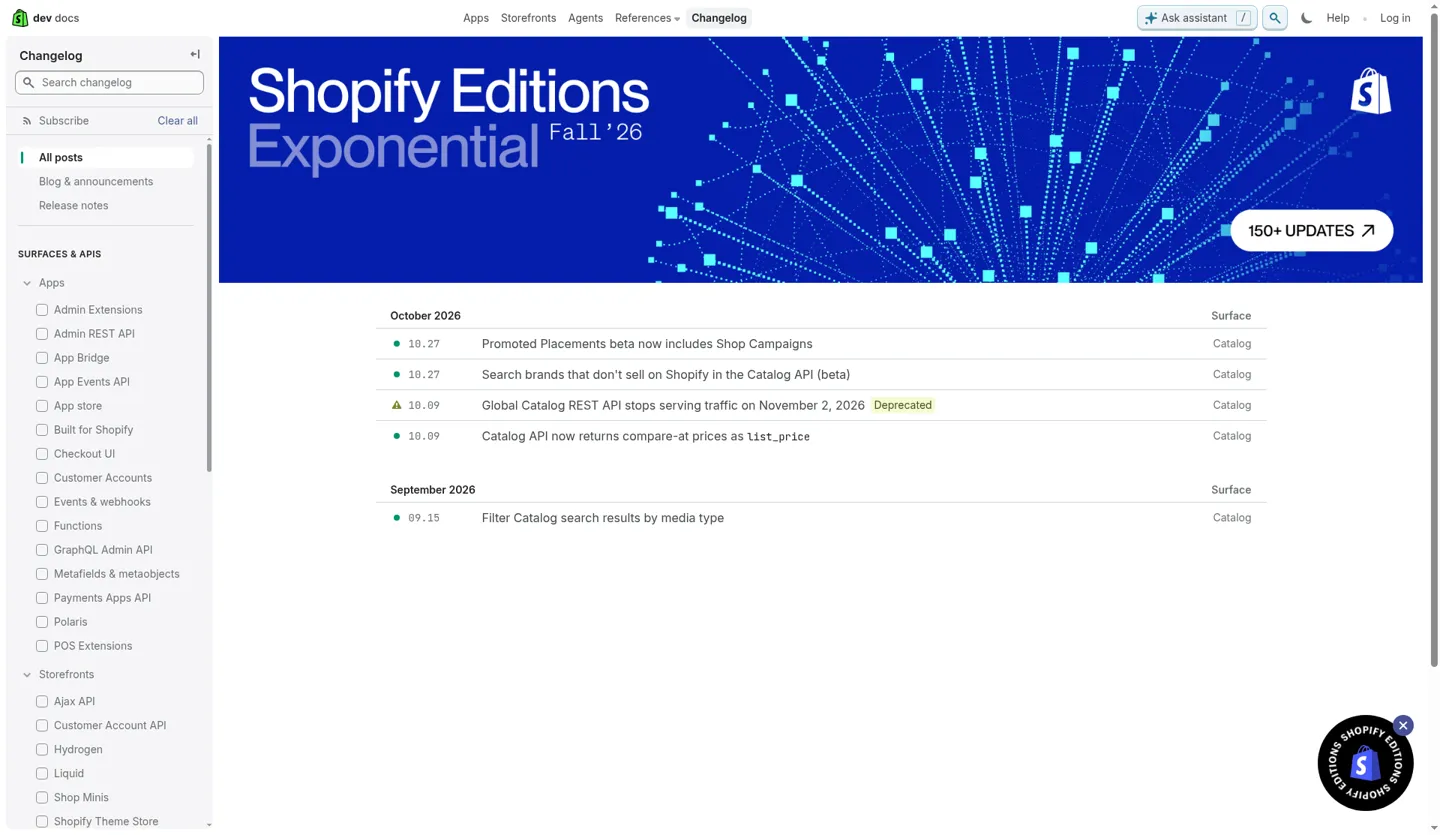
Shopify.dev changelog, Oct 27: Catalog API search for brands that don't sell on Shopify (beta).
How the Catalog API works
The Catalog API is Shopify's implementation of the Universal Commerce Protocol (UCP) catalog capability, exposed as an MCP server. There are two flavors, described in About Catalogs: Global Catalog, which searches across merchants at catalog.shopify.com/api/ucp/mcp, and Storefront Catalog, scoped to a single store. Neither needs an API key. Every request carries an agent profile URL that declares which capabilities the agent supports.
The Global Catalog reference describes a two-step flow. An agent discovers products with search_catalog (text, an image, or a similar-product reference) or lookup_catalog (known IDs), then evaluates one with get_product to pick options and get the seller's link. Results are grouped by a Universal Product ID, so the same product sold by several stores can come back as one product with several offers.
The filters tell you a lot about what Shopify thinks matters to an agent: availability (on by default, so unavailable items are dropped), condition, ships-to and ships-from country, taxonomy category, a small set of attributes (Color, Size, Target gender), minimum review rating and review count, relative price tier within a category, and whether the product has images, video or 3D models. Shopify also adds inferred fields, including enriched descriptions, top features, unique selling points and technical specs, and labels them as inferred because they're generated rather than written by the merchant.
Who calls this API? AI agents and assistants, and also apps that use it to power on-site search or recommendations, which is the audience Shopify names in the changelog. On the merchant side, Shopify's agentic storefronts docs say agentic storefronts such as ChatGPT and Microsoft Copilot find products through Shopify Catalog.
How products from outside Shopify get into results
This is the part the docs say the least about. Here's what's documented:
External product data comes from each brand's website. Shopify indexes it; the brand doesn't publish it through Shopify.
Shopify says it doesn't verify external product data and provides it as is.
Prices are what Shopify saw on the brand's page at the last refresh. The docs call them indicative and say the merchant's page is authoritative.
Stock isn't tracked. An external offer shows as available whenever it's listed, so agents are told to confirm availability on the brand's page.
Descriptions come through as plain text, images are cached copies of the brand's images, and store policy links might be missing.
Brands and rights holders can ask for a product, image or domain to be removed through the Shopify Help Center.
What isn't documented: how Shopify finds and reads those pages, which on-page signals it uses, how often it refreshes them, whether a brand can ask to be included, and how external offers are ranked against Shopify merchants in a mixed list. I'd expect clean product pages with accurate structured data to be read more reliably than messy ones, but that's my inference from how indexing generally works, not something Shopify has said.
Where the shopper ends up
The checkout handoff is where this gets practical. Depending on the product, a click from the Catalog API can now land in three different places:
A brand that doesn't sell on Shopify: the brand's own product page, through the variant
url. There's nocheckout_url. Shopify's usage rules forbid apps from building carts, checkouts or payment flows for these offers, or presenting Shop Pay as available.A Shopify merchant: the merchant's product page or cart. In our test, every result's links pointed at the merchant's own domain and carried
utm_source=shopifyandutm_medium=catalog.A Shopify merchant funding commission through Shop Campaigns: Shop. The Promoted Placements docs say those variant links point to shop.com instead of the merchant's online store, and the higher commission is paid only when the buyer completes the purchase in Shop.
The usage rules for external offers are strict. Apps have to link every external offer to the brand's page, show the seller's name, label mixed results so shoppers can tell sources apart, never imply Shopify endorses the brand, never reassemble the brand's product page from the fields, never keep the data past the shopper's session, and never use it to train or evaluate models. As written, the rules keep the listing, the traffic and the sale with the brand.
What we saw when we called it
On October 27, 2026, I called Global Catalog search_catalog directly for "linen throw pillow" with a US shopper context, using Shopify's hosted example agent profile and no special access. I ran it three times: without sources, with ["shopify", "external"], and with ["external"].
All three runs came back with Shopify merchants only. None of the variants had a source field, and there was no message saying the setting was ignored. Even ["external"] quietly returned Shopify merchants. That matches the docs: without an enabled client, sources doesn't apply. The practical takeaway is that you can't currently check from the outside whether your brand shows up as an external offer. You need an enabled client, or a partner who has one.
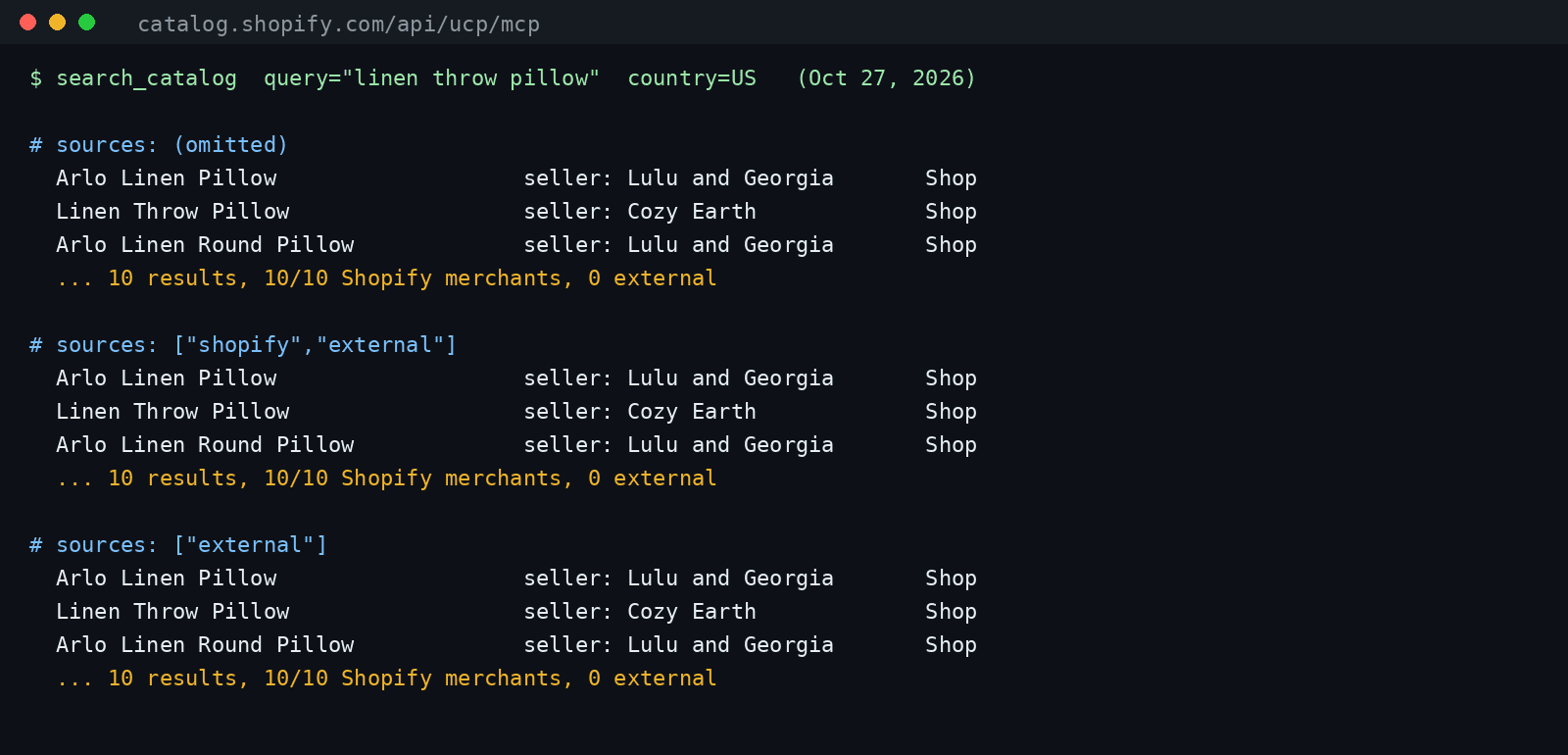
Our October 27 calls: with sources omitted, both, or external only, all 10 results came from Shopify merchants.
We also have hands-on context on the search side. We've built conversational product discovery on top of Shopify with our own retrieval layer, and the lesson from that work applies here: the agent can only reason about what's in the index. If an attribute lives only in a metafield the index doesn't read, it might as well not exist. If you're weighing whether to build on Shopify's Catalog or run your own index for conversational search, that tradeoff is now more interesting, because Shopify's index can reach beyond your own store and beyond Shopify.
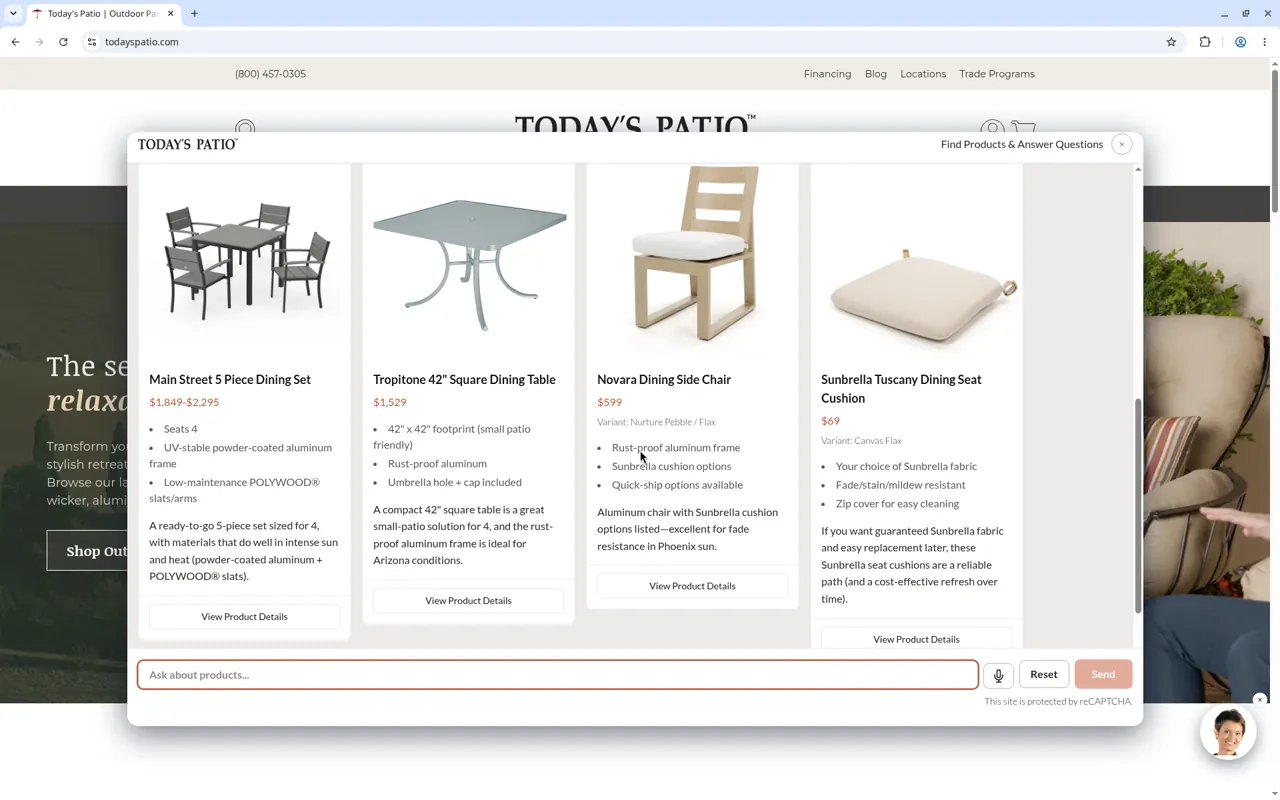
Pat on Today's Patio: product cards render from the store's own structured catalog, the same kind of data Shopify Catalog indexes.
The paid layer: Promoted Placements and Shop Campaigns
Promoted Placements pays the developer of the agent or app, not the merchant. Per the Promoted Placements docs, currently invite-led with rates that might change:
Developers who join and turn on Earn commission for a saved catalog get a base rate of 0.3% on attributed purchases of eligible products.
Merchants running Shop Campaigns with "other platforms" turned on now count the Catalog API as one of those platforms. Shopify converts their campaign settings into extra commission on top of the base rate. That extra applies only to products in an active US campaign, in USD.
Attribution is last non-direct click with a 7-day window, and every eligible item in the order earns commission, not only the one clicked.
For enrolled catalogs, Shopify's server-side configuration decides whether to blend promoted placements into the ranked results. Developers have to label promoted results and disclose that they may earn a commission.
External offers are never promoted and never earn commission.
On the merchant side, Shop Campaigns is pay-per-acquisition. You set a daily budget and an average customer acquisition cost, and Shopify says a higher acquisition cost ranks your offer higher in the list of offers shown to customers. Reach also depends on an ad recommendation status built from your order history: fulfilling within 96 hours, tracking on orders, delivery within 10 days, low refund and cancellation rates, and your review rating on Shop. Opting into other platforms is all or nothing, covering Bing, ChatGPT, Google, Meta, Microsoft Monetize, Pinterest, Snapchat and X as well as the Catalog API. Shopify's billing page also notes that acquisition costs aren't refunded if an attributed order is later canceled or refunded.
What I couldn't find: any statement that merchant-funded commission moves a product higher in Catalog API results. The docs say a developer earns more on those products and that Shopify decides how promoted placements are blended in. Whether a well-paid placement beats a better organic match is not documented.
The open question: why would Shopify promote merchants who don't sell on Shopify?
I don't have an answer to this yet, and I don't think the docs give one. These are the questions I keep coming back to:
What does Shopify gain? Is the point a more complete catalog, so agent builders pick Shopify's index over a general web search? Is it a path to bring those brands onto Shopify later, when Shopify already offers an Agentic plan for businesses without a Shopify online store? Or is the value in becoming the default product index for agents, whoever's checkout the sale ends up in?
Is it to the detriment of Shopify merchants? A merchant pays for a Shopify plan and keeps product data clean in Shopify. An external brand pays nothing and can show up in the same ranked list. Does that shrink the advantage of being on Shopify, or does it barely matter next to the extra agent traffic a more complete index might attract?
Who do the incentives favor? Developers earn commission only on Shopify merchants, and only Shopify merchants can fund extra commission. That could tilt apps toward Shopify products. It could also mean merchants feel pressure to pay just to stay visible next to a growing pool of outside products.
What happens to the data? External offers can't be redistributed or used for training, and Shopify can drop them on request. How much a brand outside Shopify can see or control about how it's represented isn't spelled out beyond the removal route.
I'd like to hear how other merchants and partners read this. If you have a view, or data from your own store, tell us.
What merchants can do now
None of this requires waiting for the beta to finish. Most of it is the same work that helps every agent channel.
1. Make sure you're in Shopify Catalog at all
Inclusion is automatic if you meet the requirements: Starter plan or higher, not in private mode, products with a title, at least one image and a price above zero, published to the Online Store, Hydrogen or Headless channels with an identifiable product URL, and not Unlisted or hidden from search engines. Check Sales channels > Agentic > Sources > Shopify Catalog in your admin. It shows how many products are included or why the store is ineligible. If you run a Hydrogen storefront or another headless build, Shopify requires its expected route format for product URLs, which is worth confirming rather than assuming.
Shopify's Fall '26 Edition, announced October 28, adds a Catalog eligibility view to the admin. It shows whether your store qualifies and links to the fix for anything in the way. If your store is ineligible, start there. None of the steps below help in Catalog-powered channels until the store qualifies. Shopify does note that AI channels might still find your products through ordinary web crawling.
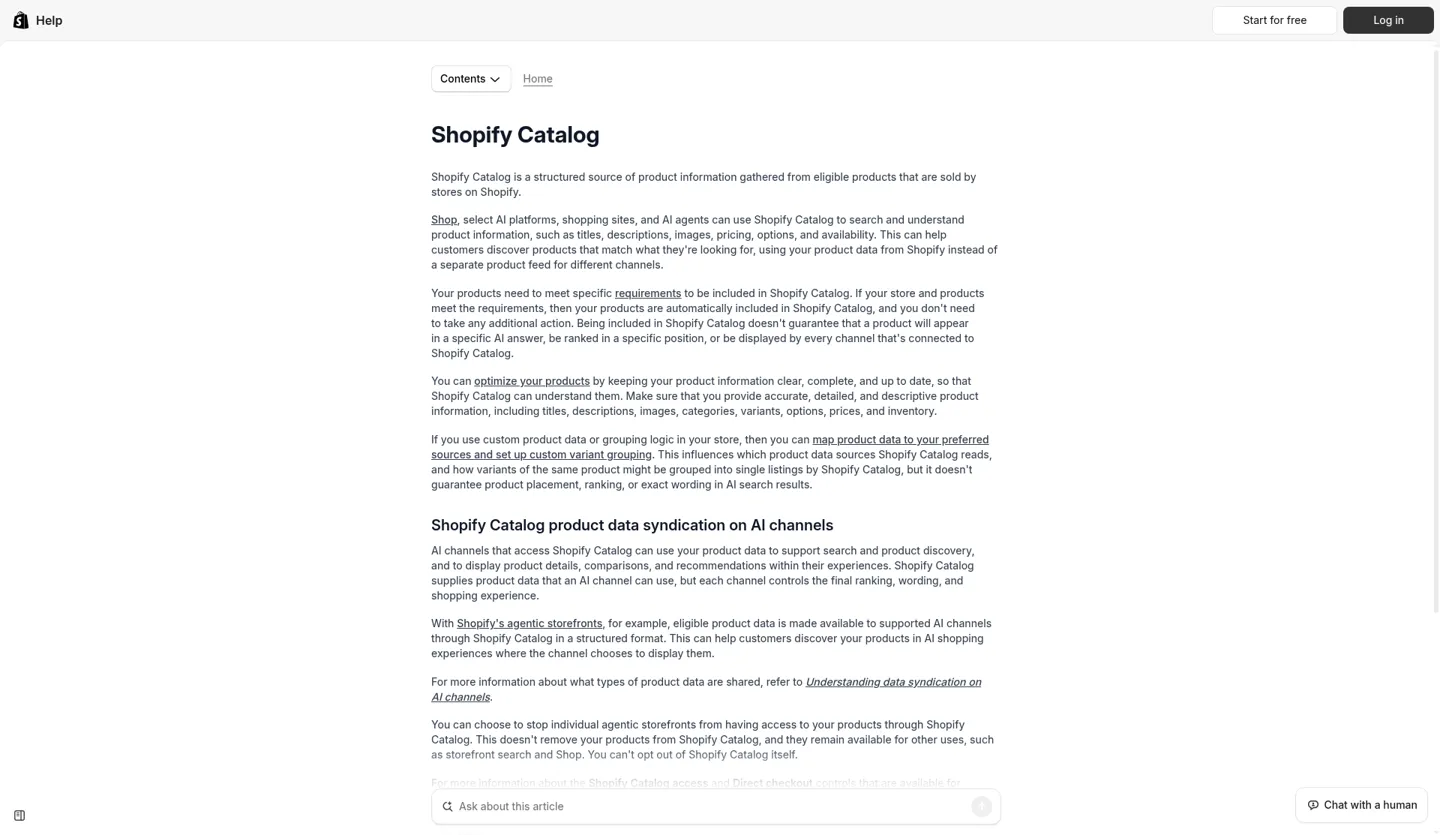
Shopify's Catalog help overview: the product surface these API calls search.
2. Give the index data it can match on
Shopify's optimization guidance lists the fields AI platforms consider: title, description, images, type, vendor, collections, tags, barcodes such as GTIN and UPC, and variants with clear option names. Map those to what the Catalog API filters on. Assign accurate standard taxonomy categories. Use the standard Color and Size options where they apply. Add video or 3D media for products where shoppers need it. If your real product data lives in metafields or metaobjects, use Shopify Catalog Mapping so the Catalog reads the right source. Our post on preparing a product catalog for AI shopping goes deeper on writing descriptions agents can use.
3. Keep availability and price honest
Search filters to sale-ready items by default, so out-of-stock variants simply drop out. Keep inventory in Shopify accurate. Decide whether to share compare-at prices; if you do, agents can show a strikethrough price. This is also one of the few places Shopify merchants have a structural edge over external offers today: your stock and price come from live Shopify data, while an external offer's price is a last-seen snapshot and its stock isn't tracked.
4. Build up reviews and publish your store facts
Agents can filter on minimum rating and review count, and Shop Campaigns reach depends partly on your Shop review rating. Complete your refund, shipping and privacy policies and the agentic storefronts knowledge base, so agents can answer questions about your store from what you wrote. Shopify's optimization guidance covers both.
The knowledge base now has its own page in the admin, at Sales channels > Agentic > Knowledge base. Shopify drafts facts from your storefront, such as return windows, shipping destinations and gift services, and suggests updates for you to review. Nothing Shopify drafts reaches an agent until you publish it. Facts tied to your admin, like store policies and contact details, are published when Shopify creates them. Agents that support Ask, a draft UCP capability, can call ask_business on your store and get answers built from your published facts and policies. An accurate draft you never published does nothing for you, so review the drafts, correct them and publish. Coming from the old Knowledge Base app with more than 1,000 facts? Shopify says to add back the ones you want before the app goes away on January 15, 2027.
5. Check whether Shop Promise applies to you
Shop Promise is a free Shopify program for US stores. It puts a badge on qualifying products, on product pages, at checkout and in the Shop app, naming benefits like trusted delivery and returns. In the Fall '26 Edition, Shopify says merchant eligibility has grown 20x. It also says badged products can rank higher in Shop app search and in the Shopify Catalog data that shopping agents use. It's rare for Shopify to name a Catalog ranking signal, so this one is worth checking.
To qualify, a store needs an active Shopify plan, a US location that fulfills US orders and Shop Pay turned on. It also needs tracking on at least 90% of eligible orders and good account standing. Shopify reassesses eligibility daily and shows your status on the Shop Promise card in your shipping and delivery settings. Once it's on, each product earns benefits separately. Trusted delivery depends on how fast orders in that product's category reach the carrier, and returns benefits depend on your return rules. Shopify is rolling the updated program out gradually and doesn't say how much weight the badge carries. If you checked before and didn't qualify, check again.
6. Decide on Shop Campaigns with eyes open
If you already run Shop Campaigns with other platforms on, the Catalog API is now included. If you're considering it, set a bounded budget, watch the ad recommendation status, and remember that funded clicks go to Shop rather than your own site and that acquisition costs aren't refunded on returns. In my view it's a test to run with a clear stop rule, not a default.
7. Measure the channel
Catalog links to Shopify merchants carry utm_source=shopify and utm_medium=catalog, so you can report on Catalog traffic in your analytics today. Set up that segment now, so you have a baseline before external offers reach more agents.
If you sell outside Shopify
Your products may already be eligible to appear as external offers, read from your website. You can't buy promotion, and agents won't check out for you; the shopper comes to your site. Keep product pages accurate and readable, and use the Help Center removal route if you'd rather not be included. If the bigger question is whether to move platforms, that's a business decision with real cost and risk, and it's the kind of ecommerce platform migration decision we help teams think through.
How we know
This post is based on Shopify's October 27, 2026 changelog entries, the Catalog API and Promoted Placements developer docs, and Shopify Help Center pages on Shopify Catalog and Shop Campaigns, all read on October 27, 2026. The test results are from our own calls to the Global Catalog endpoint that day. Our view of search and indexing comes from building conversational product discovery for Shopify stores. The Fall '26 additions come from Shopify's October 28, 2026 Fall '26 Edition announcement and the related Help Center and developer docs, read on October 29, 2026.
Limits
Both features are in beta or preview. Shopify says fields, behavior and commission rates can change. We didn't have an enabled client, so we couldn't see external offers ourselves, and we have no data on how Shopify ranks mixed results or how much traffic either feature drives. Nothing here is a promise that any step will move a product up in results; Shopify says inclusion doesn't guarantee placement and that each channel controls its own ranking.
Last reviewed: October 29, 2026.
Sources
Search brands that don't sell on Shopify in the Catalog API (beta), Shopify changelog, October 27, 2026 (accessed October 27, 2026).
Promoted Placements beta now includes Shop Campaigns, Shopify changelog, October 27, 2026 (accessed October 27, 2026).
Global Catalog extension: Catalog sources, Shopify developer docs (accessed October 27, 2026).
Global Catalog MCP, Shopify developer docs (accessed October 27, 2026).
About Catalogs, Shopify developer docs (accessed October 27, 2026).
Earn with promoted placements, Shopify developer docs (accessed October 27, 2026).
UCP catalog specification (2026-08-25), Universal Commerce Protocol (accessed October 27, 2026).
Shopify Catalog, Shopify Help Center (accessed October 27, 2026).
Requirements for being included in Shopify Catalog, Shopify Help Center (accessed October 27, 2026).
Optimizing your products for AI platforms, Shopify Help Center (accessed October 27, 2026).
Shopify Catalog and product discovery for agentic storefronts, Shopify Help Center (accessed October 27, 2026).
Setting up agentic storefronts for stores on the Agentic plan, Shopify Help Center (accessed October 27, 2026).
Understanding Shop Campaigns, Shopify Help Center (accessed October 27, 2026).
Paying for Shop Campaigns, Shopify Help Center (accessed October 27, 2026).
Exponential: Shopify's Fall '26 Edition, Shopify News, October 28, 2026 (accessed October 29, 2026).
Knowledge base is now built into your admin, Shopify changelog, October 26, 2026 (accessed October 29, 2026).
Answering customer questions with your knowledge base, Shopify Help Center (accessed October 29, 2026).
Ask MCP, Shopify developer docs (accessed October 29, 2026).
Shop Promise, Shopify Help Center (accessed October 29, 2026).
Eligibility for Shop Promise, Shopify Help Center (accessed October 29, 2026).
Thinking about agent search for your store?
Whether you're tuning product data for Shopify Catalog or deciding if your own conversational search should sit on Shopify's index or your own, we're glad to help you work through it as a partner. Talk to us.
Frequently asked questions
What is the sources setting in Shopify's Catalog API?
It's a beta option on search_catalog that chooses which products come back: Shopify merchants only (the default), brands that don't sell on Shopify only, or both in one ranked list. It needs API version 2026-08-25 or draft and an API client Shopify has enabled; other clients have it ignored.
Can shoppers buy external products through Shopify checkout?
No. External offers always return native_checkout: false and have no checkout URL. Shopify's usage rules say apps must send the shopper to the brand's own product page to buy.
How does a brand that doesn't sell on Shopify end up in results?
Shopify indexes product data from the brand's own website. The docs don't describe how pages are found or how often they're refreshed. Brands can request removal of products, images or domains through the Shopify Help Center.
Does paying for Shop Campaigns move my products higher in Catalog API results?
Shopify's docs don't say that. Merchant-funded commission increases what an enrolled developer earns on your products, and Shopify decides how promoted placements are blended into results. Within Shop Campaigns itself, Shopify says a higher acquisition cost ranks your offer higher in the list of offers shown to customers.
How do I check whether my store is in Shopify Catalog?
In your Shopify admin, go to Sales channels > Agentic and look at Sources > Shopify Catalog. It shows the number of included products or the reason your store isn't eligible. Shopify's Fall '26 Edition also adds an admin view for Catalog eligibility that links to fixes for anything blocking your store.
What do AI agents learn about my store from the knowledge base?
The facts you've published at Sales channels > Agentic > Knowledge base, such as return windows, shipping destinations and gift services. Shopify drafts facts from your storefront, but nothing it drafts reaches an agent until you publish it. Facts tied to your admin, like store policies and contact details, are published when Shopify creates them. Shopify's Help Center covers the details.
Does Shop Promise affect ranking in Shopify Catalog?
Shopify says products with the Shop Promise badge can rank higher in Shop app search and in the Shopify Catalog data shopping agents use. It doesn't say how much weight the badge carries. Shop Promise is free for eligible US stores, and Shopify says merchant eligibility has grown 20x. Check your status on the Shop Promise card in your shipping and delivery settings.