


TLDR
- After Shopify Fall '26, whether AI checkout keeps your customizations depends on whose checkout the buyer finishes in.
- Hosted direct checkout in Microsoft Copilot and Google AI Mode and Gemini still skips most checkout UI customizations: upsells, add-ons, local delivery and pickup, client-side validation.
- Browser agents using Shopify's new WebMCP tools work on your own checkout with its validation, and hand extension steps back to the buyer.
- Server-side Functions, automatic discounts and discount codes carry over on every path. ChatGPT sends buyers to your own checkout.
- Audit every customization, move critical rules to the server, review your agent knowledge base, then decide direct checkout per channel.
Whether an AI checkout keeps your checkout customizations now depends on where the order completes. Shopify's Fall '26 Edition, announced October 28, 2026, put agent tools on every Liquid and Hydrogen storefront and checkout. Browser agents that use those tools work inside your own checkout, with its validation, and hand the buyer back for anything an extension needs.
Direct checkout hosted inside Microsoft Copilot and Google AI Mode and Gemini still works the other way. Shopify loads only the checkout blocks essential to finishing the sale, so most of what you added to your checkout isn't there. The upsells, shipping rules, validations and tracking drop out. The order still goes through. The rules just stop being enforced.
So the risk we described when this post first ran on October 26 is still real. It's narrower now, and easier to locate. Below are the AI checkout paths a Shopify merchant faces after Fall '26. For each, we cover what it keeps, what it drops and what to audit.
The AI checkout paths after Fall '26
The question that matters for customizations is simple: whose checkout does the buyer finish in? Four paths cover most Shopify stores today.
Hosted direct checkout in Copilot and Google. The buyer pays inside the assistant, in a checkout Shopify powers for that channel. It's on by default for eligible stores. Google's version is still rolling out to buyers in the US, Canada and Australia, and Fall '26 made it a headline feature. This is the path that drops most checkout customizations.
Browser agents using WebMCP. Shopify now registers WebMCP tools on every Liquid storefront and checkout, and on Hydrogen 2026-10 storefronts that load Shopify's scripts. An agent in the buyer's browser can search, build the cart, fill in checkout and place the order once the buyer approves. It works on your checkout page and uses that checkout's own validation.
Agents that call Shopify's checkout tools from a server. This covers apps built on Shop.dev and agents using the shop.md skill. Shopify's docs say the merchant always stays the merchant of record. When a checkout needs buyer input or review the API can't collect, the agent has to send the buyer to your prefilled checkout.
Universal Checkout. One checkout for carts from several merchants. It's live in the Shop app and in early access for partners. Shopify says it "still respects every merchant's extensions and validations," and carts that can't be combined fall back to each merchant's own checkout.
ChatGPT sits with the stores' own checkouts. Shopify's ChatGPT page says buyers there complete the purchase on your online store checkout, so "all your customizations, branding, selling strategies, and payment methods are supported." OpenAI moved that way in a March 2026 announcement, saying its first Instant Checkout "did not offer the level of flexibility that we aspire to provide."
Fall '26 also put Shop Pay inside personal agents, starting with Muse from Meta, Claude Duet and Instinct. We haven't found Shopify documentation on which checkout blocks load there. Until it exists, plan for those the way you plan for the hosted channels.
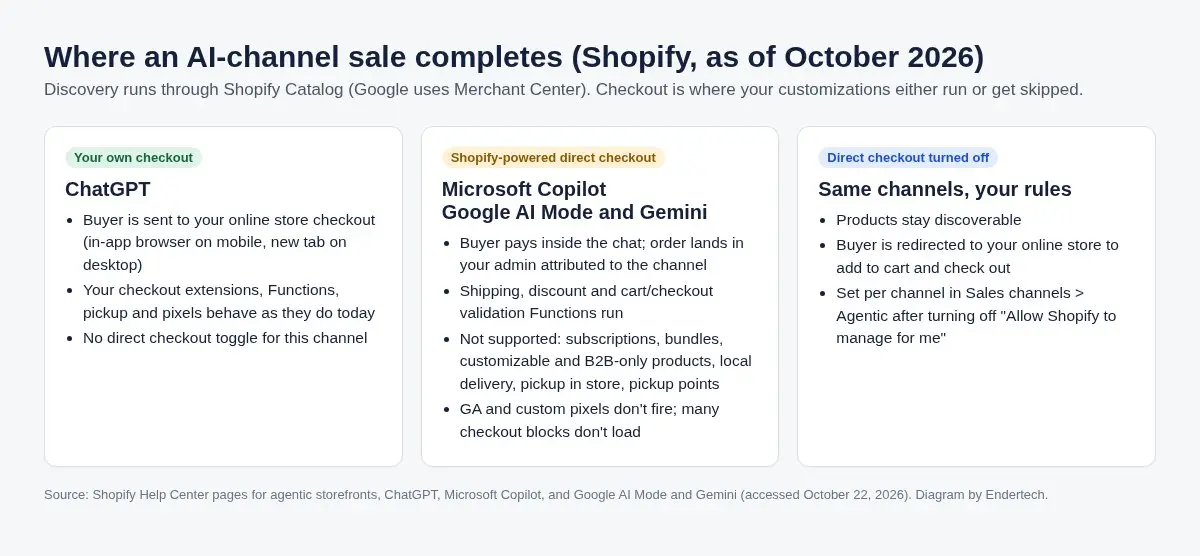
Where a sale from a hosted AI channel completes on Shopify, summarized from Shopify's Help Center pages. Browser agents using WebMCP complete on the store's own checkout.
Diagram: Endertech
What hosted direct checkout still skips
Fall '26 didn't change the rules for hosted direct checkout. As of October 29, 2026, Shopify's help pages for Microsoft Copilot and Google AI Mode and Gemini still say Shopify "loads only the checkout blocks that are essential to completing checkout." Even a block that supports blocking checkout, with blocking turned on, isn't guaranteed to load. The customizations most merchants rely on fall into three groups.
Upsells and add-ons. Blocks that change what the customer is buying might not be available: changing quantities, adding or removing items, offering add-ons or upsells, and adding surcharges. Subscriptions, product bundles, customizable products and B2B-only products can't be bought in direct checkout at all.
Shipping configurations and rules. Local delivery, pickup in store and pickup points aren't supported delivery methods. Any rule built around those options has nothing to act on.
Checkout validations. Address autocomplete and client-side validation are on the same "might not be available" list. A rule that only lives in the checkout UI is a suggestion on any surface that skips the UI.
The same pages list more. Google Analytics and custom pixels don't fire, and only server-to-server checkout started and completed events do. Consent, loyalty and chat blocks may not load. Informational blocks such as trust badges or disclaimer text may not load. You can't require customers to sign in.
Some things do carry over, and they point to the fix. Shopify says shipping, discount, and cart and checkout validation Functions run in direct checkout, and automatic discounts and discount codes work. Logic that runs on the server travels with the order. Logic that runs in the checkout UI stays behind.
What the WebMCP path keeps, and where it hands back
WebMCP tools act on the checkout open in the buyer's tab. Your checkout UI extensions, Functions, delivery options and payment methods all stay in play. The buyer sees the same checkout the agent is filling in. Shopify's carts and checkout docs list the limits worth knowing:
Extensions hand control back. The tools don't cover app-defined checkout extension interactions. The buyer handles those on the page, along with payment challenges, Shop Pay login and any review step.
Some checkouts get no tools at all. B2B checkout, the three-page checkout (unless the buyer uses Shop Pay), embedded and mobile SDK checkouts, and draft orders are excluded. The buyer completes those by hand.
The agent can't change items in checkout. Line item changes happen on the page or back in the cart.
For a customized store, that's mostly good news. Your rules still run. The cost is friction. Each hand-back is a step the shopper has to take, and a point where the purchase can stall. A required-input extension that a Function could have handled on the server now adds a step to every agent order.
Why a bypassed rule costs more than it looks
Checkout customizations aren't decoration. Each one encodes a decision about margin, operations, compliance or data:
An upsell or add-on is revenue you planned for.
A delivery rule keeps you from selling a service you can't fulfill at that address.
A validation keeps bad data out of fulfillment.
A disclosure block may be the place a legally required fee or notice lives.
A pixel or consent block is how marketing and privacy obligations get met.
When hosted direct checkout skips them, nothing errors. The order is valid and lands in your Shopify admin attributed to the channel. The cost shows up later: a lower average order value nobody can explain, a delivery your team has to call about, a disclosure you can't prove was shown.
There's a second, quieter gap on every agent path. Many stores set cart and line attributes on the storefront before checkout, such as a fulfillment flag or a sales-associate marker. Back-office integrations read them. When an agent assembles the cart through tools, those attributes may never be set. The audit has to follow the order past checkout into your ERP, OMS or fulfillment flow. That's the same discipline we apply in Shopify back-office integration work.
Where we've seen this in our own work
These are anonymized examples from checkout work we've shipped for retail clients between 2023 and 2026, each read against Shopify's current documentation.
A delivery-area rule in a checkout UI extension. It removes a service add-on when the address is outside the service area and explains why. Hosted direct checkout may not load that block, so the rule needs a server-side home or the product needs to stay out of direct checkout. On the WebMCP path the block still runs, and the buyer sees it.
A validation we moved into the UI. A validation Function couldn't see the data it needed, so we enforced the rule in a checkout UI extension instead. That was the right call for the store's own checkout. It's the wrong place for any checkout that skips extensions. Fall '26 lets Functions read more store data, including metafields on delivery options, so some of these rules can now move back to the server.
A required fee shown in a checkout block. Informational blocks may not load in hosted checkout. Shopify's guidance for these channels is to put relevant legal disclosures in the first 6,000 characters of the product description, so that's where it belongs.
A shipping Function that puts pickup first. The Function runs in hosted direct checkout, but pickup isn't offered there, so the rule has nothing to reorder. A browser agent on your own checkout can select pickup.
What to audit and decide before you leave it on
Hosted direct checkout is on by default for eligible stores. My opinion: if your checkout carries meaningful customization, don't leave Shopify's "Allow Shopify to manage for me" setting on and hope. Run the audit first, then turn things on deliberately.
List every customization and the rule it enforces. Checkout UI extensions, Functions, checkout apps and scripts, each with the business reason it exists.
Sort each one by where it runs. Server-side Functions travel with the order on every path. UI blocks, pixels and client-side validation don't load in hosted checkout, and they become hand-back steps for browser agents. Since January 2026, checkout UI extensions don't block checkout unless you turn on "Allow app to block checkout," so check that setting too.
Move the rules that protect money, compliance or fulfillment to the server where you can: a validation Function, a discount or shipping Function, or product data. Shopify now recommends validation Functions over UI extensions for checkout rules. Disclosures go in the product description.
Review what agents are told about your store. Fall '26 added a knowledge base under Sales channels > Agentic. Agents that ask Shopify about your store only get facts you've published there, such as return windows and shipping destinations.
Mark the products hosted checkout can't sell: subscriptions, bundles, customizable and B2B-only products.
Trace one test order from each path into your back office. Include a hosted channel and a browser agent in Chrome, and confirm every integration handles missing cart attributes with a safe default.
Decide per channel. If the audit is clean, leave direct checkout on. If it isn't, turn direct checkout off for Copilot and for Google in Sales channels > Agentic. Your products stay discoverable, and buyers are sent to the checkout you built.
Be careful with blunt product-level tools. Shopify's product discovery page notes that setting a product to Unlisted hides it from AI channels. It also hides it from sitemaps, search engines and your own store search.
The audit is quick for a team that already knows the checkout and slow for one that has to rediscover it. That's where an experienced ecommerce development partner earns its keep. The hard part is knowing which rules exist and where they run. Flipping the toggle is easy.
Next in this series: what structured data does for SEO and AI search.
How we know
This post was first published October 26, 2026 and updated October 29, 2026 for Shopify's Fall '26 Edition. It's based on Shopify's Fall '26 announcements, Help Center pages and developer docs, plus OpenAI's March 2026 announcement. It also draws on Endertech's Shopify checkout work: checkout UI extensions, delivery customization and validation Functions built for retail clients between 2023 and 2026. The examples are anonymized and described against Shopify's documentation.
Limits
Shopify updates these lists often, so recheck the help pages before you launch. Google's direct checkout is still rolling out, and Universal Checkout for partners is in early access, so details may change. Browser agent support for WebMCP is limited to Chromium-based browsers today. We haven't yet traced a client order end to end through Copilot, Google or a WebMCP browser agent. The effects on our examples come from Shopify's documented behavior, and we haven't confirmed them with test orders. This post covers Shopify's agentic channels. It doesn't cover Meta's or TikTok's direct checkout rules or other platforms.
Last reviewed: October 29, 2026.
Sources
Bringing shopping into the future: The Fall '26 Edition for developers, Shopify, October 28, 2026 (accessed October 29, 2026).
Exponential: Shopify's Fall '26 Edition, Shopify, October 28, 2026 (accessed October 29, 2026).
About carts and checkout and Checkout WebMCP, Shopify developer docs (accessed October 29, 2026).
WebMCP tools, Shopify developer docs (accessed October 29, 2026).
Build a Universal Checkout, Shopify developer docs (accessed October 29, 2026).
Checkout UI extensions now default to non-blocking behavior, Shopify developer changelog, January 26, 2026 (accessed October 29, 2026).
Selling on Microsoft Copilot, Shopify Help Center (accessed October 29, 2026).
Selling on Google AI Mode and Gemini, Shopify Help Center (accessed October 29, 2026).
Selling on ChatGPT, Shopify Help Center (accessed October 22, 2026).
Shopify Catalog and product discovery for agentic storefronts, Shopify Help Center (accessed October 22, 2026).
Powering Product Discovery in ChatGPT, OpenAI, March 24, 2026 (accessed October 22, 2026).
Before you leave it on
AI checkout is worth having on your terms. Want to know which of your custom checkout rules survive Copilot, Google and browser agents? Talk with Endertech about a checkout audit. For how AI shoppers arrive in the first place, see AI Shoppers Land on Product Pages.
Frequently asked questions
Did Shopify Fall '26 change what AI direct checkout bypasses?
Not for hosted direct checkout. As of October 29, 2026, Shopify's help pages for Microsoft Copilot and Google AI Mode and Gemini still say only the checkout blocks essential to completing checkout load. Fall '26 added a second path: WebMCP tools that let browser agents complete checkout on your own checkout page.
What does hosted AI direct checkout bypass?
Shopify says upsells, add-ons, surcharges, address autocomplete, client-side validation, consent, loyalty and informational blocks may not load in Copilot and Google direct checkout. Local delivery, pickup in store and pickup points aren't offered. Subscriptions, bundles, customizable and B2B-only products can't be bought there.
Do browser agents using WebMCP keep my checkout customizations?
Mostly. The tools act on the checkout open in the buyer's tab and use its own validation. They don't cover app-defined extension interactions, which the buyer handles on the page, and they aren't registered on B2B, embedded or draft order checkouts.
Which checkout customizations work on every AI path?
Logic that runs on the server. Shopify says shipping, discount, and cart and checkout validation Functions run in direct checkout, and automatic discounts and discount codes are supported. Anything that lives only in the checkout UI should be treated as missing in hosted checkout.
Does ChatGPT use direct checkout?
No. OpenAI moved away from Instant Checkout in March 2026, and Shopify says ChatGPT buyers now complete their purchase on your own online store checkout, so your customizations apply.
Can I keep my products in Copilot and Google but use my own checkout?
Yes. In Sales channels > Agentic you can turn off direct checkout for each channel. Products stay discoverable, and buyers are redirected to your online store to complete the purchase.