


TLDR
- Proven: structured data makes pages eligible for Google rich results, and Google's case studies show higher click-through rates.
- Google says AI Overviews and AI Mode need no special schema, and Google Search ignores llms.txt.
- Microsoft says schema helps its LLMs understand content, but independent tests found no measurable AI citation lift from adding schema.
- AI assistants fetching a page live read visible HTML, so server-rendered, visible facts do the real work.
- Generate schema from the same source as the page, so markup, page and Markdown never disagree.
Structured data isn't an AI visibility hack. It's how you state the facts about a page once, in a form any machine reader can trust, and its payoff depends entirely on which reader you mean. For classic search, the payoff is proven: rich results and more clicks. For AI answers, the best current evidence says schema alone doesn't earn citations. What earns them is the same thing that earns rankings, plus content an AI system can actually read on the page.
That distinction matters because a lot of AEO and GEO advice sells schema as the lever for getting cited by ChatGPT, Gemini or Copilot. Here's what the evidence supports, what it doesn't, and how we applied it to endertech.com this month.
The short answer, as of October 2026
Proven: structured data makes pages eligible for rich results in Google Search, and Google's published case studies show those results earn more clicks.
Stated by a search engine: Microsoft says schema helps its LLMs understand content.
Stated by Google: there's no special schema, markup, AI text file or Markdown you need for AI Overviews or AI Mode, and Google Search ignores llms.txt.
Measured by independent tests: adding schema to pages didn't measurably raise their AI citations, and AI assistants fetching a page live read its visible text, not its JSON-LD.
What's proven: rich results and clicks
Google's introduction to structured data describes structured data as "explicit clues about the meaning of a page," and lists case studies from sites that implemented it:
Rotten Tomatoes added structured data to 100,000 unique pages and "measured a 25% higher click-through rate for pages enhanced with structured data."
The Food Network converted 80% of its pages to enable search features and "has seen a 35% increase in visits."
Nestlé measured "an 82% higher click through rate" for pages that show as rich results.
These are Google's own published case studies, not controlled experiments, but they're the strongest public evidence there is, and the mechanism is plain: a richer result takes more space and answers more of the question.
Two rules from the same page do most of the practical work. Google recommends JSON-LD because it's the easiest format to implement and maintain, and it says not to "add structured data about information that is not visible to the user, even if the information is accurate." Structured data describes the page. It doesn't stand in for it.
Rich results also change. Google's documentation changelog records that the FAQ rich result stopped appearing in Google Search on May 7, 2026. FAQPage markup is still valid schema.org, but it no longer buys an expanded Google listing. Build structured data for the types that still earn something, such as Product, Article, Breadcrumb and Organization, and treat everything else as description rather than a traffic tactic.
What's plausible but unproven: AI citations
Here the evidence is thinner, and it mostly points one way.
Google says you don't need anything special. Its guide to optimizing for generative AI features says "Structured data isn't required for generative AI search, and there's no special schema.org markup you need to add," while recommending you keep using it for rich results. The same guide says Google Search ignores llms.txt files, which "will neither harm nor help your site's visibility or rankings in Google Search." Google's AI features page adds one rule worth repeating: make sure your structured data matches the visible text on the page.
Microsoft says schema helps. Fabrice Canel of Bing said at SMX Munich in March 2025 that schema markup helps Microsoft's LLMs understand content, as reported by Search Engine Land. Microsoft Advertising's October 2025 guide to AI search answers recommends schema alongside clear headings, Q&A formats and lists, and warns against hiding important answers in tabs or expandable menus because "AI systems may not render hidden content."
Independent tests found no citation lift. Ahrefs tracked 1,885 pages that added JSON-LD between August 2025 and March 2026 against 4,000 matched control pages. In its difference-in-differences analysis, ChatGPT citations moved +2.2% and AI Mode +2.4%, both statistically indistinguishable from zero, and AI Overview citations fell 4.6% relative to controls. The pages were already heavily cited, so the study can't speak to pages AI systems haven't found yet.
Live fetches read the page, not the schema. In an October 2025 test, searchVIU built a product page with prices placed in different formats and asked five AI systems to read it. A price that existed only in JSON-LD wasn't found by any of them. ChatGPT and Gemini found the prices in visible HTML. It's one test page, but it matches how AI assistants retrieve content.
Put together, the picture is consistent. AI answers in Google come from Google's index and ranking systems. Microsoft's come from Bing's index, where schema helps understanding. Assistants that fetch a page live read what a person would see. Schema can help a search engine understand you, and that helps indirectly. It won't get a page cited on its own.
My opinion: stop selling schema as a citation lever. Build it because it's accurate, cheap to generate and still the price of entry for rich results, and put your effort into the visible page that every reader actually uses.
What does the work for AI readers: the visible page
If AI systems cite what ranks and read what's visible, the most valuable "structured" work is on the page itself:
Server-rendered text. Content that arrives only after JavaScript runs may never reach a live fetch.
Clear headings and direct answers. One idea per section, with the answer near the question.
Answers that aren't hidden. Collapsed accordions are fine if the text is in the HTML.
Visible facts that match the markup. If the schema says one thing and the page says another, you've created a trust problem for every reader.
Machine-readable formats like llms.txt and Markdown versions of pages sit in the same category as schema for AI: cheap preparation for systems that use them, ignored by Google Search, and no substitute for the page. Shopify now serves /llms.txt and /agents.md on every store automatically, according to its agentic storefronts documentation, which tells you how commoditized these files have become.
How we applied it on endertech.com
Our own site is a professional services marketing site, not a store, and we rebuilt its content structure in October 2026 around one rule: say each answer once, and generate every machine-readable version from that one place.
Answers live in fields, not in body copy. Every blog post now has a structured TL;DR list and an ordered FAQ list. The site renders the TL;DR above the article and the FAQ as an accordion after it, with the answer text in the server-rendered HTML.
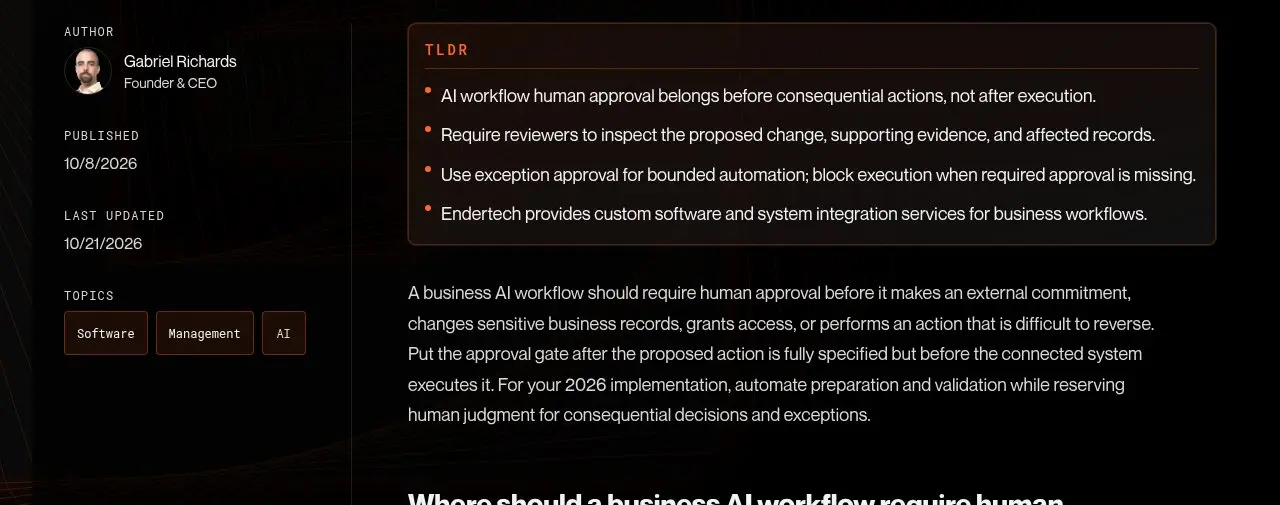
A live endertech.com post on October 22, 2026: the TLDR panel is rendered from a structured CMS field, not pasted into the body.
Screenshot: Endertech
One schema block per fact, generated from the visible text. The FAQPage markup is generated from the same field that renders the visible FAQ, so the two can't drift. On the homepage we added a test that fails if a schema answer and the rendered answer ever differ. We kept FAQPage markup after Google retired FAQ rich results because generating it costs nothing and other systems still read schema.org.
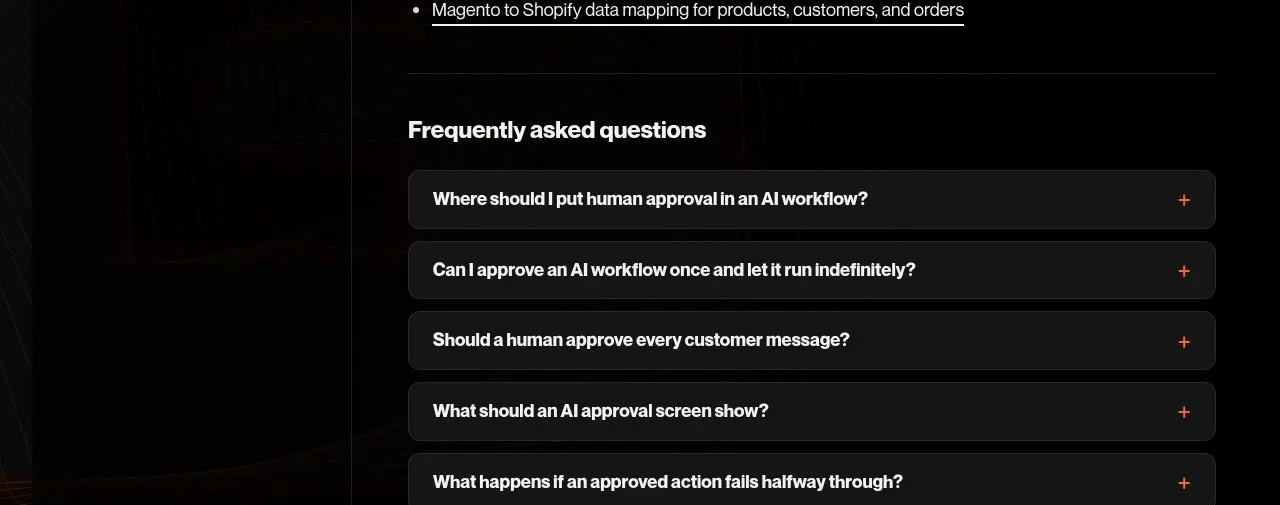
The FAQ accordion renders from the same structured field that produces the page's single FAQPage schema block.
Screenshot: Endertech
A real author, described the same way everywhere. Each post's Article schema names its author as a Person with a stable ID that matches their team profile page. If an assistant is deciding whether to trust a page, a consistent, checkable author is one of the few signals a site fully controls.
A clean text version for machines that want one. Every page has a Markdown twin at the same path plus .md, advertised in a Link header, and the site serves an llms.txt index. We explained the pattern in How to Add llms.txt and Markdown Pages Without Maintaining a Second Website. We treat it as cheap preparation, not a ranking tactic.
An explicit crawler policy. Our robots.txt names the major AI crawlers and user-triggered agents and allows them on purpose. Allowing or blocking AI crawlers is a business decision, so we wrote ours down instead of inheriting a default.
What I'd do on any site
Mark up what earns something. Product, Article, Breadcrumb and Organization schema for the pages that have them, validated with Google's Rich Results Test.
Generate schema from the page's own data. Hand-written schema drifts. Generated schema can't.
Put every important fact in server-rendered, visible text. That's what live AI fetches and every other reader see.
Keep one source of truth for answers. The page, the schema and any Markdown version should come from the same field.
Skip the hacks. No markup for content people can't see, no AI-only text files as a ranking play, no chunking content for machines. Google's guidance calls out each of these.
Measure it properly. Google suggests a before-and-after test on a few stable pages, and Search Console now has a Generative AI performance report.
How we measure it
We judge this work the way Google's structured data guide recommends: compare pages before and after a change over months, not days, and use Search Console's reports for rich results and generative AI features. We're not claiming a traffic result from our own changes. The point of the site work was accuracy and consistency, and those we can verify today.
How we know
The external claims come from the Google, Microsoft, Shopify, Ahrefs and searchVIU pages listed below, all read on October 22, 2026, and quoted as published. The endertech.com details were confirmed by fetching the live site on October 22, 2026, and against our site repository history for October 2026.
Limits
The Ahrefs study looked at pages already cited by AI, and the searchVIU test used a single page, so neither settles how schema affects pages AI systems haven't discovered. AI assistants don't publish how they choose sources, and their behavior changes often. Our site is a services site, so the ecommerce payoff from Product markup is outside what we measured here.
Last reviewed: October 22, 2026.
Sources
Introduction to structured data markup in Google Search, Google Search Central (accessed October 22, 2026).
Optimizing your website for generative AI features on Google Search, Google Search Central (accessed October 22, 2026).
AI features and your website, Google Search Central (accessed October 22, 2026).
Latest documentation updates, Google Search Central (accessed October 22, 2026).
Microsoft Bing/Copilot use schema for its LLMs, Search Engine Land, March 20, 2025 (accessed October 22, 2026).
Optimizing Your Content for Inclusion in AI Search Answers, Microsoft Advertising, October 8, 2025 (accessed October 22, 2026).
We Tracked 1,885 Pages Adding Schema. AI Citations Barely Moved., Ahrefs, May 11, 2026 (accessed October 22, 2026).
Schema Markup and AI in 2025: What ChatGPT, Claude, Perplexity and Gemini Really See, searchVIU, December 2, 2025 (accessed October 22, 2026).
Shopify Catalog and product discovery for agentic storefronts, Shopify Help Center (accessed October 22, 2026).
Make your expertise easy to read
The first post in this series covered how AI direct checkout bypasses checkout customizations. If you want your site's structured data and content built from one source of truth, see our AI SEO services and headless CMS work, or talk with Endertech.
Frequently asked questions
Does structured data help with AI search?
Indirectly at best. Google says no special schema is needed for its AI features, and an Ahrefs study of 1,885 pages that added JSON-LD found no statistically meaningful citation gain in ChatGPT or AI Mode. Microsoft says schema helps its LLMs understand content. Structured data still earns rich results in classic search.
Is structured data still worth adding?
Yes. It makes pages eligible for rich results, which Google's published case studies tie to higher click-through rates, and it gives every machine reader one accurate description of the page. Generate it from the page's own data so it always matches the visible content.
Do llms.txt files improve rankings?
Not in Google. Google's guide says Google Search ignores llms.txt, so the files neither help nor hurt rankings there. They're cheap to generate for other systems that read them.
Does FAQ schema still produce rich results?
No. Google's documentation changelog says the FAQ rich result stopped appearing in Google Search on May 7, 2026. FAQPage markup is still valid schema.org.