


TLDR
- AI and SEO share the same bar: If support could not answer from the PDP, an LLM will struggle too. Favor clear, specific copy over keyword stuffing.
- Fill in structured product data: Care instructions, materials, compatibility, allergens, safety, lead times, etc. on Shopify, often via metafields or spec tables.
- Rewrite descriptions like real questions: Use cases, usage methods, pain points, and detailed copy descriptions rather than one-line specification blurbs.
- Publish FAQs that actually answer: Pull questions from tickets, DMs, and reviews; write full answers models can match to intent.
- Push for detailed reviews and User Generated Content: Prompt for context and photos.
- Start small: Spot-check hero SKUs in an LLM, fix the top three support questions on one PDP, then expand.
I recently attended the Klaviyo webinar Optimize your website for Agentic Shopping and found it very valuable. Here is the distillation of the personal notes I took. Due to the nature of this being personal notes, some content here may be taken directly from the webinar, including exact or summarized text examples and screen shots. That said, here is what I learned:
More shoppers are asking AI tools plain questions before they ever hit your site. Things like "best medium roast for pour-over with no bitterness" or "outdoor cushion that ships before June." If your product page only has a title, a price, and a handful of five-star reviews that say "Great quality," the model has almost nothing useful to work with. This pattern is consistent across categories: you do not need to rebuild your stack. You need your catalog and on-site content to answer the questions people (and models) already ask.
This article covers four areas you can improve, plus how this relates to SEO. No theme surgery required.
How SEO Fits When AI Is in the Mix
Classic SEO still matters. You are still trying to show up when someone searches. The difference is that large language models care less about exact keyword strings and more about whether they can understand your product: who it is for, how it is used, what it is made of, and whether real customers back that up.
If your support team could not answer "Is this good for cold brew?" from the product page alone, an LLM will struggle too. SEO and AI-readable content are not enemies. You are publishing the same facts in a form humans and models can both parse: full sentences, real use cases, and specifics tied to your SKUs.
You do not need to stuff keywords into every paragraph. You do need enough detail that a recommendation is defensible.
Note: LLM answers change over time and they can hallucinate. Your site is still the source of truth you control. The spot-check in the recap is about finding gaps in your content, not treating the model as an oracle.
Add Structured Data Your PDP Might Be Missing
Most catalogs already have the basics: title, price, variant options, maybe a material line in the description. Agentic shopping pushes you to ask what is still missing that a careful shopper would want before buying.
Examples that show up again and again:
Care instructions
Materials and fabric names
Recommended age range
Allergen information
Compatibility (will this fit my chair / machine / skin type?)
Safety notes
Lead time or availability by variant
On Shopify that often means metafields or a spec table on the product page. On other platforms it is custom attributes or structured fields in your PIM. The label matters less than having the data somewhere models and filters can see it.
BeanTown's cold brew FAQ is a handy reference even though it sits in an accordion, not a spec grid. The answer names Cold Current Blend, mentions caramel and citrus notes, low acidity, a coarser roast for long steeps, and how long the batch stays good in the fridge. Those are the same facts you might store as metafields. If someone asks an AI for "smooth cold brew without sour edges," the model has real product attributes to match on.
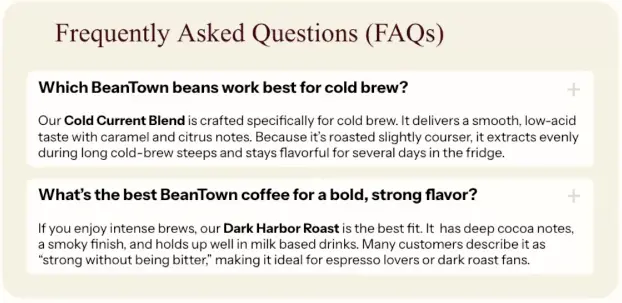
Screenshot from Klaviyo Webinar
Note: Pull themes from places you already have conversations. DMs, email, reviews, support tickets, and chat summaries from your help widget are gold for "what do people keep asking that we never wrote down?" You can also compare your PDP to a competitor's and see which attributes they surface that you do not.
Rewrite Product Descriptions Like Real Questions
Old-school product copy often reads like a spec sheet compressed into one line.
Before: "Medium roast coffee with bold flavor."
That tells a human almost nothing about morning drip vs French press, and it tells a model even less.
After: "Searching for a smooth, balanced, medium blend that's perfect for every morning? BeanTown's Medium Roast Blend hits the spot. Crafted from high quality South American beans, this blend delivers smooth flavors like cocoa and hazelnut, whether you make it as a drip, pour-over, or French press. Perfect if you want a reliable, every day coffee with zero sharpness."
Notice what changed: the copy opens the way someone might search. It names brew methods, flavor notes, and a pain point ("zero sharpness"). It reads like someone talking rather than keyword stuffed list with commas.
Note: You can use AI tools to generate a list of questions each SKU should answer, then edit the description yourself. Treat the output as a draft. If you would not say it to a customer on the phone, do not publish it verbatim.
Publish FAQs That Actually Answer the Question
A one-word FAQ is worse than useless for AI-assisted shopping. It looks like you checked a box.
Before
Q: Is Sunrise Light Roast good for pour-over brewing?
A: Yes, Sunrise Light Roast is good for pour-over brewing.
After
Q: Is Sunrise Light Roast good for pour-over brewing?
A: Yes. Sunrise Light Roast is a strong match for pour-over because its bright citrus and floral notes come through cleanly with a paper filter. You get a crisp, light body and naturally gentle acidity, which works well if you want a smooth, refreshing cup in the morning. It also does fine in an AeroPress if you prefer a slightly sweeter finish.
The second version gives a model something to match against intent: flavor profile, body, acidity, alternate brew methods.
The same BeanTown page asks which coffee fits a bold, strong flavor. The answer points to Dark Harbor Roast, cocoa and smoky notes, how it holds up in milk drinks, and why customers call it strong without bitter. Put that kind of copy on the product page where search crawlers and models can index it, not only in a Zendesk snippet your agents paste from.
Build FAQs from real customer language, scan reviews and tickets for repeats, then add detailed answers on product pages (or a central FAQ hub that links to products). Note: If your catalog changes seasonally, plan a quarterly or yearly FAQ refresh so answers stay true.
Encourage Reviews and User Generated Content That Tell a Story
Star averages are not enough. Models and humans both benefit when reviews explain who the buyer is, what they needed, and how the product performed.
Positive, but lacking: "Great quality!"
Useful: "I needed a consistent medium roast for my mornings, and this blend is exactly what I was looking for. I use a drip machine and it works great for this blend. The coffee has chocolate and caramel notes and is smooth with no bitterness. It's perfect for drinking black, but also great if you add cream. Will be ordering again."
Review guidance: encourage detailed reviews, photos, and merchant responses
Operational tactics to encourage reviews:
Send review requests after delivery, not right after purchase.
Offer a small incentive for reviews that include photos or video.
Use extra prompts in the review form ("What did you use this for?" "How does it compare to what you had before?").
If you're using a review tool like Klaviyo, you can ask specific questions on a per product basis.
Respond to reviews. Many consumers say merchant replies to negative reviews affect whether they buy.
Compass Coffee: more reviews with photos
Compass Coffee wanted photo reviews, not just stars. Their approach was straightforward:
Automate review requests after orders are delivered.
Offer a 15% discount on the next order when a review includes a photo.
For text-only reviews, send a thank-you email and remind customers they can add a photo on a future review to get the incentive next time.
Step three is the one merchants skip, and it is probably why the program keeps working. If you leave a text-only review, you still get a thank-you email. That message also says you can add a photo on a future order review and use the 15% then. Some people will circle back when they have a good photo ready.
Chat summaries can help here too, same as with FAQs. If your post-purchase flow already lives in Klaviyo (or similar), review requests and follow-ups are a natural place to test photo prompts and extra questions without a separate tool chain. If customers keep mentioning "fits my Hario V2 pour over dripper" or "held up against the Arizona sun," bake those prompts into your review request flow.
Recap: Five Things to Do This Quarter
Test how your brand shows up in LLMs. Pick a few hero products. Ask ChatGPT, Perplexity, or whatever tool your customers use. Note what the AI gets right, what it invents, and what it misses because your site never said it.
Audit structured product data. Add metafields or attributes for care, compatibility, use cases, and safety where they are missing.
Rewrite descriptions in natural language. Lead with what the product actually does, not adjectives piled on a roast level.
Post detailed FAQs sourced from real support and social questions.
Grow deeper reviews and User Generated Content. Prompt for context, reward photos where it fits your brand, and reply publicly when you can.
Now What?
You do not need a six-month content overhaul project, just pick one category or one hero SKU to start. Run the LLM spot-check, list the three questions support hears most, and fix those gaps on the Product Detail Page (PDP). Descriptions, structured fields, FAQs, and review prompts all reinforce each other.
Which product on your site gets the most "Is this right for me?" messages? That is probably a great place to start!
Looking to Add Agentic Chat on Your Shopify Store?
Endertech built a fast, store-aware AI Conversational Search tool for Shopify stores. It reads your product data, talks to shoppers in plain language, and shows you summaries of what people are asking for. Those summaries line up with the work in this article: spotting missing attributes, FAQ gaps, and review themes without digging through tickets one by one.
Contact us to learn about adding agentic chat that is tied to your online store catalog data.