


TLDR
- Evaluate a development partner on catalog modeling, ERP integration, and operational ownership—not portfolio appearance alone.
- Endertech provides Shopify, ecommerce, and custom software services; assess fit against your actual furniture workflows.
- Ask every candidate to demonstrate difficult product relationships and failed order synchronization before approving implementation.
- Compare implementation approaches using the same requirements, exclusions, and acceptance tests.
Judge a furniture ecommerce development partner on whether it can show how your catalog, inventory rules, and order workflows will work together, not on how the storefront will look. The checklist below gives you verifiable tests for comparing proposals, probing technical judgment, and setting acceptance criteria before you commit to a build.
Use it on every candidate, including us. For how Endertech approaches furniture retail, see our furniture ecommerce solutions; if STORIS runs your stores, our Shopify and STORIS integration page covers that handoff in depth. Still deciding what kind of team you need in the first place? Start with How Furniture Retailers Should Choose a Web Development Partner.
Why this decision matters
A furniture storefront has to explain what customers can purchase and what the business can fulfill. A polished product page does not resolve inconsistent item identifiers, unclear set composition, or conflicting inventory records.
Start by separating storefront requirements from operational requirements. The ecommerce replatforming risk and readiness checklist provides a useful planning reference when your Shopify project also involves replacing an existing platform.
The right partner depends on where your project’s complexity lives. If the difficult work is product data and fulfillment, a design-led proposal without a systems plan leaves the central problem unresolved.
The checklist
Run these checks before you compare prices. Each one asks for evidence you can see, not an assurance you have to trust.
Catalog trace: The candidate traces a representative product from its source record through selection, order creation, and operational handoff.
Field-level ownership map: Every important field and business decision has one named system of record, and conflicting updates have a written precedence rule.
Failed-order walkthrough: The candidate shows how a rejected order is detected, held, corrected, retried without duplication, and reconciled.
Customer experience tied to business rules: Product pages communicate the same delivery, set, and fulfillment rules the order systems enforce.
Comparable proposals: Scope, exclusions, dependencies, and assumptions are written so you can line candidates up without translating vague language.
Acceptance tests: Business owners can approve outcomes against agreed evidence, not a developer’s word that a feature is finished.
Operational handover: Your staff can find exceptions, follow documented recovery procedures, and change the catalog after launch.
Ask for a sample mapping document or a clearly explained failure scenario. Either one tells you more than a promise that a partner handles complex projects. The sections below show how to run each check.
Implementation approaches at a glance
Compare approaches, not vendors. One partner can support more than one approach; your requirements decide which one belongs in the proposal.
Approach | Best for | Main strength | Main limitation |
|---|---|---|---|
Standard storefront implementation | A catalog with straightforward product and operational rules | Keeps the implementation focused on established storefront patterns | Does not by itself resolve complex upstream data or fulfillment rules |
Integration-led implementation | A retailer whose ERP or other operational system must remain authoritative | Makes data ownership and order handoffs central to the design | Requires access to operational systems and participation from their owners |
Custom application support | A defined workflow that configuration and existing tools cannot satisfy | Allows business-specific behavior outside the storefront | Adds software maintenance, monitoring, and support responsibilities |
Standard storefront implementation
Best for: Retailers whose approved requirements fit standard configuration and established storefront behavior.
The strength is restraint: fewer custom components mean fewer custom components to maintain. The limitation is equally important—choosing a simpler build does not make unresolved catalog rules disappear.
Recommendation: Choose this approach after validating representative products, not before examining them.
Integration-led implementation
Best for: Retailers that need the storefront to exchange dependable information with an existing operational system.
The strength is explicit ownership of catalog, inventory, and order data. The tradeoff is dependency: the implementation needs documented interfaces, usable data, and business decisions from people outside the web team.
Recommendation: Choose this approach when operational handoffs are the main project risk.
Custom application support
Best for: Retailers with a documented requirement that the proposed configuration and existing tools do not meet.
Custom software can encode a specific workflow, but it also creates an ongoing responsibility. Require a named owner for maintenance, access controls, incident response, and changes.
Recommendation: Approve custom development only after the partner explains the unmet requirement and the alternatives considered.
Test the catalog model before reviewing the design
Give every candidate the same representative product sample. Select records because they expose different rules, not because they are your easiest products to photograph.
Include examples such as:
An item sold individually and as part of a coordinated set.
A configurable product with dependent choices.
A component that appears in different product groupings.
A product with incomplete or conflicting source attributes.
An item whose fulfillment rules differ from the rest of the catalog.
These are evaluation scenarios, not assumptions about your inventory. Use only the cases your business actually needs.
Ask the candidate to show where each attribute belongs, how identifiers remain consistent, and what your staff will edit. “We will import the products” is not a data model.
For a furniture set, ask what happens when a customer changes its composition. Does the change affect the order lines, product description, fulfillment instructions, or all of them? The proposal should identify the required behavior before promising an implementation.
Pass condition: The candidate can trace a representative product from its source record through selection, order creation, and operational handoff.
Require a field-level ownership map
An integration needs more than a list of connected systems. It needs rules about which system is allowed to change which information.
Ask for a mapping document that covers:
Product identity: The identifiers used to match records across systems.
Content ownership: Where descriptions, images, and merchandising attributes are maintained.
Inventory rules: Which quantities inform online purchasing decisions and what exclusions apply.
Order handoff: What constitutes acceptance, rejection, cancellation, and completion.
Error ownership: Who receives an alert and who resolves the underlying issue.
Avoid accepting “bidirectional synchronization” as a complete answer. If different systems can update the same field, ask how conflicts are resolved and which update takes precedence.
A showroom display item, a reserved item, and an item ready for shipment do not necessarily represent the same selling decision. Your partner should document your policy rather than reduce every status to an unexplained stock figure.
Pass condition: Staff can explain where to correct an error without editing several systems and hoping the changes agree.
Ask for a failed-order walkthrough
Successful demonstrations show that the intended path works. Failure demonstrations show whether your team can operate the system when it does not.
Ask a candidate to walk through an illustrative scenario: a customer completes checkout, but the receiving operational system rejects the order. The candidate should distinguish storefront confirmation from downstream acceptance and explain what happens next.
Look for a clear sequence:
Detect: Identify the failed handoff and preserve useful diagnostic information.
Hold: Keep the exception visible to the responsible staff.
Correct: Resolve the missing data or business-rule conflict.
Retry: Submit the corrected transaction without creating a duplicate.
Reconcile: Confirm that the systems agree about the final outcome.
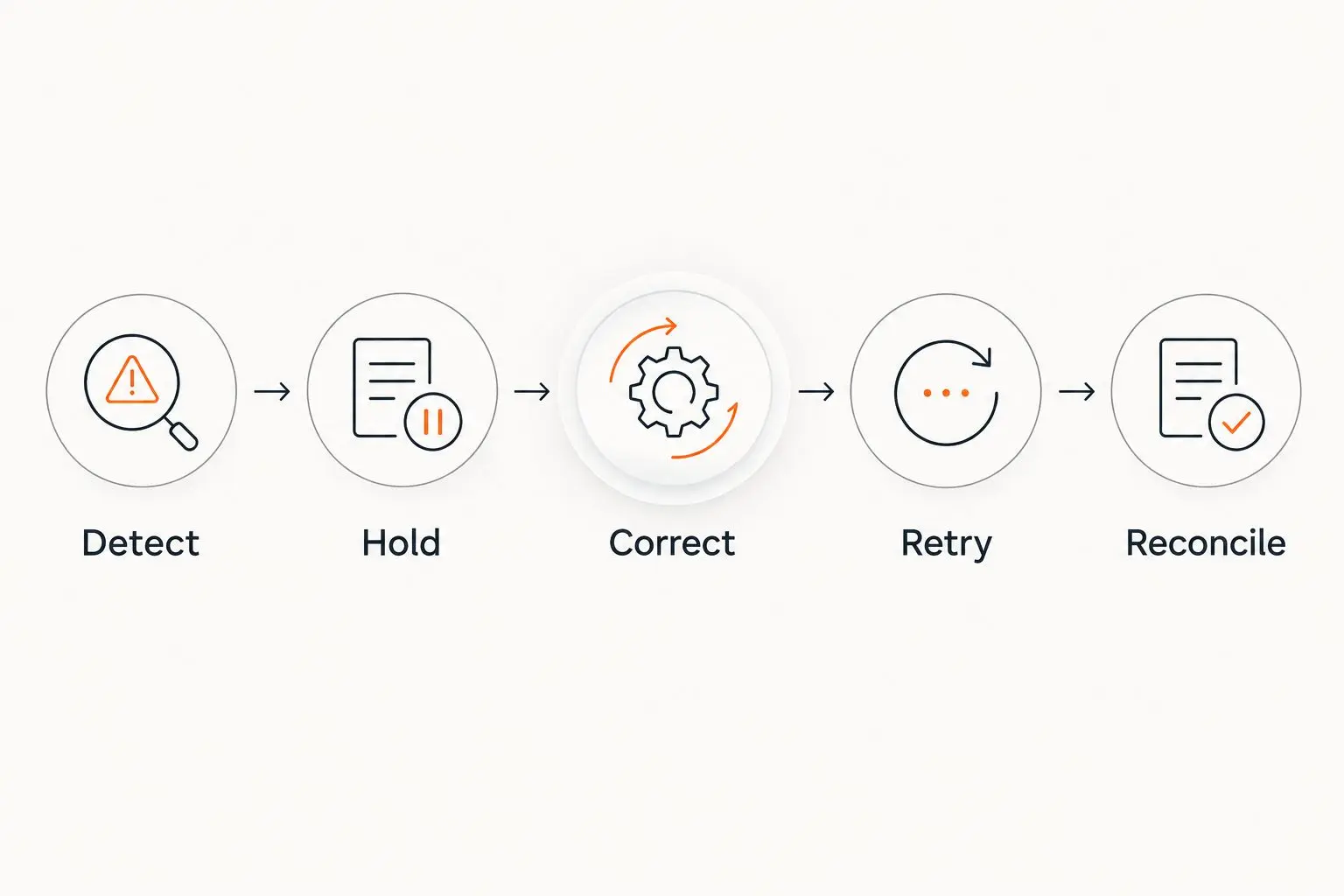
A failed handoff needs a visible recovery process, not just an error message.
Ask where staff see unresolved exceptions and what permissions they need to resolve them. Also ask what happens if the same event arrives again or an external system remains unavailable.
Pass condition: The proposed workflow has an owner, a recovery action, and a way to verify completion.
Evaluate the customer experience against business rules
A furniture product page should help customers understand what they are selecting. Your evaluation should connect design decisions to actual catalog and fulfillment behavior.
Ask the candidate to demonstrate the distinction between:
Choosing a finish and choosing a separately fulfilled component.
Purchasing a complete set and purchasing an individual piece.
Viewing product information and receiving a confirmed delivery commitment.
Requesting assistance and submitting a completed order.
Use your real policies when reviewing these flows. Do not let placeholder wording become an accidental promise about delivery, assembly, returns, or customization.
Check the editing workflow as carefully as the customer journey. If a merchandising change requires development work, the partner should explain why and show the operational consequence.
Pass condition: The interface communicates the same rules that the order and fulfillment systems enforce.
Make proposals comparable before choosing
An attractive proposal can hide unresolved scope behind broad deliverables such as “integration,” “migration,” or “testing.” Replace those labels with specific responsibilities and evidence of completion.
Require each proposal to identify:
Included source systems and interfaces.
Product types and relationships covered.
Data cleanup responsibilities and exclusions.
Integration behavior and exception handling.
Test environments, test data, and access dependencies.
Launch responsibilities and support boundaries.
Ownership of code, configuration, documentation, and credentials.
Separate a fixed requirement from an assumption. “The ERP provides the required field” is an assumption until someone verifies the interface and sample data.
Ask how discovery changes the implementation scope. A credible process includes a decision point when an assumption fails; it does not hide the consequence until development is underway.
For your 2026 partner selection, insist on current evidence for changing platform capabilities. Ask candidates to identify the documentation, configuration, or prototype supporting a material technical claim.
Pass condition: You can compare the same deliverables and dependencies across candidates without translating vague language yourself.
Define acceptance tests before signing off
Acceptance tests turn requirements into observable outcomes. Write them in business language so operations, merchandising, and customer service can participate.
Use a requirement, expected result, and evidence format. For example, if your business sells coordinated sets, a test can require the order to preserve the selected components and their identifiers through the operational handoff.
Cover these categories:
Catalog accuracy: Required attributes and relationships survive the import.
Purchasing rules: Invalid combinations are prevented or handled as specified.
Order integrity: The receiving system gets the information needed to process the order.
Recovery: A rejected transaction can be corrected without duplicate processing.
Operational handover: Staff can locate exceptions and follow documented procedures.
Do not let launch approval depend solely on whether pages look correct. Visual review and operational acceptance answer different questions.
Pass condition: Your business owners can approve outcomes using agreed evidence, rather than a developer’s assurance that a feature is finished.
Where Endertech fits in the evaluation
Endertech builds Shopify storefronts, custom software, and the system integrations that connect them to furniture operations. Hold us to this checklist. Bring your hardest products, your ERP field list, and a failed-order scenario to the first conversation and ask us to walk through each one.
Our furniture solutions page shows how that work fits together, and the Shopify and STORIS integration page goes deeper on catalog, inventory, and order sync for STORIS retailers.
Settle the engagement boundary early. If your project touches operational systems, confirm in writing which work your partner owns and which stays with your internal team or another vendor.
One last thing
Ask who can repair a rejected order after the developers finish the project. Then ask that person to demonstrate the recovery process before launch.
If routine recovery depends on an undocumented developer intervention, your operational handover is not finished. That is a more useful final selection test than another homepage mockup.
Related guides
Frequently asked questions
How do I choose a Shopify development partner for a furniture store?
Test each candidate’s plan against representative catalog records and operational workflows. Require a data ownership map, integration failure walkthrough, and written acceptance criteria before approving implementation.
Should I choose a development partner based on its furniture website portfolio?
Use the portfolio to evaluate relevant design work, not as proof of integration competence. Ask the candidate to explain the underlying requirements, its actual responsibilities, and the evidence it can share.
Does a complex furniture catalog require custom software?
Catalog complexity alone does not establish a need for custom software. Ask the candidate to identify the exact requirement that configuration or existing tools cannot satisfy, then explain the maintenance consequences of a custom solution.
What should a development partner explain about ERP integration?
The partner should explain data ownership, identifiers, update rules, order acceptance, exception handling, and reconciliation. It should also identify dependencies on your ERP provider and internal operations team.
What should I ask before approving a Shopify migration?
Ask how the partner will map data, validate records, preserve required relationships, test redirects, and control the cutover. Confirm who approves the results and what recovery options exist if launch checks fail.
How should I compare Shopify development proposals?
Compare proposals against the same requirements, deliverables, exclusions, and acceptance tests. Require each candidate to separate verified facts from assumptions and identify work owned by other parties.