


Instead of manually exporting showroom activity and building follow-up lists, connect STORIS webhooks to custom middleware and Klaviyo’s event API so quotes, purchases, and fulfillments can trigger relevant marketing workflows. This guide explains how to build a STORIS Klaviyo integration in 2026, preserve consent, and stop messages when the customer’s situation changes.
- A STORIS Klaviyo integration connects showroom activity to marketing through webhooks, middleware, and Klaviyo events.
- Endertech provides system integration services for businesses connecting operational software with customer-facing workflows.
- Start with quote follow-up, then add purchase and fulfillment workflows after testing identity, consent, and duplicate handling.
- Keep customer events separate from marketing consent; a purchase is not permission to send promotional messages.
Why this matters
A showroom quote tells you something an email signup does not: the customer has discussed a purchase with your team. But that context stays inside the operational system unless the integration carries it into marketing.
The connection needs more than a data transfer. It must identify the customer, distinguish a quote from a completed purchase, and prevent outdated follow-ups. The broader ERP-to-ecommerce integration requirements apply here too: decide which system owns each field before synchronizing it.
Endertech is a fit for business teams that need custom system integration between operational software and marketing workflows. The benefit is control over business rules; the tradeoff is responsibility for maintaining, monitoring, and testing the connection.
Before you start
- Confirm STORIS access. Obtain access to the relevant integration interfaces, available webhook events, and event documentation for your environment. Identify who can configure subscriptions and provide representative payloads.
- Prepare Klaviyo and middleware access. You need permission to manage API credentials and flows, plus a hosted service that can receive HTTPS requests, store processing records, and send API requests. Keep credentials on the server, not in browser code.
- Resolve the consent gotcha first. Customer records, email addresses, and purchase history are not marketing permission. Document where consent originates, how withdrawals propagate, and which system controls subscription changes before importing customers or enabling messages.
STORIS setup depends on the interfaces enabled in your environment. Use the supplied administration instructions rather than assuming a particular menu path or copying field names from another installation.
Choose the first workflow
For a 2026 rollout, start with 1 initial flow rather than activating every possible event. Quote follow-up is a useful starting point when your team can reliably identify open quotes and match subsequent purchases.
The following comparison covers workflow choices, not competing service providers.
| Workflow | Best for | Strength | Limitation | Essential safeguard |
|---|---|---|---|---|
| Quote follow-up | Customers considering an in-store purchase | Uses an explicit expression of purchase interest | Becomes irrelevant after conversion or cancellation | Recheck quote status before sending |
| Post-purchase follow-up | Customers with a completed purchase | Supports communication tied to purchased items | Purchase does not establish fulfillment | Separate purchase and fulfillment events |
| Fulfillment follow-up | Customers whose qualifying order has been fulfilled | Aligns communication with operational progress | Partial fulfillment needs explicit rules | Define whether the trigger applies to a line or the whole order |
Avoid starting with a broad segment such as everyone who has visited the showroom. A specific event gives the workflow a clearer purpose and makes failures easier to diagnose.
Configuration unit: event contract
- Define the business event. Write down exactly what qualifies: a newly created quote, a completed purchase, or a fulfillment update. Decide whether later edits generate another event.
- Select a stable customer identifier. Preserve the STORIS customer reference in the integration. Define how that reference maps to the Klaviyo profile and how verified email changes are handled.
- Define the event payload. Include the source record identifier, occurrence time, business status, relevant item context, and an event identifier suitable for duplicate detection. These are proposed contract fields, not guaranteed STORIS payload names.
- Document field ownership. Keep operational statuses under STORIS control. Define a separate rule for marketing preferences, including how Klaviyo unsubscribe changes reach any system that needs them.
- Set data boundaries. Send only information needed for the workflow. Exclude internal notes, payment details, and unrelated personal information from marketing event properties.
Expected result: You have a written mapping that explains what each event means, how it identifies a customer, and which fields can change.
A representative quote payload is more useful than a generic customer export. Review an actual payload with operations staff; the field called status must mean the same thing to the salesperson and the integration developer.
Configuration unit: webhook receiver
- Create the receiving endpoint. Configure a server-side HTTPS endpoint for the selected STORIS event subscription. Apply the authentication or verification mechanism documented for your source interface.
- Validate incoming messages. Check required identifiers and supported event types. Reject or quarantine malformed records instead of letting them create incomplete marketing profiles.
- Persist before processing. Store the accepted event in a durable queue or processing record before acknowledging receipt. This separates receipt from downstream API delivery.
- Prevent duplicate side effects. Record the source event identifier. Where no usable event identifier exists, define a repeatable deduplication key from documented source fields and test its behavior during edits.
- Handle failures explicitly. Retry transient failures according to the destination API response. Send permanent validation failures to a review queue with enough context to correct the mapping.
Expected result: An accepted event survives a temporary Klaviyo failure, while a replay does not produce another marketing action.
Use this processing sequence as the implementation blueprint: Receive event, Validate identity, Record event, Send event, and Monitor outcome. Subscription changes follow their own consent rules rather than being inferred from this sequence.
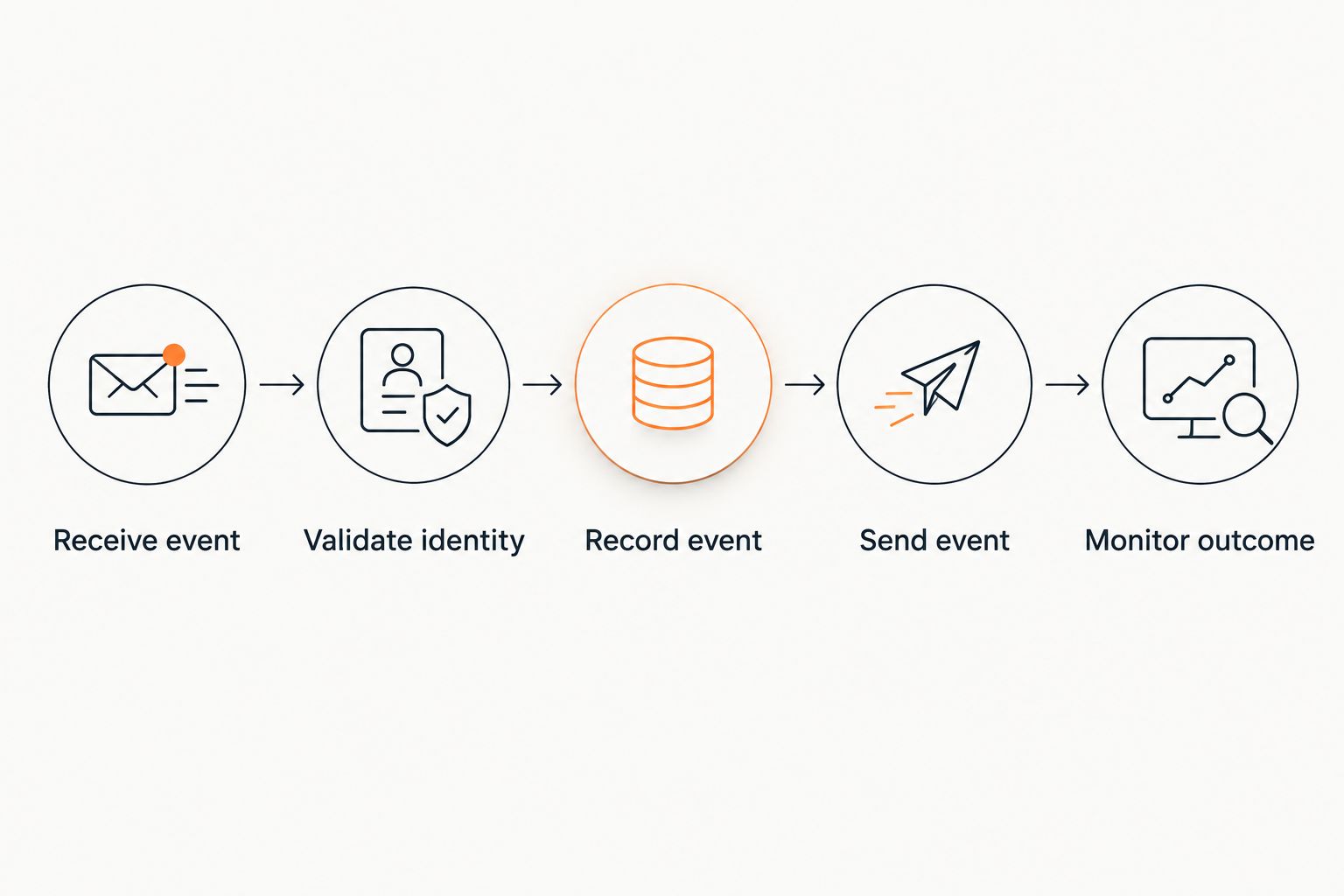 Record accepted events before downstream delivery so temporary failures do not erase showroom activity.
Configuration unit: Klaviyo event mapping
- Create a server-side API credential. Give the integration only the permissions required for its profile, event, and consent operations. Store the credential outside source code and establish a rotation process.
- Map customer identity. Use the profile identifier supported by the current Klaviyo API contract. Preserve the operational customer reference through an appropriate supported field rather than matching customers by name alone.
- Create the event request. Map the business event to a clearly named metric and include its occurrence time and relevant properties. Names such as Showroom Quote Created are suggested conventions, not built-in STORIS or Klaviyo events.
- Separate subscription operations. Send consent changes through the appropriate subscription interfaces and rules. Creating a profile or recording a purchase must not automatically subscribe that customer.
- Verify destination records. Inspect the profile and event in Klaviyo. Compare the source record identifier, customer identity, status, and occurrence time with the original STORIS record.
Expected result: The correct profile receives an understandable event, and its marketing subscription status remains consistent with the recorded permission.
Pin implementation decisions to the Klaviyo API revision selected for your 2026 deployment. Keep that revision in the technical documentation; do not assume an old request example matches the current contract.
Configuration unit: flow controls
- Open Klaviyo’s Flows area. Select Flows, then Create flow. Configure a metric-triggered flow using the event name your middleware sends.
- Define the message purpose. A quote follow-up should help the customer continue the specific purchase discussion. Do not imply that quoted merchandise has already been purchased or delivered.
- Add eligibility checks. Apply the relevant subscription requirements and exclude converted or cancelled quotes. Decide how the flow obtains current operational status before a scheduled message.
- Set timing with the business team. Document when a follow-up is useful and when it becomes intrusive. Treat the delay as a business decision, not an integration default.
- Test before enabling live sending. Use controlled profiles and source records. Verify the trigger, message content, exclusion conditions, and behavior when a customer unsubscribes after entering the flow.
Expected result: An eligible open quote enters the workflow, while an ineligible or converted quote does not receive an outdated follow-up.
A filter cannot check data the integration never sends. If purchase conversion must stop quote follow-up, provide the conversion event or current status needed to enforce that rule.
Variant: trigger follow-up when fulfillment changes
Once quote follow-up works, add a fulfillment-driven workflow. For your 2026 implementation plan, define the milestone before configuring the marketing trigger: an order update is not necessarily a completed fulfillment.
- Identify the source event and status that represent the chosen milestone.
- Decide whether the milestone applies to an individual item or the complete order.
- Send the fulfillment event with the customer reference and the relevant order context.
- Configure a separate Klaviyo metric-triggered flow and test repeat status updates.
For split fulfillment, define 2 decision branches: qualifying partial fulfillment and qualifying complete fulfillment. Your business can choose to message on either branch or only on completion, but the integration must distinguish them.
This variant supports follow-up tied to fulfillment rather than checkout. Its limitation is operational ambiguity: a generic completed flag is insufficient when different items reach different stages.
Treat review requests and cross-sell messages as separate marketing decisions. Fulfillment data supplies context; it does not remove consent requirements or determine what the customer should receive.
Troubleshooting
An event arrives, but the wrong profile receives it
Inspect the identity mapping and the source customer reference. Shared addresses, changed addresses, and incomplete records require explicit handling; matching by display name is not a reliable rule.
Quarantine ambiguous records rather than choosing a profile automatically. Correct the identity rule before replaying affected events.
A customer receives duplicate follow-ups
Check whether the source replayed an event, middleware retried a successful request, or an edit created another qualifying trigger. Deduplication must cover event processing, while flow rules must cover legitimate repeat business events.
Store delivery outcomes and use the destination’s documented duplicate-handling features where applicable. Do not treat every event for the same customer as a duplicate; separate quotes can be valid.
Quote reminders continue after a purchase
Check whether the purchase references the original quote and whether the integration updates the data used by the flow’s exclusion rules. A purchase on the same profile does not by itself establish which quote converted.
Preserve the quote-to-order relationship where the source provides it. Otherwise, define and test a business-approved cancellation rule before enabling reminders.
An unsubscribed customer becomes subscribed again
Find the operation that changed subscription state. A profile update or historical import must not override a later withdrawal of permission.
Keep consent provenance and modification times, and prevent older records from restoring a withdrawn subscription. Pause the offending synchronization until the rule is corrected.
Events stop reaching Klaviyo
Inspect receiver logs, queue depth, credential errors, and destination responses. Distinguish rejected payloads from temporary service failures and rate limits.
Alert on processing failures and stranded records, not just endpoint availability. A healthy web server does not prove that events are reaching marketing.
Customize your workflow
Before expanding the 2026 integration, run 5 test cases: a valid quote, a replayed event, a converted quote, a withdrawn subscription, and a downstream API failure. Record the expected profile, event, and messaging outcome for each case.
Then extend the scope by adding item context, store attribution, or customer segments only where the source data supports them. Document each new property’s meaning and owner so marketing does not build campaigns on misunderstood fields.
Endertech’s custom software and system integration services fit projects where this middleware needs business-specific rules. Read the API integration planning guide when defining responsibilities across operations, marketing, and development.
FAQ
How do I connect STORIS to Klaviyo for in-store personalization?
Connect relevant STORIS webhooks to server-side middleware that validates customer identity and sends mapped events to Klaviyo’s event API. Build metric-triggered flows around those events, with separate consent handling and operational status checks.
Can I connect STORIS and Klaviyo without custom middleware?
A middleware-free connection depends on an available connector that supports your required events, identity rules, and consent handling. Verify those capabilities before choosing it; this guide describes a custom middleware architecture.
Does a STORIS purchase automatically subscribe someone to Klaviyo marketing?
No. A purchase event is separate from marketing permission, so the integration must preserve recorded consent and respect withdrawals.
What should trigger a showroom quote follow-up?
Use a clearly defined quote event linked to an identifiable customer and a qualifying open quote. Recheck eligibility before sending so converted or cancelled quotes do not receive obsolete reminders.
How do I stop duplicate Klaviyo events from STORIS webhooks?
Record source event identifiers and delivery outcomes in middleware, then apply the destination API’s documented duplicate-handling behavior. Also test legitimate quote edits so deduplication does not suppress meaningful updates.
Can fulfillment events trigger review requests?
Fulfillment events can supply the trigger and context for a review-request workflow. Define the qualifying milestone, handle partial fulfillment explicitly, and apply the relevant messaging and consent rules.
What should I test before launching a STORIS Klaviyo integration in 2026?
Test customer identity, duplicate delivery, quote conversion, consent withdrawal, and downstream API failure before enabling live messages. Verify both the event record and the final messaging decision; successful API delivery alone is not sufficient.
One last thing
Test the message that must not be sent. In a 2026 rollout, an event appearing in Klaviyo proves data delivery, but a converted quote receiving no reminder proves that the business rule works. Make that negative test part of every workflow change.