


Best starting point for standard retail connections: Celigo. Best for cross-department automation: Workato. Best for engineering-led control: custom middleware. These Boomi alternatives for ecommerce integrations solve different problems; this 2026 guide explains which architecture fits your orders, inventory, accounting, and support responsibilities.
- Celigo is the first Boomi alternative to evaluate for standard ecommerce and ERP connections.
- Workato fits ecommerce integrations that extend into approvals, finance, and customer operations.
- MuleSoft fits API-centered architecture; Azure Logic Apps fits Azure-based integration teams.
- n8n fits developer-managed workflows; custom middleware fits business-specific transaction rules.
- Choose against real order failures, data ownership, and recovery requirements—not connector counts.
Why this matters
Replacing an integration platform changes more than the software that moves records. It changes where business rules live, who diagnoses failed orders, and how your team recovers when a system rejects an update.
An ecommerce integration has to preserve meaning across systems. A storefront order, an ERP sales order, and an accounting transaction are related records, not interchangeable copies. Start with what an ecommerce ERP integration must handle before comparing interfaces or automation builders.
Endertech provides ecommerce integration and custom software services for businesses connecting storefronts with operational systems. The useful buying question is whether your replacement supports the workflow you actually run, including its exceptions.
What makes the best Boomi alternative?
For a 2026 shortlist, use these criteria before assigning a winner:
- Workflow coverage: Confirm the required operations, not just whether a connector names your storefront or ERP.
- Data ownership: Decide which system controls each field, including inventory, customer identity, fulfillment status, and payment references.
- Failure recovery: Require a defined process for rejected records, duplicate events, retries, and reconciliation.
- Change control: Check how mappings, credentials, and workflows move from testing into production.
- Operating responsibility: Name the team that monitors failures and maintains integrations after launch.
- Architecture fit: Match the platform to your existing infrastructure and the amount of custom logic you need.
A connector is a starting point, not proof that an integration is complete. Your shortlist should survive a walkthrough of a real transaction from checkout through fulfillment and accounting.
Boomi alternatives at a glance
These recommendations identify distinct use cases, not a universal performance ranking. Each option needs validation against your exact systems and requirements.
| Option | Best for | Standout approach | Key limitation |
|---|---|---|---|
| Celigo | Standard retail system connections | Integration platform with ecommerce-focused packaged integrations | Packaged flows still need business-specific validation |
| Workato | Cross-department workflows | Recipe-based integration and automation | Business-critical recipes still require engineering discipline |
| MuleSoft Anypoint Platform | API-centered enterprise architecture | API development, management, and integration | More architectural responsibility than a narrow sync requires |
| Azure Logic Apps | Azure-based operations | Managed workflows within the Azure ecosystem | Connector behavior and Azure configuration require careful design |
| n8n | Developer-managed automation | Workflow automation with self-hosting options | Workflow tooling does not remove transaction-management work |
| Custom middleware | Business-specific transaction rules | Application code controlling integration behavior | Your organization owns ongoing software maintenance |
1. Celigo: best for standard retail system connections
Celigo is an integration platform with packaged integrations for business applications, including ecommerce workflows. Evaluate it first when your project connects established retail systems and your processes resemble the flows those integrations support.
The decisive question is how much of your actual process fits the packaged approach. An order connection that handles a straightforward sale still needs checking against partial fulfillment, customer matching, tax treatment, and cancellations.
Celigo pros:
- Packaged integrations give you a concrete starting point for evaluation.
- An integration-focused platform keeps connection work in a dedicated environment.
- Ecommerce-oriented workflows make retail requirements a useful starting discussion.
Celigo cons:
- Connector presence does not establish support for every required operation.
- Unusual mappings and exceptions still need explicit design.
- Configuration still needs an owner who understands the business process.
Best for: Retail teams seeking packaged integration foundations rather than a fully custom application.
For a 2026 evaluation, demonstrate the difficult order cases before accepting the standard flow. Verdict: Buy when the packaged foundation matches your core transactions; skip when exceptions dominate the design.
2. Workato: best for cross-department ecommerce automation
Workato combines application integration with recipe-based workflow automation. It belongs on your shortlist when ecommerce events trigger actions across finance, customer service, approvals, and other business functions.
For example, an order exception can require a customer-service task and an internal approval rather than another database update. That scenario is illustrative: you still need to verify the required applications, triggers, and actions.
Workato pros:
- Recipe-based workflows make event-and-action logic explicit.
- Integration and automation sit within the same platform approach.
- Its scope fits processes that cross departmental boundaries.
Workato cons:
- Visual workflows still need testing, permissions, and controlled releases.
- Transaction logic becomes harder to follow when spread across many recipes.
- A departmental automation approach needs clear ownership for core order processing.
Best for: Businesses connecting commerce operations with wider administrative workflows.
Keep order-critical logic separate from optional notifications so an email failure does not become an order-processing failure. Verdict: Buy for cross-functional automation; hold if your only requirement is a tightly defined inventory sync.
3. MuleSoft: best for API-centered enterprise architecture
MuleSoft Anypoint Platform supports API development, management, and application integration. Evaluate it when ecommerce is one consumer of shared business services rather than the only integration problem.
An API-centered approach can separate storefront behavior from underlying ERP details. That separation requires architectural decisions about interfaces, access, versioning, and responsibility; it is not simply another way to draw a workflow.
MuleSoft pros:
- API management and integration belong to the same platform family.
- Shared interfaces can serve multiple business applications.
- The approach suits teams deliberately building reusable business services.
MuleSoft cons:
- API design and governance add responsibilities beyond connecting applications.
- A narrow storefront-to-ERP project does not automatically justify this architecture.
- Reusable interfaces still require maintenance when underlying systems change.
Best for: Enterprise teams with an API strategy spanning commerce and other applications.
In 2026, choose MuleSoft because shared interfaces solve a documented organizational problem, not because the project sounds enterprise-sized. Verdict: Buy for an established API-centered strategy; skip for a simple connection without that requirement.
4. Azure Logic Apps: best for Azure-based integration teams
Azure Logic Apps is Microsoft's managed workflow service for connecting systems and orchestrating actions. It is a relevant alternative when your technical team already operates within Azure and wants integration workflows in that environment.
The practical advantage is alignment with existing operating practices. Your team still needs to design access controls, deployment, error handling, and any custom components the connectors cannot cover.
Azure Logic Apps pros:
- Managed workflows fit an Azure-based operating model.
- Connector-based orchestration provides a starting point for system connections.
- Workflows can participate in a wider Azure application architecture.
Azure Logic Apps cons:
- Connector behavior must match the specific operations you require.
- Azure configuration adds responsibilities for teams unfamiliar with the environment.
- Complex transformations can still require custom development.
Best for: Businesses whose integration support team already owns Azure infrastructure.
Validate the entire support path, including how someone traces a failed order across workflow and application components. Verdict: Buy when Azure alignment simplifies ownership; hold when adopting Azure would create a separate support burden.
5. n8n: best for developer-managed workflows
n8n is a workflow automation tool with self-hosting options and support for connecting services through workflow nodes and HTTP requests. It fits teams that want direct involvement in how workflows run and how custom actions are implemented.
Do not confuse editable workflows with a finished ecommerce transaction system. Reliable order processing still requires durable state, duplicate protection, reconciliation, and an exception-handling process designed for your business.
n8n pros:
- Self-hosting gives teams a deployment option they can operate themselves.
- HTTP-based steps support connections beyond packaged integrations.
- Workflows expose the sequence of actions for inspection.
n8n cons:
- Self-hosting assigns infrastructure maintenance to your team.
- Complex business rules can turn workflows into difficult-to-maintain applications.
- Recovery and transaction consistency remain design responsibilities.
Best for: Technical teams building bounded automations with clear operational ownership.
Begin with a workflow whose failure consequences your team can manage, then validate transaction-critical requirements separately. Verdict: Buy for developer-owned automation; skip as a shortcut around integration engineering.
6. Custom middleware: best for business-specific transaction rules
Custom middleware is an application built to connect your systems and implement your rules. It is an architectural alternative to Boomi, not a packaged platform with a ready-made feature list.
This approach fits workflows where mapping is only part of the problem. A furniture retailer, for example, can require separate treatment of showroom activity, online orders, fulfillment updates, and marketing consent; each rule needs an explicit design.
Custom middleware pros:
- Business rules can live in application code with automated tests.
- Data models and recovery behavior can match the required workflow.
- Integration boundaries can be designed around your operational systems.
Custom middleware cons:
- Your organization owns maintenance, deployment, security, and support.
- Every required capability must be built or selected deliberately.
- Documentation and knowledge transfer become essential operating assets.
Best for: Businesses with distinctive workflows and a named software maintenance owner.
Endertech's ecommerce integration and custom software services fit businesses that need business-specific connections between storefronts and operational systems. That is a service role, not a reason to rank the agency as an integration product.
Verdict: Buy the custom approach when your rules justify software ownership; skip when packaged workflows already meet the requirements.
How these alternatives are ranked
The order prioritizes a standard retail evaluation path, then separates options by operating model. It is not a claim that one platform outperforms every other platform.
The criteria are workflow coverage, data ownership, recovery, change control, support responsibility, and architecture fit. Your 2026 shortlist should change when those requirements change.
Validate the replacement before migrating
Use a transaction walkthrough, not a feature checklist alone. Write down what enters the integration, what each system must store, and how an operator confirms that the process finished correctly.
Workflow inventory
Start with 3 workflows: orders, inventory, and fulfillment. Document the owner, trigger, required fields, destination, and exception path for each; add returns, payments, and customer updates wherever your operation requires them.
Data mapping
Record identifier relationships and field ownership before building transformations. During a platform migration, mapping products, customers, orders, and integrations makes these dependencies explicit.
Failure testing
Send 2 deliveries of the same order event and require 1 ERP order as the acceptance result. This is a duplicate-protection test, not a platform performance benchmark. Also test an unavailable destination and a record rejected because required information is missing.
Cutover control
Define which integration can write each record during the transition. Running old and new connections together without clear ownership creates a route to duplicate or conflicting writes.
Operational handoff
Document how support finds a failed transaction, corrects its cause, and resumes processing. Give someone responsibility for unresolved exceptions; an alert without an owner is not a recovery process.
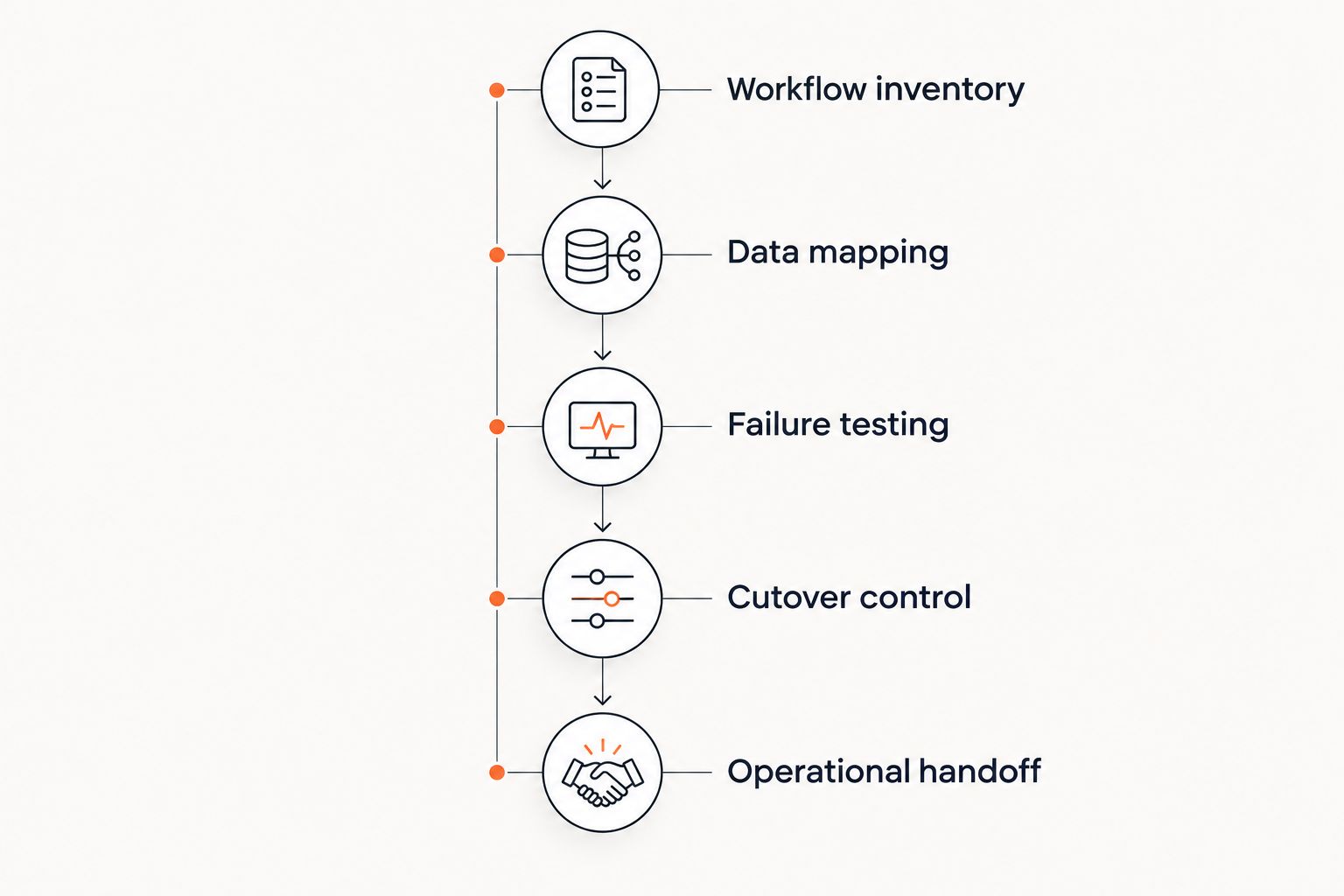 Validate recovery and ownership before handing the integration to operations.
Which Boomi alternative should you choose?
Start with Celigo when packaged retail connections match your requirements. Choose Workato for broader business automation, MuleSoft for shared API architecture, Azure Logic Apps for Azure-based ownership, and n8n for developer-managed workflows.
Choose custom middleware when business-specific rules outweigh the benefit of packaged flows. Endertech is a fit for businesses needing ecommerce integration and custom software services, rather than another workflow platform to administer.
For a 2026 replacement decision, do not authorize migration until you have a demonstrated transaction, a tested recovery path, and a named maintenance owner. Those deliverables matter more than a polished demonstration.
FAQ
What's the best Boomi alternative for ecommerce integrations?
Celigo is the first option to evaluate when your requirements match packaged retail integrations. Workato, MuleSoft, Azure Logic Apps, n8n, and custom middleware fit different workflow and ownership requirements.
Is Workato better than Celigo for ecommerce?
Workato fits cross-department automation, while Celigo is a starting point for packaged retail system connections. Compare your actual order, fulfillment, and exception workflows rather than choosing a universal winner.
Can n8n replace Boomi for order processing?
n8n can form part of an order-processing integration, but the workflow needs explicit duplicate protection, recovery, and reconciliation. Self-hosting also assigns infrastructure maintenance to your team.
When should a retailer choose custom middleware?
Choose custom middleware when business-specific rules do not fit packaged workflows and you can assign ongoing software ownership. Custom development does not remove maintenance; it makes maintenance your responsibility.
How much work does replacing Boomi involve?
The work depends on workflow count, mapping complexity, custom rules, system access, and recovery requirements. Include testing, cutover, documentation, and operational handoff in the scope rather than estimating connector setup alone.
Can existing Boomi workflows move directly to another platform?
Do not plan on transferring existing workflows unchanged. Use the existing business rules and mappings as requirements, then rebuild and validate them against the replacement platform's execution model.
What should an ecommerce integration proof of concept test?
Test a successful transaction, duplicate event delivery, a rejected record, and an unavailable destination. Require traceable results and a documented recovery process before approving production migration.
One last thing
Ask the finalist to demonstrate a failed order, not just a successful one. A successful demonstration proves that a path exists; recovery shows whether your operations team can keep using it when real systems reject data.