


TLDR
- Shopify's research says its TCO is 29% better than Adobe Commerce on average. Shopify commissioned that study, so treat it as the vendor's case.
- EY's report, also commissioned by Shopify, says migrating to Shopify is 25% faster and 3.3 times more likely to finish on budget than migrating to Adobe Commerce.
- Our maintenance tickets show the costs a license fee hides: forced security-patch upgrades, search engine moves that need Adobe support, storage alerts, and Adobe deadlines for services under the store.
- Adobe Commerce still fits deep B2B customization, a recent well-kept install, and hosting or compliance control.
- Compare twelve months of real maintenance work for your store against a Shopify build before you decide.
Adobe Commerce and Shopify differ most in the work after launch. Patches, version upgrades, hosting services, and the people who run them all add to total cost of ownership (TCO). None of them appear on a license line. Shopify has published research that says its TCO is 29% better on average. We maintain Adobe Commerce stores and build on Shopify, so this post sets Shopify's numbers next to what we see in our own maintenance tickets.
Every Shopify figure below comes from research that Shopify paid for, and we label each one. Treat them as the vendor's case, and as inputs for your own math.
What Shopify's commissioned research says
Shopify's public comparison pages cite two studies. Shopify commissioned both.
Total cost of ownership (Shopify-commissioned): Shopify's TCO is 29% better than Adobe Commerce on average. An independent consulting firm ran the research for Shopify from December 2023 to January 2024 and surveyed about 250 businesses in the US and Canada.
Cost areas in the same study (Shopify-commissioned): Adobe Commerce costs run 42% higher for platform fees and ecommerce stack, 24% higher for operations and support, and 42% higher for implementation and setup.
Migration speed and budget (Shopify-commissioned): EY's 2025 report The Pursuit of Time to Value says migrating to Shopify is 25% faster than migrating to Adobe Commerce. It also says migrations are 3.3 times more likely to finish on budget, with 3% lower budgeted implementation cost.
Bombas (Shopify case study): Shopify says Bombas lowered its platform costs in the first year after moving to Shopify Plus. The page gives a dollar amount, which we leave out. The story starts with a young company whose site crashed after a TV appearance. It is one company's account and a poor benchmark for a mature retailer.
You can read the sources yourself: Shopify's Shopify vs. Adobe Commerce page, its TCO comparison, EY's report page, and the Bombas case study.
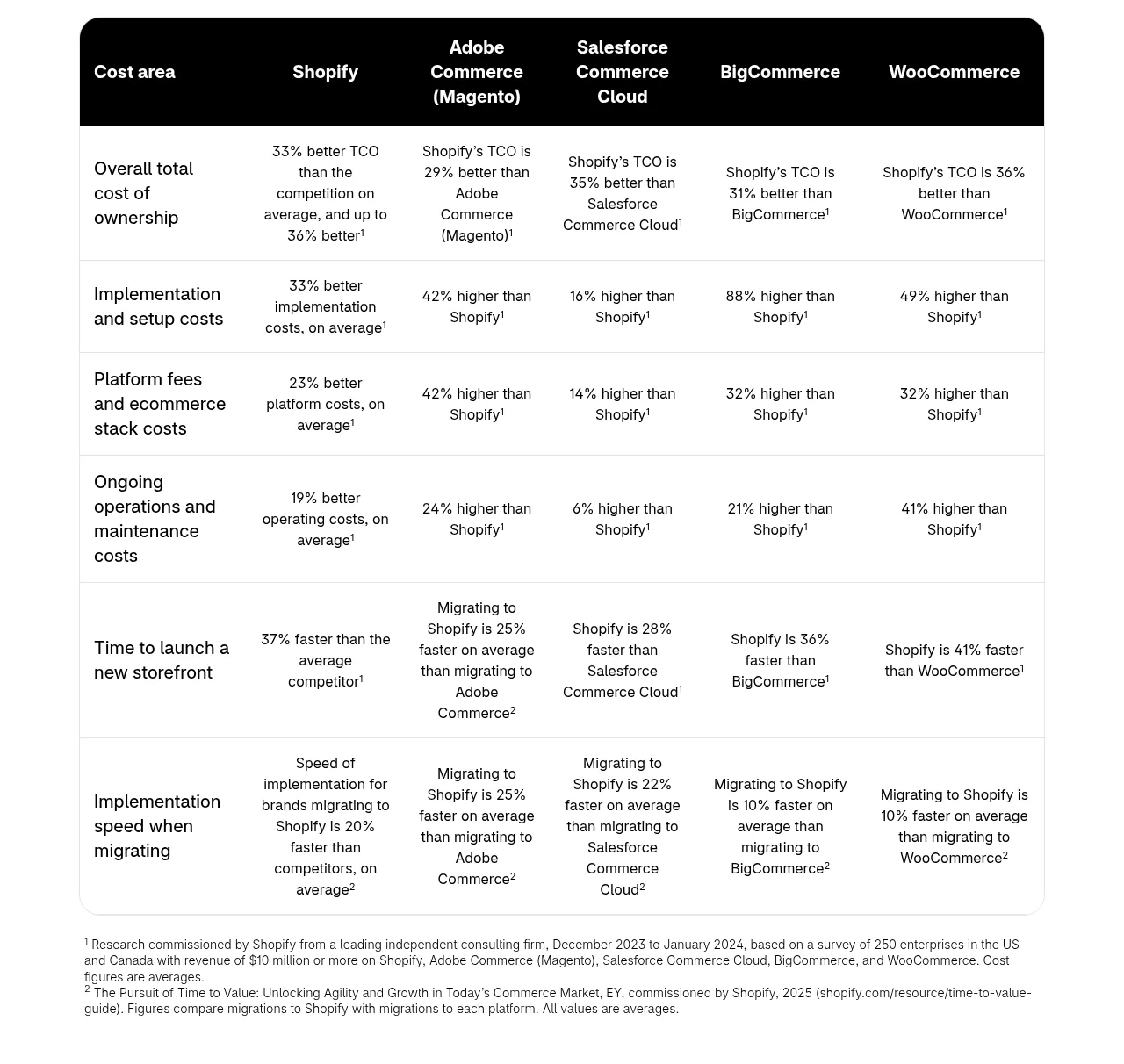
Shopify's own TCO table. Every figure in it comes from research that Shopify commissioned.
How to read these numbers
These are averages from a survey, and the sponsor chose the questions. A 29% average can hide a wide range. A retailer with few extensions and a current version may spend little on upkeep. A retailer with heavy customization may spend far more. The 3% lower budgeted cost is small. The 3.3 times figure says more, because it speaks to how predictable projects were.
The research also cannot see your store. Maintenance tickets can, so here is what ours show.
What Adobe Commerce upkeep looks like in our tickets
These examples come from one retailer we maintain on Adobe Commerce Cloud. We keep the client anonymous and describe the work without hours or prices.
A security bulletin became a version upgrade
In February 2025, Adobe published security bulletin APSB25-08. Within a week, the retailer's Adobe security scan flagged a critical issue on its production store, which ran version 2.4.5-p6. We first applied Adobe's isolated patch for the critical vulnerability (CVE-2025-24434). The scan still failed. That left the larger fix: move the whole application from 2.4.5-p6 to 2.4.5-p11.
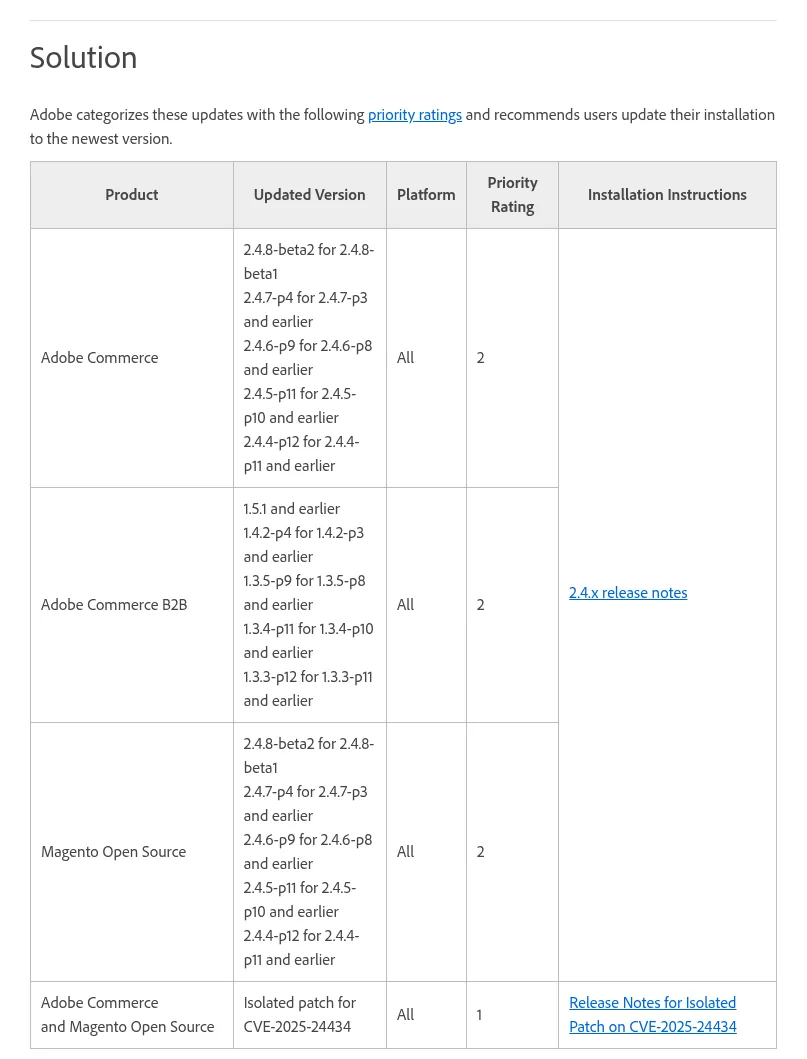
Adobe's APSB25-08 bulletin names 2.4.5-p11 as the fixed version for stores on 2.4.5-p10 and earlier.
From the first alert to the production push took about four weeks. A commercial extension package tied to the older version made the jump harder. The team used a Composer aliasing workaround to test on staging, then removed it once the extension files were updated. After the upgrade, search results looked wrong on staging.
A search engine change that needs 48 hours' notice
The search problem traced back to the search engine. Staging still ran Elasticsearch, so Adobe support had to switch it to OpenSearch. Production ran OpenSearch 1.2, and 2.4.5-p11 needs 1.3. On Adobe Commerce Cloud Pro, Adobe's team makes that change in staging and production, and the production work needs about 48 hours' notice. Adobe's service upgrade rules describe the same process.
Adobe ran the production upgrade in March 2025. Catalog listing pages were unavailable while it ran. Afterward we reindexed and redeployed.
Disk space alerts
Adobe's monitoring also emails when storage fills. In July 2025 it flagged the retailer's production storage at about 85% full, and a similar alert had come in before. Someone had to find which folders were growing before the server ran short. On staging, the biggest folders held product media and a large var directory full of compressed files, so cleanup meant removing old files. Another warning, this time for the exports volume, arrived in November 2025. Each alert is small. Each one still needs a person to read it, find the cause, and clear space.
Patches keep coming
Adobe's critical update APSB25-88 arrived in September 2025. One patch would not apply because the vendor code already contained the fix. A developer confirmed that and deployed the update to the live site as a soft patch. The store later moved to the 2.4.8 line. A tax connector needed its newest version, and custom code written against older extension versions had to be updated.
Adobe now sets deadlines for the services under the store
In 2026, Adobe published required actions for Adobe Commerce on Cloud. MariaDB 10.5 and below, RabbitMQ 3.9 and below, and any Elasticsearch version had to be upgraded by October 30, 2026. Stores on 2.4.4 or 2.4.5 must move to the latest version, or to Adobe's SaaS offering, by June 1, 2027. Adobe says environments that miss a deadline may lose Admin access or have traffic suspended.
Our retailer's ticket covered the same work: MariaDB from 10.4 to 10.6 or higher and RabbitMQ from 3.9 to 3.13 or higher, with OpenSearch planning alongside. The first Adobe deadline has already passed, so stores on older versions should ask Adobe Support where they stand.
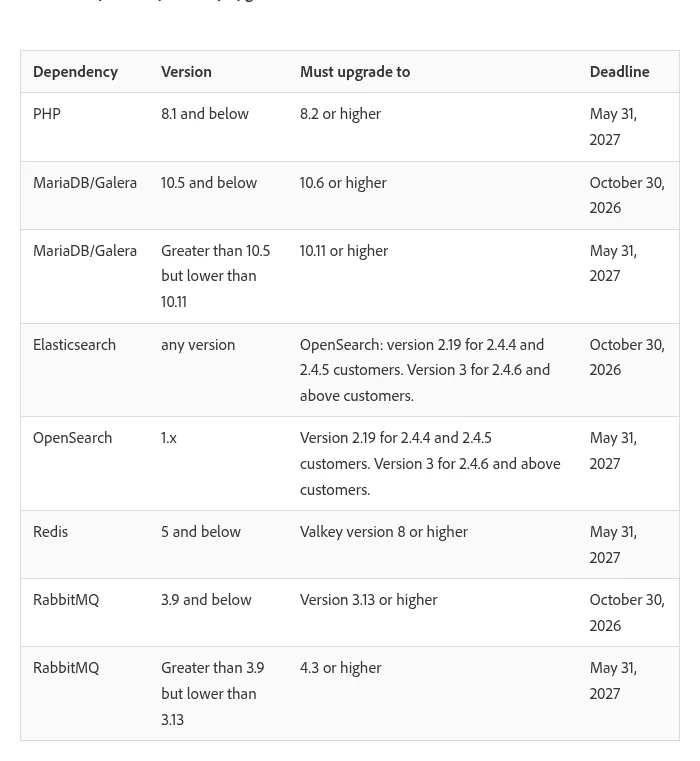
Adobe's table of required dependency upgrades for Adobe Commerce on Cloud, with deadlines.
What these tickets add to TCO
Each item above needed senior developer time. Each needed a staging test before production. Several waited on Adobe support to act on a schedule we did not control, and a few put the storefront at risk while they ran.
This is the work behind Shopify's 24% higher operations and support figure. Shopify says it handles hosting, patching, and infrastructure for you. On Shopify you still pay for apps, theme and custom development, and your plan. The difference is who runs the platform layer, and how often your team must schedule a project because of it.
When Adobe Commerce still fits
Adobe Commerce can be the better choice. We would keep a store on it in these cases.
Deep B2B customization. If you run company accounts, negotiated price lists, quote workflows, and ERP-driven pricing with logic built over years, rebuilding it on Shopify costs real time. Our comparison of Shopify Plus and Adobe Commerce for B2B covers the details.
A recent, well-kept install. A store already on 2.4.8 or 2.4.9, with few extensions and a team that applies patches on schedule, has already absorbed much of the upkeep. Moving it needs a business reason beyond cost.
Hosting or compliance control. Some companies must control where code and data run. Adobe Commerce supports on-premises and cloud options. Shopify is a hosted platform.
Adobe's managed option. Adobe Commerce as a Cloud Service moves upgrades to Adobe, and Adobe positions it for stores that want to leave upgrade cycles behind. Our tickets cover Adobe Commerce on Cloud, so we cannot speak to that option's day-to-day cost.
If you run 2.4.4 or 2.4.5, your choices are narrower. Adobe requires an upgrade to the latest version, or a move to its SaaS, by June 1, 2027. That deadline is a natural time to price every path.
How to compare your own TCO
Pull twelve months of data from your tickets, agency invoices, and Adobe support cases:
Patch and upgrade projects, and how long each took from alert to production.
Adobe support cases about services, storage, and search.
Extensions that blocked or slowed an upgrade, and their renewal terms.
Incidents or maintenance windows that affected sales.
The same list for a Shopify build: apps, theme work, custom functions, and integrations.
Price each item with your own rates. Use Shopify's percentages only as a sanity check.
If the comparison points toward Shopify, plan the move around search first. Our guide to migrating Magento to Shopify without losing organic search traffic covers redirects and layered navigation. Our Shopify SEO migration checklist covers the steps for any platform.
Endertech has helped businesses with ecommerce since 2000. We work from Los Angeles with clients across the United States, and we maintain Adobe Commerce stores as well as build on Shopify. We can price both paths from your ticket history. See our Magento to Shopify migration page.
Frequently asked questions
Is Shopify cheaper than Adobe Commerce?
Shopify's commissioned research says its total cost of ownership is 29% better than Adobe Commerce on average. That is a vendor-funded average. Your result depends on your extensions, your customization, and how much upkeep your team and agency do today. Compare twelve months of real maintenance work with a quote for a Shopify build.
What does the Adobe Commerce license fee leave out?
Hosting and services, extension licenses, security patches, version upgrades, search and database upgrades, storage cleanup, and the developer time to test each change. In our tickets, version upgrades and search engine changes took the most coordination.
Do I have to upgrade Adobe Commerce 2.4.5?
On Adobe Commerce on Cloud, Adobe requires versions 2.4.4 and 2.4.5 to move to the latest version, or to Adobe Commerce as a Cloud Service, by June 1, 2027. Adobe set October 30, 2026 for the first required upgrades to services such as MariaDB, RabbitMQ, and Elasticsearch. Check Adobe's required actions page and contact Adobe Support if you are unsure where you stand.
When should a store stay on Adobe Commerce?
When it has deep B2B customization, a recent and well-maintained install, or hosting and compliance needs that a hosted platform cannot meet. Our Shopify Plus vs Adobe Commerce for B2B comparison covers the B2B side.
Will I lose search traffic if I move from Adobe Commerce to Shopify?
Not if you plan for it. Map every URL, use 301 redirects, carry over metadata, and monitor Search Console for weeks after launch. See our guide to migrating Magento to Shopify without losing organic search traffic and our Shopify SEO migration checklist.