


Choose Shopify Plus if your B2B operation needs a fast-launching storefront with a manageable catalog and a small internal team; choose Adobe Commerce if you're running multi-entity B2B operations with complex quoting, tiered pricing, and custom workflows that justify a larger engineering investment. The real axis isn't "which platform is better" — it's how much custom logic your B2B sales process actually requires versus how much speed and low-maintenance operation you need to launch and keep running.
- Shopify Plus vs Adobe Commerce for B2B comes down to native complexity versus speed to launch.
- Adobe Commerce ships deeper B2B features out of the box: company accounts, quotes, requisition lists, tiered pricing.
- Shopify Plus launches faster and carries a lower ongoing maintenance burden for most mid-market B2B brands.
- Catalog scalability is a near-tie in 2026 — both platforms handle large SKU counts with different architectures.
Why this matters
B2B buyers don't shop like consumers. They negotiate contract pricing, order against credit terms, buy through multiple approvers, and reorder the same SKUs on a schedule. A platform that handles that well reduces manual order processing; one that doesn't turns your sales and ops team into a workaround factory.
Both Shopify Plus and Adobe Commerce can run a B2B storefront in 2026. They get there through opposite architectures — Shopify Plus as a managed SaaS platform, Adobe Commerce as a self-hosted or cloud-hosted application built on the Magento core. That architectural difference drives almost every tradeoff below. If you're weighing Shopify alternatives for B2B wholesale brands, this comparison is the starting point, not the whole decision.
At a glance
| Dimension | Shopify Plus | Adobe Commerce |
|---|---|---|
| Best for | Fast-launching B2B or hybrid B2B/D2C brands | Complex multi-entity, multi-brand B2B operations |
| Pricing model | Flat-rate SaaS subscription, predictable | Licensing plus infrastructure, variable |
| Standout feature | Managed hosting, no server ops | Native B2B module (company accounts, quotes) |
| B2B feature depth | Built through apps and B2B on Shopify | Native company accounts, quotes, requisition lists |
| Speed to launch | Weeks to a few months, standard themes | Months, heavier customization typical |
| Customization and extensibility | Constrained by Shopify's app/API model | Full source access, PHP-level customization |
| Checkout customization | Checkout Extensibility narrows the gap | Full checkout control by default |
| Hosting and operations | Fully managed, no server maintenance | Requires hosting, patching, and scaling ownership |
| Catalog scalability | Handles large catalogs, tuned for retail-scale search | Handles large catalogs, tuned for complex attribute sets |
| Multi-brand / multi-entity support | Multiple storefronts via Shopify Plus, added complexity | Multi-site, multi-store-view built into the core |
Adobe Commerce offers deeper native B2B functionality out of the box
Adobe Commerce's B2B module — company accounts, negotiated quotes, requisition lists, and shared catalogs — ships in the core platform. A distributor with multiple buyers per account, tiered credit limits, and negotiated pricing gets most of that structure without a third-party app.
Shopify Plus reaches the same functionality through B2B on Shopify plus a layer of apps for quoting and account hierarchies. It works, and Shopify has closed much of the gap since B2B on Shopify shipped, but you're assembling capability rather than inheriting it.
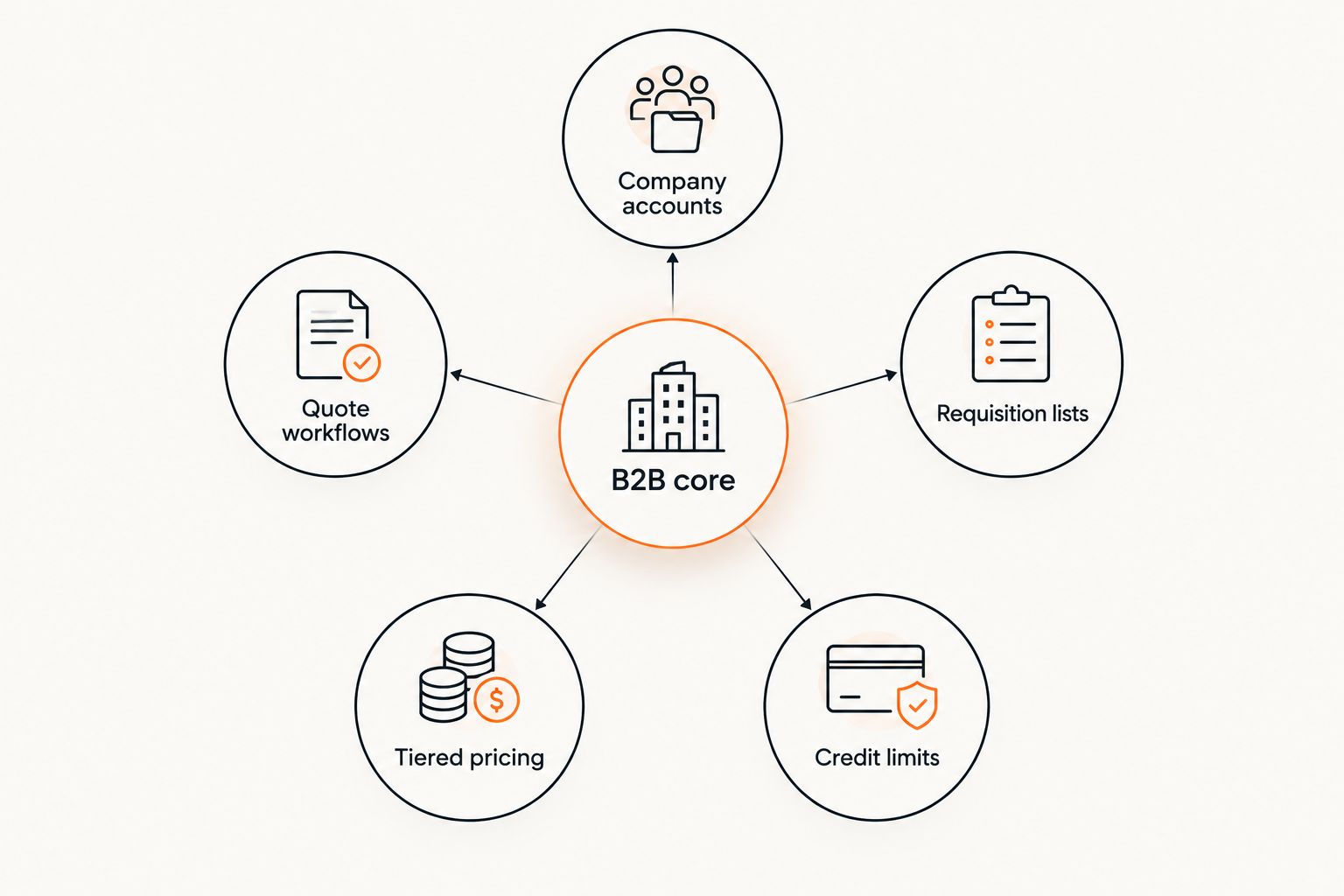 These five capabilities ship in Adobe Commerce's core rather than as bolt-on apps.
Verdict: if your sales process runs on negotiated terms and account hierarchies today, Adobe Commerce starts you closer to done.
Shopify Plus launches faster for B2B storefronts
Shopify Plus projects move faster because the platform handles hosting, security patching, and infrastructure decisions for you. A team building a standard B2B storefront on themes and apps can go live in weeks rather than months.
Adobe Commerce projects almost always involve more upfront architecture work — defining hosting, planning for PCI scope, and configuring the B2B module for your specific account structure. That work pays off in flexibility later, but it adds real time before launch.
Verdict: teams on a tight launch timeline lean Shopify Plus; teams that can absorb a longer build lean Adobe Commerce.
Adobe Commerce gives developers more control over custom logic (by a lot)
Adobe Commerce is open at the code level. Developers can modify checkout flow, pricing logic, and order processing directly in the application layer. That matters when a B2B workflow doesn't fit a standard ecommerce pattern — custom approval chains, unusual pricing math, or integration logic that has to run inline with checkout.
Shopify Plus limits how deep you can go. You extend through Shopify's APIs, Shopify Functions, and app architecture rather than modifying the platform's core. That's a deliberate tradeoff Shopify makes for stability and upgrade safety, but it means some custom logic simply isn't possible without workarounds.
Verdict: if custom order logic is central to your B2B process, Adobe Commerce wins here clearly.
Shopify Plus's Checkout Extensibility narrows the customization gap
Shopify's move to Checkout Extensibility gave Plus merchants far more control over checkout than the old checkout.liquid model allowed — custom fields, conditional logic, and app-based extensions at checkout. It's not full source access, but for most B2B checkout requirements (PO number capture, net-terms selection, approval flags) it's enough.
Adobe Commerce still has the edge for checkout logic that needs to branch in ways Shopify's extension model doesn't anticipate.
Verdict: for typical B2B checkout requirements, Shopify Plus is close enough that the gap rarely decides the project.
Shopify Plus removes infrastructure management entirely
Shopify Plus is fully managed. No server provisioning, no PHP version upgrades, no scaling decisions during a traffic spike — Shopify owns that layer. For a lean internal team, that's a direct reduction in operational risk, the same risk covered in how much it costs to fix a slow-loading Shopify store when that ownership gets skipped.
Adobe Commerce requires a hosting decision — Adobe Commerce Cloud or self-managed infrastructure — and ongoing responsibility for patching, scaling, and PCI compliance boundaries. That ownership gives you more control over performance tuning, but it's a real staffing and budget line, not a one-time setup cost.
Verdict: teams without dedicated DevOps resources are better served by Shopify Plus's managed model.
Both platforms handle large B2B catalogs well, with different scaling models
Catalog scalability is one of the few genuine ties. Shopify Plus's search and catalog infrastructure scales well for large SKU counts and high-traffic retail patterns. Adobe Commerce's catalog engine handles deep attribute sets and complex categorization — common in distribution and manufacturing catalogs — at similar scale.
The difference isn't capacity, it's shape: Shopify optimizes for fast, retail-style browsing at volume; Adobe Commerce optimizes for attribute-heavy, configurable product structures. Either can outgrow a catalog decision made without planning — see ecommerce platforms ranked by catalog scalability for how that plays out across platforms generally.
Verdict: neither platform is the constraint for most B2B catalogs — your data model and attribute strategy usually matter more than the platform choice here.
Adobe Commerce handles multi-brand, multi-entity B2B operations better
Adobe Commerce's multi-site and multi-store-view architecture is built for running several brands, regions, or B2B/D2C storefronts from one instance with shared or separated catalogs, pricing, and inventory rules. Distributors managing multiple legal entities or brand lines get that structure natively.
Shopify Plus supports multiple storefronts, but coordinating shared inventory, pricing, and customer data across them typically requires custom middleware or third-party sync tools rather than a built-in multi-entity model.
Verdict: multi-brand or multi-entity operations should weight this heavily toward Adobe Commerce.
Pricing models: predictability versus flexibility
Neither platform's pricing is fixed enough to quote in a comparison article — Shopify Plus pricing depends on your sales volume and contract terms, and Adobe Commerce licensing scales with your gross revenue and hosting choice. What's stable is the model each one uses.
- Shopify Plus: a subscription-based model with predictable recurring cost, making budgeting simpler but offering less room to negotiate as volume changes.
- Adobe Commerce: a licensing model tied to business scale, plus separate hosting and development costs — more variable, but with more room to control where the money goes.
If platform cost is being weighed against a migration decision, the real number to model is total cost of ownership over 2-3 years, not the sticker price of either platform. Magento to Shopify migration cost breaks down the variables that actually move that number.
Final verdict
Choose Shopify Plus if you're a growing wholesale or hybrid B2B/D2C brand that needs a storefront live in months, has a catalog that fits standard ecommerce patterns, and doesn't have in-house DevOps to manage infrastructure — Shopify Plus wins for speed and low operational overhead.
Choose Adobe Commerce if you're an enterprise manufacturer or distributor running multiple entities or brands, negotiated account-level pricing, and order workflows that don't fit a standard checkout — Adobe Commerce wins for depth of native B2B control.
Scorecard recap
| Dimension | Winner |
|---|---|
| B2B feature depth | Adobe Commerce |
| Speed to launch | Shopify Plus |
| Customization and extensibility | Adobe Commerce |
| Checkout customization | Shopify Plus (close) |
| Hosting and operations | Shopify Plus |
| Catalog scalability | Tie |
| Multi-brand / multi-entity support | Adobe Commerce |
Not sure which platform fits your B2B model?
Get a technical review of your catalog, workflows, and integration needs before you commit.
FAQ
Is Shopify Plus good for B2B ecommerce in 2026?
Yes, for B2B brands with manageable catalog complexity and standard order workflows. Shopify Plus uses B2B on Shopify plus apps to cover company accounts, quoting, and net terms, and launches faster than Adobe Commerce for most mid-market projects.
Is Adobe Commerce better than Shopify Plus for B2B?
Adobe Commerce is better when your B2B process needs native multi-entity support, deep custom order logic, or complex negotiated pricing. Shopify Plus is better when speed to launch and low maintenance matter more than deep customization.
Which platform has better native B2B features?
Adobe Commerce ships company accounts, requisition lists, and quote workflows in its core B2B module. Shopify Plus builds equivalent functionality through B2B on Shopify and third-party apps.
Does Shopify Plus support multiple B2B storefronts?
Shopify Plus supports multiple storefronts, but syncing shared inventory and pricing across them usually requires custom middleware rather than a built-in multi-site model like Adobe Commerce's.
How does Shopify Plus checkout customization compare to Adobe Commerce?
Shopify's Checkout Extensibility covers most B2B checkout needs like PO number fields and net-terms selection. Adobe Commerce still allows deeper, code-level checkout changes when a workflow doesn't fit Shopify's extension model.
Who manages hosting for Shopify Plus versus Adobe Commerce?
Shopify manages hosting entirely for Plus merchants. Adobe Commerce requires you to choose and manage hosting, whether through Adobe Commerce Cloud or a self-managed environment.
Can Adobe Commerce or Shopify Plus handle large B2B catalogs?
Both handle large catalogs well in 2026. Shopify Plus is tuned for high-traffic retail-style browsing at scale, while Adobe Commerce is tuned for deep, attribute-heavy catalog structures common in distribution.
Is migrating from Adobe Commerce to Shopify Plus common for B2B brands?
It happens most often when a B2B brand's catalog and order workflows are standard enough to run on Shopify Plus and the team wants to shed infrastructure management. It's less common when multi-entity or heavily custom quoting logic is core to the business.
One last thing
The decision usually isn't platform capability — both platforms can technically do most of what a B2B operation needs by 2026. It's whether your team wants to own infrastructure and code-level customization (Adobe Commerce) or hand that layer to a managed platform and work within its extension model (Shopify Plus). Map your actual order workflows — approval chains, pricing tiers, credit terms — against each platform's native support before pricing anything out; that exercise catches more mismatches than a feature checklist ever will.