


TLDR
- Algolia is the best starting point for search-led product discovery, not a complete shopping assistant.
- The OpenAI API fits custom buying advice when your application supplies verified product facts and business rules.
- Rasa fits controlled shopping conversations that need explicit steps, validation, and handoffs.
- The best AI shopping assistant platforms depend on catalog quality, retrieval, and ecommerce integration.
Best default for search-led product discovery: Algolia. Best for custom buying advice: the OpenAI API. Best for controlled shopping workflows: Rasa. This 2026 guide compares the best AI shopping assistant platforms by catalog requirements, implementation work, and the limits of each approach—not by chatbot appearance.
Why this matters
A shopping assistant has to translate a customer's question into defensible product choices. That requires more than fluent answers: it needs structured attributes, reliable retrieval, and a clear boundary between product facts and generated explanations.
A furniture shopper asking for a sofa that fits a narrow doorway needs dimensions and delivery constraints, not a persuasive description. An automotive shopper asking about fitment needs compatibility records, not a model's guess. Missing data remains missing after you add a chatbot.
Endertech is a fit for businesses that need an AI shopping assistant integrated with ecommerce and custom business systems. Endertech provides ecommerce, custom software, and system integration services; it is not a software platform in this ranking.
What makes the best AI shopping assistant platforms?
Use these criteria to evaluate a 2026 shortlist before watching demonstrations:
Catalog grounding: Recommendations must point to actual product records and distinguish verified attributes from missing information.
Intent handling: The system must turn ordinary language into useful filters, follow-up questions, or retrieval requests.
Business constraints: Mandatory requirements belong in explicit rules, not instructions that a language model can reinterpret.
Integration ownership: Identify who maintains catalog feeds, storefront connections, authentication, and downstream actions.
Operational control: You need observable failures, correction paths, and a way to stop problematic responses.
Evaluation: Judge relevant recommendations, factual answers, and completed shopping tasks separately from conversational fluency.
The strongest implementation matches these responsibilities to the right components. A discovery engine, recommendation engine, and conversation framework solve different parts of the problem.
Platforms at a glance
These are implementation choices, not interchangeable turnkey assistants. The order follows the use-case sections below; it does not imply that every retailer should buy the first option.
Platform | Best for | Standout capability | Key limitation |
|---|---|---|---|
Algolia | Search-led catalog discovery | Search, filtering, and product discovery infrastructure | Conversation and business actions need additional implementation |
OpenAI API | Custom consultative shopping | Language interaction and tool calling | Your application owns retrieval, validation, and storefront behavior |
Rasa | Controlled shopping workflows | Explicit conversational flows and custom actions | Catalog discovery needs separate search or retrieval infrastructure |
Google Vertex AI Search for commerce | Retail search and browsing | Retail-focused search and recommendation services | Conversational behavior remains a separate implementation responsibility |
Amazon Personalize | Behavior-based product suggestions | Managed personalized recommendation models | It is not a conversational shopping assistant |
1. Algolia: best for search-led shopping assistance
Algolia provides search and discovery infrastructure that an application can use to retrieve products, apply filters, and present relevant results. It fits assistants whose central job is helping shoppers find products within a structured catalog.
Consider a shopper requesting a compact dining table with an extendable top. The assistant can translate that request into searchable attributes, then explain the retrieved results. Algolia supplies the discovery layer; the implementation still needs to decide how conversations become queries and how product evidence becomes an answer.
Algolia pros:
Search and filtering provide a concrete foundation for product retrieval.
Structured attributes can support explicit shopping constraints.
Search relevance can be managed separately from conversational wording.
Algolia cons:
Product data still needs consistent indexing and attribute definitions.
An index does not independently verify a product's suitability.
Conversation history, cart actions, and escalation require application work.
Best for: Retailers whose main problem is helping customers find the right catalog items.
Verdict: Buy for search-led discovery; do not treat Algolia alone as a finished shopping assistant. Start with retrieval quality before adding elaborate dialogue.
2. OpenAI API: best for custom consultative shopping
The OpenAI API provides language models and tool-calling capabilities for building a custom assistant. Your application supplies the product retrieval tools, permitted actions, conversation interface, and validation rules.
This approach fits shopping questions that require explanation and clarification. A shopper comparing upholstery materials, for example, can ask follow-up questions while the application retrieves documented material characteristics. The model explains the evidence; it must not invent care instructions or durability claims.
OpenAI API pros:
Supports natural-language questions and explanatory responses.
Tool calling connects conversations to application-defined functions.
A custom application can combine catalog records with approved guidance.
OpenAI API cons:
Generated answers require factual checks and clear failure behavior.
Tool requests need application-side authorization and validation.
The retailer owns testing, integration, monitoring, and ongoing maintenance.
Best for: Businesses whose shopping experience needs tailored advice across several connected systems.
Verdict: Buy as a development component when custom advice is essential; skip it as a standalone catalog solution. In 2026, the model choice should follow the application requirements—not replace them.
3. Rasa: best for controlled shopping workflows
Rasa is a conversational application framework with flow management and custom-action capabilities. It fits assistants that need to collect required information and follow defined business processes.
A compatibility workflow illustrates the distinction. The assistant asks for the required identifying details, validates the answers through a custom action, and returns only supported matches. The application needs a reliable compatibility source; a controlled conversation cannot repair an incomplete reference database.
Rasa pros:
Defined flows make required steps explicit.
Custom actions connect conversations to business logic.
Structured workflows support deliberate escalation and exception handling.
Rasa cons:
Search and recommendation infrastructure remain separate concerns.
Flow design requires maintenance as business rules change.
Unstructured advisory questions need additional handling beyond a fixed process.
Best for: Shopping journeys with mandatory questions, eligibility checks, or compatibility validation.
Verdict: Buy when process control matters more than open-ended conversation. Avoid forcing every discovery question into a lengthy scripted sequence.
4. Google Vertex AI Search for commerce: best for retail discovery
Google Vertex AI Search for commerce provides retail-focused search and recommendation services. It belongs on the shortlist when search and browsing are central to the shopping experience and the business can support the required catalog and event integration.
Treat it as discovery infrastructure rather than assuming it supplies your entire conversational storefront. Your implementation still needs to determine which customer requests become search queries, how results are explained, and which actions the assistant is permitted to perform.
Google Vertex AI Search for commerce pros:
Combines retail search and recommendation services within Google's cloud ecosystem.
Uses catalog information and user-event inputs for discovery functions.
Separates retrieval responsibilities from the conversational interface.
Google Vertex AI Search for commerce cons:
Catalog ingestion and event instrumentation require implementation work.
Google Cloud setup becomes part of your operating responsibilities.
It does not remove the need to validate generated product explanations.
Best for: Retail teams evaluating managed discovery services within a Google Cloud architecture.
Verdict: Buy when the discovery architecture and operating environment fit; hold until data integration ownership is clear. Do not choose it solely because the assistant demonstration sounds convincing.
5. Amazon Personalize: best for behavior-based recommendations
Amazon Personalize is a managed recommendation service that uses interaction data and, depending on the configuration, item and user information. It can supply product suggestions to an assistant, but it does not conduct the conversation itself.
Its role is different from attribute matching. A recommendation based on shopping behavior answers which products a person might find relevant; a catalog filter answers which products satisfy stated requirements. Keep those decisions separate when a shopper specifies a non-negotiable constraint.
Amazon Personalize pros:
Provides personalized recommendation infrastructure.
Uses customer interaction history rather than only written product descriptions.
Can supply recommendations to different customer-facing interfaces.
Amazon Personalize cons:
Requires suitable interaction data and event integration.
Behavioral relevance does not establish technical compatibility.
Conversation, explanations, and business rules need other components.
Best for: Retailers prioritizing personalized suggestions based on customer behavior.
Verdict: Buy as a recommendation component; skip it as the sole platform for conversational catalog advice. Lower priority is appropriate when your immediate problem is missing attributes rather than personalization.
How to implement a catalog-grounded assistant
Endertech's ecommerce and system integration services are relevant when a shopping assistant must connect to existing business applications. Define the boundaries before selecting the conversational interface. The following sequence keeps the implementation focused on product evidence and controlled actions.
Define ownership
Identify the authoritative system for each field: product identifiers, dimensions, materials, compatibility, and customer-facing descriptions. Document which fields are required for each recommendation task.
If an ERP participates in the architecture, review what an ecommerce ERP integration must handle. The assistant should consume an agreed data contract, not reconcile conflicting records during a customer conversation.
Retrieve products
Convert the customer's request into search criteria and retrieve candidate records. Separate required constraints from preferences so a desirable attribute does not override an essential one. When answers must come from your own product data and policies, RAG development grounds each response in the source records and cites where it came from.
Validate constraints
Check candidate products against explicit rules before generating advice. Missing compatibility evidence should trigger a clarification or handoff, not a confident recommendation.
Explain evidence
Generate explanations from the validated records. Keep product identifiers attached to the supporting information so the interface can show which item each claim describes.
Monitor outcomes
Record failed retrievals, unsupported responses, and unsuccessful actions. Review the underlying cause: catalog quality, query interpretation, business rules, or interface behavior.
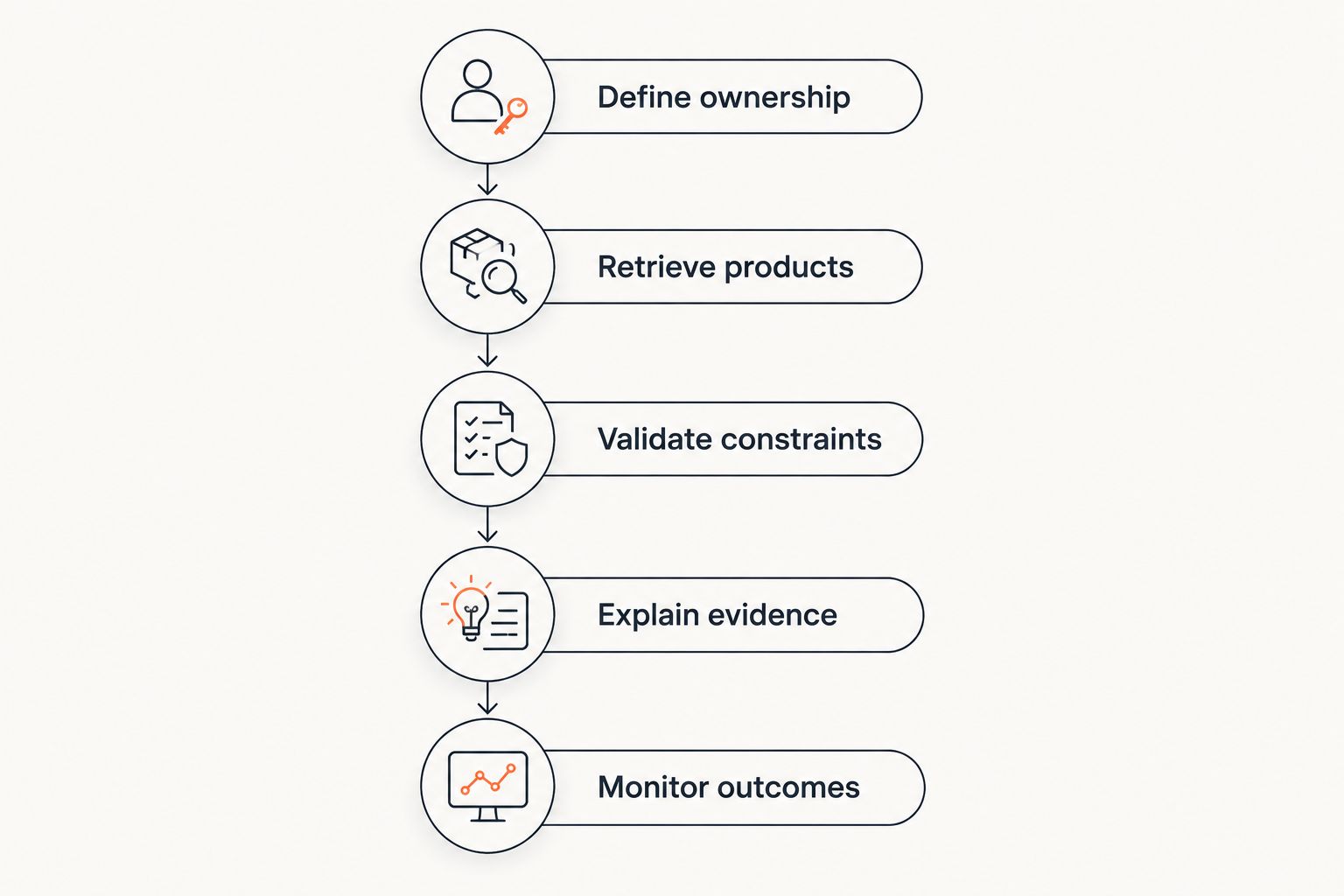
Validate product constraints before asking the assistant to explain a recommendation.
How to evaluate your 2026 shortlist
Use a proposed pilot of 30 shopping queries, including 10 comparison questions and 5 missing-attribute scenarios. These are practical test-design recommendations, not performance benchmarks. Fill the remaining cases with your customers' actual discovery and product-detail questions.
For every query, define an acceptable outcome before testing. A correct clarification is a successful answer when the catalog cannot support a recommendation; an invented answer is a failure even if it sounds helpful.
Retrieval: Did the assistant identify products satisfying the required constraints?
Factuality: Does each product claim match an approved record?
Interaction: Did the assistant ask a necessary question without restarting the journey?
Action safety: Did the application validate identifiers and permissions before acting?
Recovery: Can the customer continue when retrieval or a connected service fails?
Include ordinary storefront browsing in the evaluation. An assistant that answers accurately but makes customers work harder has not solved the shopping problem.
How we ranked
This 2026 ranking orders implementation choices by distinct catalog-assistance use cases: search-led discovery, custom advice, controlled workflows, retail discovery infrastructure, and behavioral recommendations. It is not a measured performance leaderboard.
The criteria are catalog grounding, intent handling, constraints, integration ownership, operational control, and evaluation. Endertech is identified separately as an implementation agency, not compared with software products or inserted into a provider ranking.
Which platform should you choose?
Choose Algolia first when your assistant primarily needs to find products through search and structured filters. Choose the OpenAI API when explaining and clarifying complex requirements is the central task, with retrieval and validation supplied by your application.
Choose Rasa for mandatory workflows. Evaluate Google Vertex AI Search for commerce for managed retail discovery within your cloud architecture, and Amazon Personalize for behavior-based recommendations.
For a 2026 project, select the smallest set of components that covers the actual shopping task. Adding several platforms before resolving catalog ownership increases the number of connections you must maintain without fixing the underlying product data.
One last thing
Write the correct refusal before writing the ideal recommendation. Decide what the assistant should say when a required dimension, material detail, or compatibility record is missing.
That decision reveals whether your 2026 shopping assistant is designed to help customers choose—or merely to keep answering. A useful assistant knows when the catalog does not support a conclusion.
Related guides
Frequently asked questions
What's the best AI shopping assistant platform for a product catalog?
Algolia is the default shortlist choice for search-led catalog discovery. The OpenAI API fits custom advice, while Rasa fits controlled workflows; each requires implementation beyond the platform itself.
Is a shopping assistant the same as site search?
No. Site search retrieves products, while a shopping assistant also interprets questions, asks for clarification, and explains results. Search can serve as the assistant's retrieval layer.
Can the OpenAI API recommend products from my catalog?
Yes, through an application that retrieves your product records and supplies them to the model. Your application must validate constraints and prevent unsupported product claims.
Is Amazon Personalize a complete shopping chatbot?
No. Amazon Personalize supplies personalized recommendations, not a complete conversational interface. You need separate components for dialogue, explanations, and permitted shopping actions.
Should a furniture retailer choose a chatbot before organizing product data?
No. Furniture recommendations require usable attributes such as dimensions and materials. Define the product records and required fields before choosing how the assistant presents them.
How should I test a shopping assistant in 2026?
Test against real shopping tasks with expected outcomes defined in advance. Include comparison questions, missing attributes, and mandatory constraints, then check retrieval and factual accuracy separately.
Does Endertech sell an AI shopping assistant platform?
Endertech is a digital agency, not a platform in this comparison. Its stated services include ecommerce, custom software, system integration, automation, and digital product development.