


2023 Prediction
Two Years Later: TailwindCSS Didn't Just Survive - It's Thriving (And So Is Bootstrap)
Two years ago, in December 2023, I wrote a blog post predicting the demise of TailwindCSS. I compared it to Bootstrap's trajectory and concluded that Tailwind would follow the same pattern: useful for maybe 5 or 6 years before being replaced by something new.
I was wrong.
Numbers
What the Numbers Say
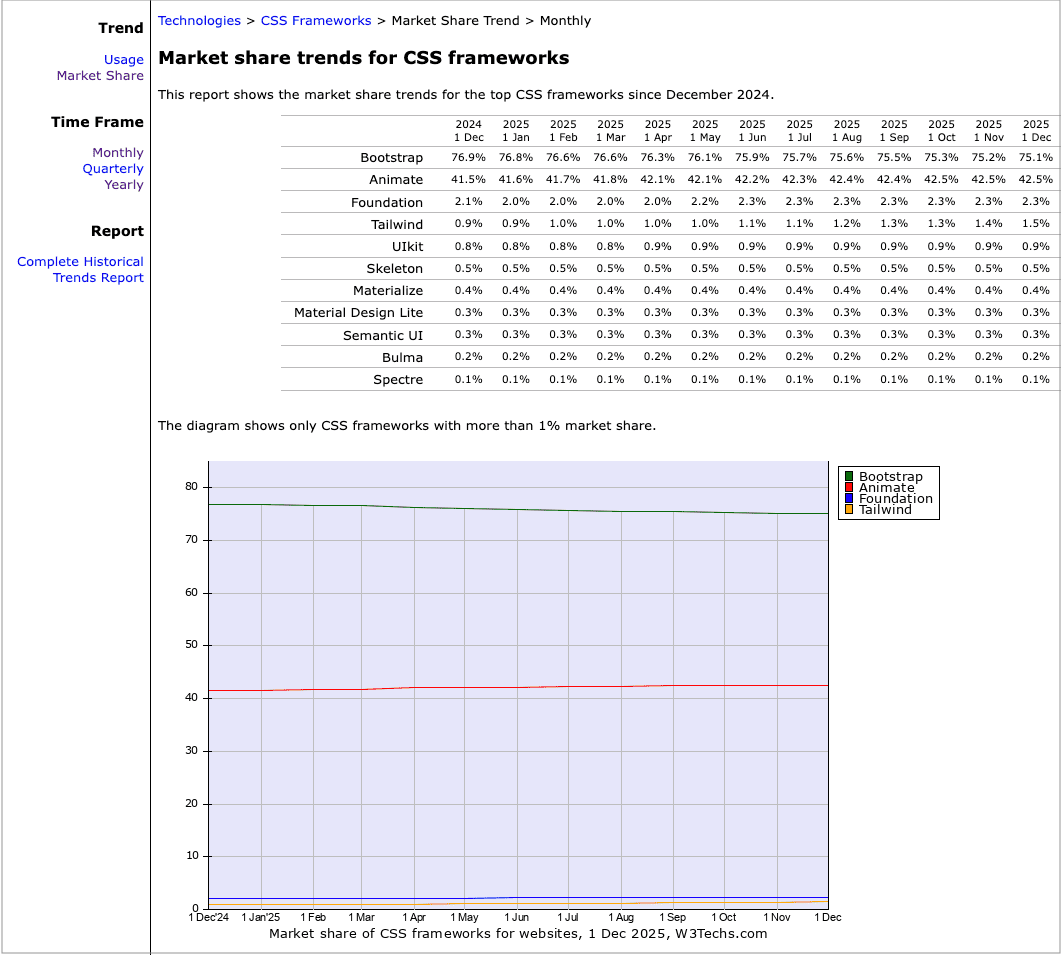
Let me start with the data. According to W3Techs, Bootstrap still commands 75.4% market share as of September 2025, down slightly from 77.1% in September 2024. That is not a framework in decline. That is remarkable stability.
And Tailwind? It grew from 0.8% to 1.3% in just one year, a 62% increase. Both frameworks are not just surviving. They are holding their ground and, in Tailwind's case, actively growing.
I expected both to be fading by now. Instead, they found their footing.
Bootstrap
Why Bootstrap Refuses to Die
I wanted to understand who actually uses Bootstrap in 2025.
Over 3.7 million companies globally use Bootstrap (6sense), including Twitter, Spotify, Lyft, and LinkedIn. But here is the interesting part: template marketplaces and developer tools dominate Bootstrap usage (AdminLTE).
Bootstrap is not thriving in cutting-edge startups or design-forward agencies. It thrives in B2B software, admin dashboards, and rapid prototyping. Small businesses have largely abandoned custom Bootstrap development (AdminLTE), but enterprise software and template businesses keep it alive.
Why? Bootstrap solves a specific problem: getting a functional, professional-looking interface up and running quickly when design is not the primary concern.
Tailwind
Tailwind Beyond Shopify
I assumed Tailwind was mainly a Shopify ecosystem tool. I was wrong about that too.
GitHub, Spotify, and Coinbase use Tailwind (Medium). Netflix adopted it (Aynsoft). Developer tool companies like Vercel, Algolia, Intercom, Clerk, and Sanity CMS built their interfaces with Tailwind (AdminLTE). The framework spans financial platforms, content management systems, entertainment sites, and e-commerce.
What these companies have in common is not Shopify. It is a need for highly customized interfaces that do not look like Bootstrap templates.
Tailwind succeeded where I thought it would fail because it solved Bootstrap's biggest problem: the inability to create truly custom designs without fighting the framework.
Adaptation
The Evolution I Missed
Here is where I got it fundamentally wrong in my 2023 prediction. I assumed CSS frameworks follow a predictable lifecycle of rise, dominance, and replacement.
What I missed: both Bootstrap and Tailwind were not standing still. They were evolving.
Bootstrap 5 released on May 5, 2021 (Orangeable), after alpha testing that began in June 2020. The biggest change? Bootstrap 5 removed jQuery as a dependency, saving 85KB of minified JavaScript (InfoQ). This was not a small tweak. It was a fundamental reimagining for the modern JavaScript era.
Without jQuery, Bootstrap became lighter, faster, and compatible with modern frameworks like React, Vue, and Angular.
Tailwind's JIT compiler changed everything too. Announced on March 15, 2021 (Tailwind CSS), and integrated into Tailwind CSS v2.1 (Tailwind CSS) shortly after, Just-in-Time mode addressed Tailwind's biggest pain point: massive development file sizes.
Before JIT, Tailwind's development builds could balloon to 10-15MB because the framework generated every possible utility class combination upfront. JIT flipped the model: it generates only the classes you actually use, as you write them.
The results were dramatic. Build times dropped from 3-8 seconds (or 30-45 seconds in webpack projects) to about 800ms, with incremental rebuilds as fast as 3ms (Tailwind CSS). Most Tailwind projects now ship less than 10kB of CSS (Tailwind CSS). The framework became more powerful while becoming lighter.
This is the evolution I missed. I assumed frameworks would be replaced. Instead, they adapted.
The AI Factor
Tailwind seems more AI-friendly
AI can generate working code in both Bootstrap and Tailwind. It detects which framework you are using and produces appropriate markup.
But I noticed something interesting: Tailwind seems more AI-friendly. The utility-first approach breaks styling into smaller, composable units that AI can recombine. There is less "magic", no hidden JavaScript dependencies, no complex component initialization.
Bootstrap's component-based approach requires AI to understand relationships between markup structure, CSS classes, and sometimes JavaScript behaviors. It is more abstraction.
That said, AI generates acceptable code in either framework. The real insight is that AI shifts the question from "which framework lets me build faster" to "which framework gives me better control when working with AI". For our Shopify work, Tailwind's granular control pairs better with AI's ability to rapidly iterate.
2025 Reflection
The Framework Landscape Today
Bootstrap remains the king of "good enough" UI. It is the framework for projects where design is not the differentiator: internal tools, admin dashboards, prototypes. Its staying power comes from the massive ecosystem of templates and developers who know it.
Tailwind dominates where customization matters. It is the framework for product companies building distinctive interfaces and developers who want granular control.
They are not competing for the same users anymore. They found their lanes and evolved to serve them better. Both frameworks are stable, actively maintained, and serving their audiences well. Neither shows signs of the decline I predicted.
I am seeing a different pattern with TailwindCSS: not replacement, but coexistence through evolution.